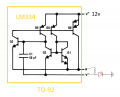
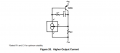
Here's my circuit. I'm just driving an LED. I need 20mA but the LM334 from TI has a max capacity of 10. So can i use 2 of them in parallel? Here's an image from the data sheet. I have a 12v battery, a resistor, and an LED.
Or, You can use a CL-520/CL-525,
which will provide exactly 20mA, and 25mA respectively.
Using 20mA on an LED that is rated for ~20mA-max-continuous, is not recommended.
It will shorten it's Life-Expectancy.
Keep it below ~15mA for max-Life.
You can also employ almost any Adjustable-3-Pin-Voltage-Regulator in a Current-Regulator configuration.
.
.
.
why not just use a current-limiting resistor and be done with it? Why do you need 20 mA? Are you sure that 10 mA won't be sufficient? Most people can't distinguish a difference in light intensity of a factor of two.
well i'm powering it off of a 12v SLA battery, so i wanna do it as efficiently as i can. And no i'm not sure i need 20mA. I won't be until i see the surveillance footage of my garage illuminated by the LEDs. So it's actually about what the camera, not the eye, can see.
Or, You can use a CL-520/CL-525.
Using 20mA on an LED that is rated for ~20mA-max-continuous, is not recommended.
It will shorten it's Life-Expectancy.
Keep it below ~15mA for max-Life.
well i'll look into those too, but the LEDs i got don't have a current rating. i'll have to keep my surveillance footage to compare the luminosity over time.
well i'm putting 4 LEDs in series, powered from a 12V battery. But i don't know the Vf of the LEDs, or the current rating of the CCRs. I guess i'll know from the surveillance footage, because i can see if/when the luminance is fading.
well i'm putting 4 LEDs in series, powered from a 12V battery. But i don't know the Vf of the LEDs, or the current rating of the CCRs. I guess i'll know from the surveillance footage, because i can see if/when the luminance is fading.
Are these infrared LEDs so that you can capture images in the dark?
Your range is going to be extremely limited with just 4 LEDs at 20 mA. An IR LED typically has about 1.5 V forward drop, that means your input power into four of them is going to be about 120 mW. Now consider that a typical basic flashlight bulb consumes about 1.5 W (this varies a lot).
If you look at most IR cameras, they are surrounded by a ring (often a double ring) of LEDs, often involving a couple dozen.
that's a good question. It's because this is a hidden camera. One of my tenants is saying that someone in my house is stealing things. Since the garage is filled with valuable stuff, i'm setting up a covert system so maybe i can catch the guilty party. I don't wanna just protect my stuff, i wanna find the offender.
Are these infrared LEDs so that you can capture images in the dark?
Your range is going to be extremely limited with just 4 LEDs at 20 mA. An IR LED typically has about 1.5 V forward drop, that means your input power into four of them is going to be about 120 mW. Now consider that a typical basic flashlight bulb consumes about 1.5 W (this varies a lot).
A small PNP transistor is recommended to increase the output. The PNP 2N2905 is a compliment of NPN 2N3904
In the study of active current regulating, a common characteristic of certain topologies is ability to current mirror.
It has been speculated that the LM334 inside uses parallel transistors the diagram is just an abbreviation. Not sure?
Related to types of current regulators, it is possible to convert voltage to current or convert current to voltage.
Another type goes further. An op amp, mosfet and sense resistor form a loop capable of actively increasing or decreasing current.
The LM334 can be set with only one resistor depicted as R_Set. Another way is to replace R_Set with a variable pot
that allows finite control and range of current. Without the transistor, Pot decreasing from 1KΩ to 64Ω for example gives very small to 1mA
The datasheet shows 1N457 diode lowered the temperature coefficient. The transistor reduces thermal drift such case R_Set = 6.4Ω achieving 10mA
Great for a small circuit but not a string of LEDs.
The LM334 has three pins or terminals: Iset, V+, and V-. (variables used in computation Vr is voltage across resistor, when 2 resistors are used the variable Vd is used which relates to the voltage across the second resistor) the arrows are used to show a voltage measurement.)

 Facebook
 Google
 GitHub
 Linkedin