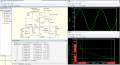
DC Analysis Of This Circuit

Thread Starter

RRRRSSSS

Joined Jun 16, 2023
128
So you now understand why it is such a bad circuit?
It would be great if someone could upload a schematic (or sim)
with a decent class AB that puts out a watt or two. One that utilizes
components that are 21st century. Every circuit seems to be
garbage.
 

dl324

Joined Mar 30, 2015
18,374
It would be great if someone could upload a schematic (or sim)
with a decent class AB that puts out a watt or two. One that utilizes
components that are 21st century.
What's wrong with the transistors you used? Don't see why they wouldn't work in that circuit.

If anything, it's the circuit that's bad. But why are you concerned about the DC bias for the output being 10.6V or 12.2V? What matters most is that you have room for sufficient voltage swing on the output.
 

Ian0

Joined Aug 7, 2020
13,158
It would be great if someone could upload a schematic (or sim)
with a decent class AB that puts out a watt or two. One that utilizes
components that are 21st century. Every circuit seems to be
garbage.
There aren't any 21st century audio transistors, but you can do a pretty good job with last century's. Here's a design I had kicking about.
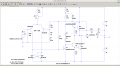
Screenshot from 2023-09-20 22-06-34.pngSPICE says 0.001% THD. About 12W output from ±15V supplies. The design will work with nearly any small signal transistors at the front end and power transistors on the output. Reduce the supply voltage for lower power.
Increase C1 to 470p if you have really pedestrian power transistors such as TIP31, otherwise it might oscillate.
 
Last edited:

crutschow

Joined Mar 14, 2008
38,543
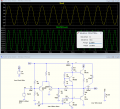
Here's the sim of a circuit that puts out a little over 2W into an 8 ohm load with a single 15V supply.
It's a variation of Marley's circuit (apparently invented by someone named Marley):
The Q1 and Q2 differential pair provide DC negative feedback to bias the output to 1/2 the supply voltage, and AC negative feedback to stabilize the gain and reduce distortion.
C6 bootstraps the bias voltage for Q5 to boost the peak positive output voltage closer to the negative peak before saturation occurs.

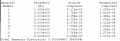
LTspice shows a total harmonic distortion of about 0.3% at 1kHz, 2.3W.

1695245110565.png

1695245191534.png
 
Last edited:

MisterBill2

Joined Jan 23, 2018
27,679
I suggested opening the feedback loop so that a set of conditions could be determined. THEN the feedback loop can be closed. otherwise, like somebody already stated, it keeps going around and around.
That is also the process for evaluating a feedback servo system. There needs to be a starting point so that the circle does not roll forever.
 

MisterBill2

Joined Jan 23, 2018
27,679
he circuit is not a "bad" circuit, it is a good way to start on a topic. But it is not suitable for mass production. It will certainly convince students that feedback has a huge effect.
 

Bordodynov

Joined May 20, 2015
3,428
Hi:

How would you start a DC analysis of this circuit?
Your circuit is bad - the modes are highly dependent on the current gain spread of the first transistor.
The quiescent current is also high. It is necessary to increase the collector resistor nominal value, this will reduce the quiescent current. By adding only one transistor you can get a circuit practically insensitive to the scatter of parameters.
See:

Class_AB_Darlington.png
 

MisterBill2

Joined Jan 23, 2018
27,679
Your circuit is bad - the modes are highly dependent on the current gain spread of the first transistor.
The quiescent current is also high. It is necessary to increase the collector resistor nominal value, this will reduce the quiescent current. By adding only one transistor you can get a circuit practically insensitive to the scatter of parameters.
See:

View attachment 303207
Certainly the original circuit would be unsuited for most applications. And in addition the analysis would be a loop process that may not converge. For teaching about how to do things right it can be useful to show how things can be wrong for the real world.
THAT IS THE VALUE OF THE ORIGINAL CIRCUIT.
Presenting students with what looks at first to be a reasonable solution that is simple to show the limitations of can be very educational. The reality of non-ideal elements being the reality is an important part of an engineering education.
So that "BAD" circuit, very difficult to analyze, serves as a starting point for a very valuable lesson.
The modeling of closed-loop transfer functions is not so very simple as it would appear prior to actually starting to do it.
So many thanks to Bordodynov, for this very useful lesson.
 

Thread Starter

RRRRSSSS

Joined Jun 16, 2023
128
Certainly the original circuit would be unsuited for most applications. And in addition the analysis would be a loop process that may not converge. For teaching about how to do things right it can be useful to show how things can be wrong for the real world.
THAT IS THE VALUE OF THE ORIGINAL CIRCUIT.
Presenting students with what looks at first to be a reasonable solution that is simple to show the limitations of can be very educational. The reality of non-ideal elements being the reality is an important part of an engineering education.
So that "BAD" circuit, very difficult to analyze, serves as a starting point for a very valuable lesson.
The modeling of closed-loop transfer functions is not so very simple as it would appear prior to actually starting to do it.
So many thanks to Bordodynov, for this very useful lesson.
Thanks folks. I will study all of this info and tinker with LTSpice.
 

MrAl

Joined Jun 17, 2014
13,720
Hi:

How would you start a DC analysis of this circuit?
Hi,

I read some of the other replies and i have to say, do not worry about if the circuit is practical or not, yet. Theoretical circuits are often not practical, they are just meant to be somewhat simplified so that you have something to work on, and several people will get similar results independently.

What you need to think about instead is what approaches you can take to analyze this circuit and what the limits of the applicability of your results will be. To this end, you start the analysis and think about how you do this analysis, one step at a time. I'll give one approach that should always work unless the circuit is really wacked out.

Start by thinking about what the typical quiescent output voltage will be for a circuit like this. In most cases, we want the output to be biased at one-half of Vcc. That would be 15 volts. The idea behind this is so that the positive and negative excursions of the output can be symmetrical, which utilizes the power source to the fullest extent possible. You can actually go on that assumption and get some useable results. The assumption also assumes that the designer knew what they were doing when they designed this, because that's probably the best way to bias this kind of amplifier. This means you can start by assuming that the emitter of Q3 is at 15 volts to start before any signal is applied to the input.

What that does is gives us something to solve for that would be reasonable, although along with that we also assume that each diode drop is between 0.6v and 0.7v. To nail it one way or the other, you can go with 0.65v or just go with the more usual of 0.7v for each diode. That also helps get this started because now we know that the voltage at the base of Q2 is always three diode drops higher than the base of Q4. Because of that assumption, we can replace the three diodes with a voltage source like a battery with a voltage equal to three diode drops.
Since we know the output is 15v now, and the emitter base junction voltages of Q2 and Q3 add up to about 1.4v, we can immediately solve for the voltage at the base of Q2, which will be that 1.4v higher than the output, or 16.4 volts. WIth the battery of three diode voltage drops that means the base of Q4 is 16.4-2.1 volts, which comes out to 14.3 volts. You'll notice now that if we subtract the output of 15 volts minus the base voltage of Q4, we get 0.7 volts, which is the base emitter drop of Q4.

You can now go on to calculate some of the currents in the circuit. For example, the current through RB1 is based on the difference between Vcc and the voltage at the base of Q2 which we found was 16.4 volts. 30v minus 16.4v is 13.6 volts, and 13.6 volts across RB1 (which is 1k) comes out to 13.6 milliamperes.

Next, for a well-working circuit the quiescent output transistor currents should be small, especially in the absence of symmetrical output resistors for each transistor section. That means most of that RB1 current will flow through the three diodes. That means the collector current of Q1 is roughly the same as RB1 current.
This in turn means that the Q1 base current is roughly the collector current divided by the assumed Beta and the emitter current is roughly the same. The emitter current establishes the emitter voltage and the base voltage, and the current into the base must be Vout minus the base voltage of Q1 divided by 150000. You can then solve for the Beta of Q1.

This is one basic approach where i don't think there is anything to iterate. It's all pretty much cut and dry unless you are trying to optimize to some other criterion as well as just getting it biased correctly.

Your next job is to calculate the AC gain of the circuit, and, how to adjust it as needed.
 
Last edited:

Thread Starter

RRRRSSSS

Joined Jun 16, 2023
128
Hi,

I read some of the other replies and i have to say, do not worry about if the circuit is practical or not, yet. Theoretical circuits are often not practical, they are just meant to be somewhat simplified so that you have something to work on, and several people will get similar results independently.

What you need to think about instead is what approaches you can take to analyze this circuit and what the limits of the applicability of your results will be. To this end, you start the analysis and think about how you do this analysis, one step at a time. I'll give one approach that should always work unless the circuit is really wacked out.

Start by thinking about what the typical quiescent output voltage will be for a circuit like this. In most cases, we want the output to be biased at one-half of Vcc. That would be 15 volts. The idea behind this is so that the positive and negative excursions of the output can be symmetrical, which utilizes the power source to the fullest extent possible. You can actually go on that assumption and get some useable results. The assumption also assumes that the designer knew what they were doing when they designed this, because that's probably the best way to bias this kind of amplifier. This means you can start by assuming that the emitter of Q3 is at 15 volts to start before any signal is applied to the input.

What that does is gives us something to solve for that would be reasonable, although along with that we also assume that each diode drop is between 0.6v and 0.7v. To nail it one way or the other, you can go with 0.65v or just go with the more usual of 0.7v for each diode. That also helps get this started because now we know that the voltage at the base of Q2 is always three diode drops higher than the base of Q4. Because of that assumption, we can replace the three diodes with a voltage source like a battery with a voltage equal to three diode drops.
Since we know the output is 15v now, and the emitter base junction voltages of Q2 and Q3 add up to about 1.4v, we can immediately solve for the voltage at the base of Q2, which will be that 1.4v higher than the output, or 16.4 volts. WIth the battery of three diode voltage drops that means the base of Q4 is 16.4-2.1 volts, which comes out to 14.3 volts. You'll notice now that if we subtract the output of 15 volts minus the base voltage of Q4, we get 0.7 volts, which is the base emitter drop of Q4.

You can now go on to calculate some of the currents in the circuit. For example, the current through RB1 is based on the difference between Vcc and the voltage at the base of Q2 which we found was 16.4 volts. 30v minus 16.4v is 13.6 volts, and 13.6 volts across RB1 (which is 1k) comes out to 13.6 milliamperes.

Next, for a well-working circuit the quiescent output transistor currents should be small, especially in the absence of symmetrical output resistors for each transistor section. That means most of that RB1 current will flow through the three diodes. That means the collector current of Q1 is roughly the same as RB1 current.
This in turn means that the Q1 base current is roughly the collector current divided by the assumed Beta and the emitter current is roughly the same. The emitter current establishes the emitter voltage and the base voltage, and the current into the base must be Vout minus the base voltage of Q1 divided by 150000. You can then solve for the Beta of Q1.

This is one basic approach where i don't think there is anything to iterate. It's all pretty much cut and dry unless you are trying to optimize to some other criterion as well as just getting it biased correctly.

Your next job is to calculate the AC gain of the circuit, and, how to adjust it as needed.
Thanks Mr Al
 

LvW

Joined Jun 13, 2013
2,031
A rough simulation has shown that the original circuit works in the "linear" amplification range of the transistors.
Therefore, we can assume that Vbe is app 0.7 volts.
Based on this assumption and with (assumed) B=200 for Q1 we can roughly calculate the DC bias point using the two following equations (neglecting the base currents into the Darlington transistors):

For Q1: B=200 and Ie1=Ic1
Ic1*RB1=30 volts-(Vout+1.4volts) and
Ic1*Rb2=Vb1-0.7 volts=Vout-Ic1*Rf/B -0.7 volts

Two equations with two unknown quantities (Vout and Ic1) can be solved:
Ic1=14 mA and Vout=14.28 volts.
(Simulation: Ic1=13.65mA and Vout=14.94 volts)

Comment: The calculation reveals that the operating point is rather sensitive to the assumed B factor for Q1. This is obvious because this transistor is biased with a current through a large resistor rather than with a voltage divider providing a - more or less - base current-insensitive bias voltage.
 
Last edited:

Thread Starter

RRRRSSSS

Joined Jun 16, 2023
128
A rough simulation has shown that the original circuit works in the "linear" amplification range of the transistors.
Therefore, we can assume that Vbe is app 0.7 volts.
Based on this assumption and with (assumed) B=200 for Q1 we can roughly calculate the DC bias point using the two following equations (neglecting the base currents into the Darlington transistors):

For Q1: B=200 and Ie1=Ic1
Ic1*RB1=30 volts-(Vout+1.4volts) and
Ic1*Rb2=Vb1-0.7 volts=Vout-Ic1*Rf/B -0.7 volts

Two equations with two unknown quantities (Vout and Ic1) can be solved:
Ic1=14 mA and Vout=14.28 volts.
(Simulation: Ic1=13.65mA and Vout=14.94 volts)

Comment: The calculation reveals that the operating point is rather sensitive to the assumed B factor for Q1. This is obvious because this transistor is biased with a current through a large resistor rather than with a voltage divider providing a - more or less - base current-insensitive bias voltage.
Hi LvW:

Not sure what equation #2 is with two equal signs and no brackets.

RS
 
Last edited:

Jony130

Joined Feb 17, 2009
5,598
This is nothing more than a KVL.

Vcc = Ic1 * Rb1 + Vbe2 + Vbe3 + Vout (1)
Vout = Ic1*Rb2 + Vbe1 + Ic1/β *RF (2)

And solution is :

Ic1 = (Vcc - 3Vbe)/( Rb1 + Rb2 + RF/β )

Vout = Vcc - Ic1*Rb1 - 2Vbe
 

Thread Starter

RRRRSSSS

Joined Jun 16, 2023
128
This is nothing more than a KVL.

Vcc = Ic1 * Rb1 + Vbe2 + Vbe3 + Vout (1)
Vout = Ic1*Rb2 + Vbe1 + Ic1/β *RF (2)

And solution is :

Ic1 = (Vcc - 3Vbe)/( Rb1 + Rb2 + RF/β )

Vout = Vcc - Ic1*Rb1 - 2Vbe
Thanks Jony130 this is such a big help.

I have now calculated all dc voltages and all Q1 currents. Could you please
explain why the term "RF/β" is included in your first solution equation.

I don't know how to calculate the remaining dc currents.

RS
 
Last edited:

Jony130

Joined Feb 17, 2009
5,598
Could you please
explain why the term "RF/β" is included in your first solution equation.
The current that is flowing through the RF resistor is Q1 base current. And we can express the base current in terms of a collector current.
Ic1 = β * Ib1 ---> Ib1 = Ic1/β
So the voltage drop across RF is Ib1*RF or Ic1/β * RF
And this is why we end up with RF/β term.

I don't know how to calculate the remaining dc currents.
Which currents?
 

Thread Starter

RRRRSSSS

Joined Jun 16, 2023
128
The current that is flowing through the RF resistor is Q1 base current. And we can express the base current in terms of a collector current.
Ic1 = β * Ib1 ---> Ib1 = Ic1/β
So the voltage drop across RF is Ib1*RF or Ic1/β * RF
And this is why we end up with RF/β term.


Which currents?
All of the dc currents.

For example, the node where Q1 collector, D3 cathode and Q4 base join.
Doesn't current of ≈ 16.3 mA flow into the collector of Q1, some current
flow out of the D3 cathode and some current flow out of the Q4 base?
Some how I need to figure out how the currents are distributed.

RS
 
Last edited:

Jony130

Joined Feb 17, 2009
5,598
For example, the node where Q1 collector, D3 cathode and Q4 base join.
Doesn't current of ≈ 16.3 mA flow into the collector of Q1, some current
flow out of the D3 cathode and some current flow out of the Q4 base?
Some how I need to figure out how the currents are distributed.
I see, but unfortunately, it is very hard to calculate it.
The problem is that in this case the simplest BJT model we are using in hand calculations (Ic = β*Ib and constant Vbe) does not work. We are forced to use a Shockley equation, but the most significant problem is that we do not know the most of BJT parameters to be able to start the calculations, addtional that BJT's parameters vary a lot -- even within a batch. Also, the exact calculation involves solving a nonlinear equation by iteration or by LambertW. This is why we are using the simulation programs to do the nonlinear calculations for us.
Take a look at the example of such a iterative analysis here:
https://forum.allaboutcircuits.com/threads/trying-to-understand-current-flow.156067/post-1346824
 
Top