Circuit analysis interview questions

Thread Starter

Yuanda Wen

Joined Aug 3, 2016
5
Hey everyone, here are two questions I got during a interview and I need some help better understanding them.

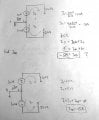
1. The first problem has two parts and I attempted the first part. I tried to follow the convention current flow from the two sources and found the current flowing through the two resistors but I'm not sure if I got the directions right.. What I wrote in red does not follow KCL and I'm not sure what to do. In the second part, a 20 ohm resistor is added to the circuit and in red I marked what I think the current flow through the circuit is but other than that I'm not sure where to start..

2. In the second question I was told that one of the ammeters in the circuit is not giving the right reading and I had to analyze the circuit and figure out which one it is. I said that if I know all the resistor values I could calculate the current going through each resistor because since they are all in parallel I know the voltages at each node are the source voltage but I was told that the resistor values are unknown and I should only work with the ammeters and then suggested that I take off R4 and try again.

Thanks for any help you can offer!
 

Attachments

Jony130

Joined Feb 17, 2009
5,593
1. For me, the current is 0A in both cases. Because current can only flow in the closed loop circuit. So, GND is the common point for the resistors hence the current in the circuit is 200V/(10Ω +20Ω) = 200V/30Ω = 6.67A and the magnitude of a current between A and B points is 0A.

2. Removing R4 and applying the Kirchhoff's current law we can see what is going one .
I_As = I_A1 + I_A2 + I_A3
 

WBahn

Joined Mar 31, 2012
32,704
Hey everyone, here are two questions I got during a interview and I need some help better understanding them.

1. The first problem has two parts and I attempted the first part. I tried to follow the convention current flow from the two sources and found the current flowing through the two resistors but I'm not sure if I got the directions right.. What I wrote in red does not follow KCL and I'm not sure what to do. In the second part, a 20 ohm resistor is added to the circuit and in red I marked what I think the current flow through the circuit is but other than that I'm not sure where to start..

2. In the second question I was told that one of the ammeters in the circuit is not giving the right reading and I had to analyze the circuit and figure out which one it is. I said that if I know all the resistor values I could calculate the current going through each resistor because since they are all in parallel I know the voltages at each node are the source voltage but I was told that the resistor values are unknown and I should only work with the ammeters and then suggested that I take off R4 and try again.

Thanks for any help you can offer!
This is actually a good example of the type of interview questions I was referring to in another thread recently.

Taking the first problem if you have a decent understanding of the fundamentals from your first circuits course (or even an intro physics course in electricity and magnetism if your school requires such before taking a circuits course) then you will be able to look at the circuit and immediately give the answer. Also, it tempts you into making a very common mistake that people that have learned the fundamentals shouldn't be making.

You've flubbed it on both accounts.

First off, what is node 'a' connected to? Nothing! So how can ANY current be flowing in the segment between 'a' and 'b'?

Second, you went and grabbed the nearest V to an R and threw it blindly at Ohm's Law to get an I. This shows that you don't understand that Ohm's Law relates and R to the voltage across THAT particular R and the current through THAT particular R.

For the second schematic in the first problem, nothing has changes as for as the current in the segment between 'a' to 'b'.

For the second problem, we need to know the ground rules. What steps could you take in order to find the defective meter? Was there a limit on how many steps you could use?

Here again you made a flub that shows you don't understand the basics. You said that because the resistors are in parallel that they all have the source voltage across them. This isn't true -- the source has a series source resistance that drops the voltage so that the voltage appearing across the parallel resistors is NOT the source voltage.

Since you were given the hint at some point that you could remove one of the resistors, it appears that it is fair game to modify the circuit. That makes the solution pretty trivial.

First, remove R1, R2, R3, and R4.

Next, put R1 back in and note whether As and A1 agree.
Next, take R1 out and put R2 back in and note whether As and A2 agree.
Next, take R2 out and put R3 back in and note whether As and A3 agree.

If the meters disagree in all three cases, then As is bad.

If the meters disagree in only one case, then meter other than As is bad.

This requires three measurements. Can you figure out how to do it if you are only allowed to make one measurement?

EDIT: Removed obsolete material from bottom of post.
 
Last edited:

Thread Starter

Yuanda Wen

Joined Aug 3, 2016
5
This is actually a good example of the type of interview questions I was referring to in another thread recently.

Taking the first problem if you have a decent understanding of the fundamentals from your first circuits course (or even an intro physics course in electricity and magnetism if your school requires such before taking a circuits course) then you will be able to look at the circuit and immediately give the answer. Also, it tempts you into making a very common mistake that people that have learned the fundamentals shouldn't be making.

You've flubbed it on both accounts.

First off, what is node 'a' connected to? Nothing! So how can ANY current be flowing in the segment between 'a' and 'b'?

Second, you went and grabbed the nearest V to an R and threw it blindly at Ohm's Law to get an I. This shows that you don't understand that Ohm's Law relates and R to the voltage across THAT particular R and the current through THAT particular R.

For the second schematic in the first problem, nothing has changes as for as the current in the segment between 'a' to 'b'.

For the second problem, we need to know the ground rules. What steps could you take in order to find the defective meter? Was there a limit on how many steps you could use?

Here again you made a flub that shows you don't understand the basics. You said that because the resistors are in parallel that they all have the source voltage across them. This isn't true -- the source has a series source resistance that drops the voltage so that the voltage appearing across the parallel resistors is NOT the source voltage.

Since you were given the hint at some point that you could remove one of the resistors, it appears that it is fair game to modify the circuit. That makes the solution pretty trivial.

First, remove R1, R2, R3, and R4.

Next, put R1 back in and note whether As and A1 agree.
Next, take R1 out and put R2 back in and note whether As and A2 agree.
Next, take R2 out and put R3 back in and note whether As and A3 agree.

If the meters disagree in all three cases, then As is bad.

If the meters disagree in only one case, then meter other than As is bad.

This requires three measurements. Can you figure out how to do it if you are only allowed to make one measurement?


If the meters A2 and A1 agree, then both are accurate, meaning that


If you remove R4, then you have a relationship between the four meters given by

As = A1 + A2 + A3

Since you are given that exactly one meter is inaccurate,
Ah, thanks you for clearing up that first one. But say I ground 'a', would what I attached be correct? Also would you mind linking me to the thread you mentioned in the beginning?
 

Attachments

Thread Starter

Yuanda Wen

Joined Aug 3, 2016
5
1. For me, the current is 0A in both cases. Because current can only flow in the closed loop circuit. So, GND is the common point for the resistors hence the current in the circuit is 200V/(10Ω +20Ω) = 200V/30Ω = 6.67A and the magnitude of a current between A and B points is 0A.

2. Removing R4 and applying the Kirchhoff's current law we can see what is going one .
I_As = I_A1 + I_A2 + I_A3
Thank you! I was so nervous and didn't realize that it wasn't grounded. Thanks for clearing that up!
 

WBahn

Joined Mar 31, 2012
32,704
Ah, thanks you for clearing up that first one. But say I ground 'a', would what I attached be correct? Also would you mind linking me to the thread you mentioned in the beginning?
You know that Iab = -Iba. Iba is the current flowing from 'b' to 'a' while Iab is the current flowing from 'a' to 'b', which is equal and opposite.

You've actually made a couple mistakes.

First, how do you get (0 + 100V) in the numerator of the second equation at the top. It's actually correct, but I'm not too confident you got the correct result through valid means -- but perhaps you did.

For a resistor R with current Ixy flowing through it where x is one end of the resistor and y is the other, the corresponding voltage across the resistor, Vxy, is the voltage on the x side of the resistor minus the voltage on the y side of the resistor.

Ixy = Vxy / R

Then in your KCL equations below that, you have Iba in one equation and it magically becomes Iab in the next. But, as already noted, Iba = -Iab.

Your second problem is correct.

As for linking to the thread -- if I can find it, I will. I don't recall the exact thread and unfortunately the post was part of a tangent discussion.
 

MrAl

Joined Jun 17, 2014
13,667
Hello Yuanda,

For the benefit of readers here is the second drawing being discussed. Note it only takes 25 kilobytes in jpg format while the original pdf file took 144 kilobytes.
Also easier to access.

CircuitProblem-1.jpg
 

Thread Starter

Yuanda Wen

Joined Aug 3, 2016
5
You know that Iab = -Iba. Iba is the current flowing from 'b' to 'a' while Iab is the current flowing from 'a' to 'b', which is equal and opposite.

You've actually made a couple mistakes.

First, how do you get (0 + 100V) in the numerator of the second equation at the top. It's actually correct, but I'm not too confident you got the correct result through valid means -- but perhaps you did.

For a resistor R with current Ixy flowing through it where x is one end of the resistor and y is the other, the corresponding voltage across the resistor, Vxy, is the voltage on the x side of the resistor minus the voltage on the y side of the resistor.

Ixy = Vxy / R

Then in your KCL equations below that, you have Iba in one equation and it magically becomes Iab in the next. But, as already noted, Iba = -Iab.

Your second problem is correct.

As for linking to the thread -- if I can find it, I will. I don't recall the exact thread and unfortunately the post was part of a tangent discussion.
Yes, I meant to keep it as Iba the whole time. Now that I look at the circuit some more I think Iba should still be 0. My reasoning is that node a and b are both ground therefore there is no voltage difference between them. Is my thought process correct?
 

WBahn

Joined Mar 31, 2012
32,704
Yes, I meant to keep it as Iba the whole time. Now that I look at the circuit some more I think Iba should still be 0. My reasoning is that node a and b are both ground therefore there is no voltage difference between them. Is my thought process correct?
Just because both ends of a wire are at the same voltage does NOT mean that the current is zero through the wire. Consider any simple circuit and you assume that there is no voltage drop across any of the wires even though they are usually carrying current.
 

Thread Starter

Yuanda Wen

Joined Aug 3, 2016
5
C
Just because both ends of a wire are at the same voltage does NOT mean that the current is zero through the wire. Consider any simple circuit and you assume that there is no voltage drop across any of the wires even though they are usually carrying current.
ould you give an example? I’m not following
 

BR-549

Joined Sep 22, 2013
4,928
Yuanda Wen........prototyping will confirm/not confirm your thinking/math. Change the voltage sources to some voltage you easily have, such as 12 volts. Redo your calculations and predict with math.

Now.....breadboard the circuit. It's very easy to breadboard. Measure the voltage between a and b.

Now insert an ammeter and measure the current between a and b.

This will show you what is actually happening.

If you cut conductor a b....do you get a voltage across it?

In the US...the 120 line voltage has 0 potential on the neutral.....but it has the same current as the hot lead does.
 

WBahn

Joined Mar 31, 2012
32,704
C

ould you give an example? I’m not following
I gave you an example:

Consider any simple circuit and you assume that there is no voltage drop across any of the wires even though they are usually carrying current.
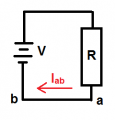
For a specific example consider the following:

CurrentInShort.png

If V is 12 V and R is 2 Ω, then the current in the circuit is 6 A and that includes Iab. But Vab, the voltage at pt 'a' relative to pt 'b' is 0 V.
 

MrAl

Joined Jun 17, 2014
13,667
Just because both ends of a wire are at the same voltage does NOT mean that the current is zero through the wire. Consider any simple circuit and you assume that there is no voltage drop across any of the wires even though they are usually carrying current.
Hello,

It is interesting to hear this said "out loud". We take things for granted as we age in the field, then someone new comes along and points a finger and it has to be looked at with new light. The answer isnt always obvious.
 

MrAl

Joined Jun 17, 2014
13,667
Yes, I meant to keep it as Iba the whole time. Now that I look at the circuit some more I think Iba should still be 0. My reasoning is that node a and b are both ground therefore there is no voltage difference between them. Is my thought process correct?
Hi,

Unfortunately, we see a point in the theory of circuit analysis where we have to apply the rules very very carefully.
Normally you would be right, but there is one condition where that idea is not true. That is with a resistance that is a true zero Ohms.
Ohms Law:
I=V/R

with zero volts we have:
I=0/R=0 amps

but what if R is zero also? Then we have an indeterminant form:
I=0/0

which in math requires taking a limit, the limit of V/R as both go to zero. But in circuit analysis we can just look elsewhere for the answer. The answer comes in the form of what else is happening in the circuit.

Now say we had that zero ohms resistance in series with another resistance, say 10 Ohms. Now we have something to work with:
I=V/(Rz+R)

where Rz is the zero ohms resistance and R is the new 10 ohm resistor. It' is easy now:
I=V/10

and we'll get a very reasonable result. The implication here though is even more profound: it means the current in the zero ohm resistance is the SAME as that in the 10 ohm resistor. So the analysis of the circuit EXTERNAL to the problem area leads to the required result, not the direct analysis of the actual circuit element this time.
This happens in other areas of circuit analysis too.

So the answer is then, when we encounter a zero ohm resistance that is a true zero, we look elsewhere for the current in that resistance. This of course happens in a lot of circuits because we use a fictional device which we call a "wire" which we usually assume has zero resistance.
This may not be an arbitrary simplification either, it may be very practical too because most other resistances in the circuit will be non zero and their resistance overshadows the zero ohm wire resistance by a long shot even if it is not perfectly zero.
 

WBahn

Joined Mar 31, 2012
32,704
So the answer is then, when we encounter a zero ohm resistance that is a true zero, we look elsewhere for the current in that resistance. This of course happens in a lot of circuits because we use a fictional device which we call a "wire" which we usually assume has zero resistance.

This may not be an arbitrary simplification either, it may be very practical too because most other resistances in the circuit will be non zero and their resistance overshadows the zero ohm wire resistance by a long shot even if it is not perfectly zero.
And it's not necessarily all that fictional. There are such things as superconductors.
 
Top