Need to find non zero values for voltage sources

Thread Starter

Suffer

Joined Aug 9, 2025
7
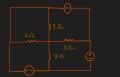
The Question was asked under mesh analysis section.

So i Labeled voltage sources and assumed mesh currents.

But i dont know what to do with the resulting equations.

What am i missing ?

I also though of assuming Node Voltages , but ultimately went nowhere as every voltage ends up with 0V (when i use ohms law on resistors).
Screenshot 2025-08-08 104756.png
 

WBahn

Joined Mar 31, 2012
32,763
The Question was asked under mesh analysis section.
What was the question?

What, exactly, where you asked to find? The voltage across a particular component? The current through a particular component? The total power dissipated by the circuit?

We are not mind readers.

So i Labeled voltage sources and assumed mesh currents.

But i dont know what to do with the resulting equations.
Uh... solve them?

What am i missing ?
Any semblance of showing your best attempt to solve the problem.

I also though of assuming Node Voltages , but ultimately went nowhere as every voltage ends up with 0V (when i use ohms law on resistors).

View attachment 353920
You don't even bother to indicate what the output voltage is on your three voltage sources, let alone show even a hint of work. How is anyone supposed to be able to tell you what you did wrong?
 

Thread Starter

Suffer

Joined Aug 9, 2025
7
Pardon my english if it is bad.
The Question itself is about finding non-zero values for the voltage sources such that the currents through the resistors are zero.
As finding the values of voltage sources was the question itself , i could not indicate the value (because i dont know how to find the values).

when i said I labeled the sources , i meant i assumed voltages like V1,V2,V3. Then i assumed mesh currents in the four meshes e.g i1,i2...

Then i wrote standard mesh equations. But i am stuck right there.

When i said the question was asked under mesh analysis , i meant the question belong to that topic (therefore i thought i would go with the assumption of mesh currents )
 

MrAl

Joined Jun 17, 2014
13,684
The Question was asked under mesh analysis section.

So i Labeled voltage sources and assumed mesh currents.

But i dont know what to do with the resulting equations.

What am i missing ?

I also though of assuming Node Voltages , but ultimately went nowhere as every voltage ends up with 0V (when i use ohms law on resistors).
View attachment 353920
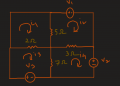
Are you sure this is drawn correctly?
I ask because there is a voltage loop which is usually not allowed unless the voltages all add up to exactly zero.
For example, if you have 1v, 2v, and 3v wired in series that is 6v total, now if you loop the positive of that 6v to the negative of the 1v source, it causes an infinite current to flow which is not usually allowed.
Brief drawing of that:
o---1v---+---2v---+---3v---o
with the positive ends of those sources all on the right side of each source the voltage adds up to 6v. If you then loop the two ends together, infinite current flows.
However, if we reverse the 3v source so it has positive on the left, then when we loop the two ends together we get no current flow, which is allowed in theory but we usually dont do that either with DC sources.

So maybe check the drawing to make sure it is correct.

Alternately, do you perhaps mean you are MEASURING those voltages and they are not actually sources themselves? In that case all the voltages would be 0v because there is no active source. Maybe one of those is an actual voltage source?

Another possibility, are you maybe trying to find out the total resistance between two nodes?
 

WBahn

Joined Mar 31, 2012
32,763
Pardon my english if it is bad.
The Question itself is about finding non-zero values for the voltage sources such that the currents through the resistors are zero.
That last little bit about "such that the currents through the resistors are zero" is a pretty big detail to have omitted.

As finding the values of voltage sources was the question itself , i could not indicate the value (because i dont know how to find the values).

when i said I labeled the sources , i meant i assumed voltages like V1,V2,V3. Then i assumed mesh currents in the four meshes e.g i1,i2...

Then i wrote standard mesh equations. But i am stuck right there.
Again, we are NOT mind readers. If you wrote a bunch of mesh equations, then show them to us.

How can we help you figure out why you are stuck when you won't show us what you have done?
 

WBahn

Joined Mar 31, 2012
32,763
Are you sure that the problem requires that the current in each and every resistor be zero? Or is it only asking for the current in a specific subset of the resistors to be zero?

If a resistor have zero current, what is the voltage drop across that resistor?

What would that then say about the voltages at the center and at the mid-points of the perimeter (i.e., the ends of the resistors)?
 

Thread Starter

Suffer

Joined Aug 9, 2025
7
Are you sure this is drawn correctly?
Yes."Choose nonzero values for the three voltage sources so that no current flows through any resistor in the circuit." I have provided the question in quotes word for word. I think it will help clear your doubts about the question.

So maybe check the drawing to make sure it is correct.
i have checked it again. It is the same.
Alternately, do you perhaps mean you are MEASURING those voltages and they are not actually sources themselves? In that case all the voltages would be 0v because there is no active source. Maybe one of those is an actual voltage source?
No. i have to choose values for the sources such that current does not flow in any of the resistors.
 

Thread Starter

Suffer

Joined Aug 9, 2025
7
Again, we are NOT mind readers. If you wrote a bunch of mesh equations, then show them to us.

How can we help you figure out why you are stuck when you won't show us what you have done?
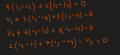
Screenshot 2025-08-10 092013.pngScreenshot 2025-08-10 092118.pngThis is where i was stuck.
 

MrAl

Joined Jun 17, 2014
13,684
Yes."Choose nonzero values for the three voltage sources so that no current flows through any resistor in the circuit." I have provided the question in quotes word for word. I think it will help clear your doubts about the question.


i have checked it again. It is the same.

No. i have to choose values for the sources such that current does not flow in any of the resistors.
Hello again,

Oh ok, that makes this a more interesting question than usual for a set of DC voltages and a set of resistors connected to them.

So you can write the equations symbolically and then set all the currents to zero, then solve for the three voltages. You seem to have done this already so what were your results?
You do realize that you have one other constraint, right? That's the sum of the voltage sources equals zero as I mentioned before.

There might also come up the question of if this is actually possible or not.
 
Last edited:

WBahn

Joined Mar 31, 2012
32,763
There are two relatively obvious approaches to arrive at the solution.

Overlooking the complete disregard for the proper use of units, what are the constraints between the various mesh currents that are imposed by the requirement that the currents in the resistors be identically zero?

For instance, in terms of the mesh currents, what is the current in the 5 Ω resistor?

What does this require the relationship between I1 and I2 to be?

Following this through to its only conclusion, what dies this require the three voltage sources to be?

Coming at it a different way, what does the question I asked about the voltage drop across a resistor that has no current flowing through it require about the relationships on the voltages on each side of that resistor?

Here's a super-duper hint. You know that you get to pick any point in the circuit that you want and call if your 0 V reference point, right? So what happens if you pick the center node of the circuit as your reference? What does Ohm's Law then require the voltage on every other node in the circuit to be? What does this then require the voltages of the three sources to be?
 

MrAl

Joined Jun 17, 2014
13,684
Hello again,

Another hint for checking any results from the mesh analysis is that one of the sources can be completely eliminated right from the start. The question is, which one. Choosing the right source to remove leads to a visual inspection solution that is very easy to spot. Note this is not an actual solution though because the solution requires mesh equations not topology simplifications. It's only good for checking the results.
 

Thread Starter

Suffer

Joined Aug 9, 2025
7
What does this require the relationship between I1 and I2 to be?
They must be equal. Applying the same logic for all the resistors , all mesh currents must be equal. Then the mesh equations result in all sources being 0V


Coming at it a different way, what does the question I asked about the voltage drop across a resistor that has no current flowing through it require about the relationships on the voltages on each side of that resistor?
They must be equal.
Here's a super-duper hint. You know that you get to pick any point in the circuit that you want and call if your 0 V reference point, right? So what happens if you pick the center node of the circuit as your reference? What does Ohm's Law then require the voltage on every other node in the circuit to be? What does this then require the voltages of the three sources to be?
if i choose central Node as ref.
Then the other side of all the resistors must also be at 0 potential. This also results in all sources being 0V. But we need to choose nonzero values for the sources.
 

Thread Starter

Suffer

Joined Aug 9, 2025
7
Hello again,

Oh ok, that makes this a more interesting question than usual for a set of DC voltages and a set of resistors connected to them.

So you can write the equations symbolically and then set all the currents to zero, then solve for the three voltages. You seem to have done this already so what were your results?
You do realize that you have one other constraint, right? That's the sum of the voltage sources equals zero as I mentioned before.

There might also come up the question of if this is actually possible or not.
If i just zero out all the currents
V1,V2,V3 end up being 0V.
 

MrAl

Joined Jun 17, 2014
13,684
If i just zero out all the currents
V1,V2,V3 end up being 0V.
Amazingly, it looks like there actually is a non-zero solution. If you can't figure it out we can go through the calculations eventually. It looks like there is a very simple proof though that does not involve mesh equations but that would just prove that there is a solution.

A hint that might help is that we must have this satisfied:
V1+V2+V3=0

That means that one of these must be true:
V1+V2=-V3
V1+V3=-V2
V2+V3=-V1

and that means that ONE source can be removed from the circuit and we are still be able to find the solution.
Try writing the equations with that in mind and see what you can get. You may have to try all three sources in turn if you don't see the right one to eliminate right off.

I think that reduces the number of equations to 3. The only question then is, is this reduction allowed by the instructor.

Because of the redundant source and the need for mesh analysis, this may require an analysis using the idea of a supermesh. You could check that out for more information.

Because of the topology change in that solution, that may actually remove one of the currents as well and that may not be allowed because it is possible that the associated current will then not be zero, only the other three. I'll look into this further.

It looks like if we solve for the currents using only two of the voltages in a full analysis without any other changes, we can then solve for one of the two voltages in terms of only one voltage. If we then insert that into all four equations we only get a zero for only one of the currents. This is no matter which one we solve for the second voltage. That indicates that there is no solution it it's exact form. If we got two zero currents we could at least say that, but it looks like we don't even get two currents that can be zero.

Now the question is why was this problem given in this manner. Could the wording of the problem be incorrect?
I don't think so, but it may be that our interpretation of the problem statement could be wrong.

When I re-read the statement, I see that the object is that the current through EACH resistor must be zero, NOT the mesh currents themselves.
Looks like we have to start over :)
This means we don't zero i1, i2, i3, i4 we have to have iR2, iR3, iR5, and iR7 zero instead. This might change things.
 
Last edited:

MrAl

Joined Jun 17, 2014
13,684
how many unknowns appear in your equations? how many equations are needed to solve system with so many unknowns?
It's not obvious maybe but not all of the algebraic variables are actually variables, some are actually considered constants. To say it another way, we might solve for some variables in terms of a set of the other variables.
 

panic mode

Joined Oct 10, 2011
4,938
cannot derive them out of thin air. solving (for specific value or as a relation to another variable or set of variables) still requires equation. even if one is to make an assumption, such as

V2 = 12V

that expression is an equation
 

MrAl

Joined Jun 17, 2014
13,684
cannot derive them out of thin air. solving (for specific value or as a relation to another variable or set of variables) still requires equation. even if one is to make an assumption, such as

V2 = 12V

that expression is an equation
Well there can be more than one goal here depending on what you want to look for. It's alway nice to be able to solve for all the 'variables' at once, but in sometimes we can't do that. In this case though, we are really just solving for the three voltages when we set all the currents iR2, iR3, iR5, iR7 to zero. So the currents are treated as constants, while the voltages are the actual true variables. So at most maybe three equations?

The funny thing is with this particular problem is that one voltage source is redundant so it's really just about solving for two voltages, any two out of the set V1,V2,V3. That's because one voltage is always dependent on the other two. This gives us Va+Vb=Vc in short, where we choose the two voltages we would like to try.

The thing we may have overlooked so far is that we do not set i1, i2, i3, i4 to zero, even though that would result in zero current though all the resistors too. We have to set the individual resistor currents to zero because that was the specification in the problem. Piecewise, that could mean that i1=1 and i3=-1 although that would only zero the current in R2 (the 2 Ohm resistor). And, somehow we have to use mesh equations to get there.
This may or may not change the final result.

I think this might be the result after applying a particular solution:
[iR2=0,iR5=0,iR3=K/R7,iR7=-K/R7]
but since K can not equal zero it's not the right solution. If it works, it might still be interesting because K can be any constant (apparently).

If you have another idea though please post it we can look it over.
 
Last edited:

panic mode

Joined Oct 10, 2011
4,938
i love to play with homework problems but simply have no time. i also think the problem is possibly not presented correctly. what we got to look at is only words and circuit by TS, not the problem as it was given to him. his interpretation of the problem goals may be incorrect.
 

WBahn

Joined Mar 31, 2012
32,763
They must be equal. Applying the same logic for all the resistors , all mesh currents must be equal. Then the mesh equations result in all sources being 0V


They must be equal.

if i choose central Node as ref.
Then the other side of all the resistors must also be at 0 potential. This also results in all sources being 0V. But we need to choose nonzero values for the sources.
But you have pretty conclusively established, via multiple approaches, that all three voltage sources must be identically zero. So there's really only two possible conclusions -- the question, as stated, has no solution, or you are not interpreting the question the way it was meant to be interpreted. If the latter, it could be that the question has some subtle point that you are missing, or it could be that whoever wrote it phased it in such a way that it doesn't convey what they meant it to.

Present you findings to the instructor and ask for clarification.
 
Top