Hardware or software as a career?

Thread Starter

ray242

Joined Nov 27, 2016
44
Hi,

I'm a second year university student and I feel it's probably time to start thinking about my careers now. However, something has been bothering me and I'd really appreciate any advices.

I love electronics so much and I enjoy playing with components. Initially my idea was to do a career in hardware but it seems to me that many cool and advanced stuff are all about software. For example, in the robotics society in our department people don't do hardware at all, they simply buy ready-to-use boards and program them to do everything. Also if people want to do things with IoT, one hot topic these days, they could also just buy boards off the shelf. So my question is if I want to do interesting projects, should I focus more on learning software rather than spending time designing my own hardware?

I know there are many job opportunities in hardware field such as analogue design, IC design power electronics etc. Do they tend to be interesting or dull? Also are they as well paid as software engineers? Our lecturers in those fields showed us salary charts which look different as I found on Glassdoor.

Above are just thoughts I came up with after one year and a half of university life. I know I might be completely wrong and please give me some directions. Thank you very much in advance.
 

MrChips

Joined Oct 2, 2009
34,629
The answer is clear and simple. Do both.

Someone had to design the off-the-shelf hardware. Do you want to be the end-user or the person that leads the pack?
The person who builds the hardware has to know as much as the person who writes the software.
The person who writes the software would be better suited to the task if he/she understood the hardware.

Learn to do both and you will be king of the hill.
 

spinnaker

Joined Oct 29, 2009
7,830
I am 59 and have been in the tech industry in one way or another all of my career. I have seen a lot of changes. Most of them not for the good job wise. I have been very lucky to survive this long. Many of my co-workers not so lucky. My advice to young people is to steer clear of tech, unless you are certain you can be tops in your trade. The rest is too easy to out source.

It might be a tough pill to sallow but forget about your passion and look to something that is difficult to outsource. Health care and elder care are just a couple.
 

OBW0549

Joined Mar 2, 2015
3,566
I'll second the advice to become adept at both hardware design (including analog) and software design; it will make you more valuable as an engineer than a person who can do only one or the other.
 

Parth786

Joined Jun 19, 2017
642
Hi,

I'm a second year university student and I feel it's probably time to start thinking about my careers now. However, something has been bothering me and I'd really appreciate any advices..
Dear friend @ray42

I would like to share my experience with you. Do not just think it's time to start working right now. I was very happy when first time i turned ON LED on breadboard. I had confidence that i did something. I used 5 Dc supply , one resistor and LED. after that I tried to find the reason why I choose particular range of resistor. you will find there is some theory I am sure You have studied KCL and KVL law. just apply law to find correct resistor. Just make simple circuit on breadboard like if you have 9v DC supply how will you turn on LED. connect switch to ON/OFF LED. In this way you will know how the component work and you will know When you need specific component.

then come on software side just select any microcontroller (PIC, 8051, AVR) and download supported compiler on your computer. just do the first project # LED blinking.. Prepare your list and find out what's require to complete this project. you will need microcontroller, resistor , LED, serial cable and computer (if you have development board then there may be inbuilt programmer so you don't need extra programmer circuit My advice work on development board), Make the connection properly check with multi meter. after that you have to write code to control LED. think how will you blink LED manually just draw the process on Paper (flow chart for program) then write your program check your program if there is no error then compile your program that will generate hex file.

Now you have hex file so you need to burn this hex file into the memory of microcontroller. if you did everything correct then you will see your LED is blinking. congratulation you have entered in the life of embedded programmer. if your led is not working means you did something wrong so just troubleshoot what you did wrong.

My personal experience is that when you try to learn new things. You will have to face some problems in the beginning But don't give up. It does not mean that you can not learn. sometime you will get success and sometime you will fail. some people encourage and some people will discourage you. stay with nice people who encourage. Just ignore the people who discourage you, many people comment on you, you can't learn, you can't do it. Just ignore them because I think every person can learn, every one has their own capability to learn. Every one learn from their mistake

so first learn hardware then come on software. Do your best for your career

Regard Parth
 

WBahn

Joined Mar 31, 2012
32,706
Hi,

I'm a second year university student and I feel it's probably time to start thinking about my careers now. However, something has been bothering me and I'd really appreciate any advices.

I love electronics so much and I enjoy playing with components. Initially my idea was to do a career in hardware but it seems to me that many cool and advanced stuff are all about software. For example, in the robotics society in our department people don't do hardware at all, they simply buy ready-to-use boards and program them to do everything. Also if people want to do things with IoT, one hot topic these days, they could also just buy boards off the shelf. So my question is if I want to do interesting projects, should I focus more on learning software rather than spending time designing my own hardware?

I know there are many job opportunities in hardware field such as analogue design, IC design power electronics etc. Do they tend to be interesting or dull? Also are they as well paid as software engineers? Our lecturers in those fields showed us salary charts which look different as I found on Glassdoor.

Above are just thoughts I came up with after one year and a half of university life. I know I might be completely wrong and please give me some directions. Thank you very much in advance.
The bottom line is that "it depends" (get used to it, that is the single most common correct answer in engineering).

There are people that barely scrape buy in both areas and there are people that command whatever rate they want to charge in both areas.

Do you think it would be interesting to design those ready-to-use robotics boards or those IoT boards, or radio link boards? If so, then that's an option. If not, the look elsewhere.

But don't focus on one at the exclusion of the other. Get good at both. Not only will that retain the option of deciding which path to follow at a later date, but which ever path you choose you will be that much better at it as a result of the proficiency in the other.

If you're a true engineer, you can make pretty much any job interesting (at least from the technical side of things).

BTW: My first interview as I was getting my bachelors was with Texas Instruments. I really wanted to work in their Defense Electronics Division. The interviewer asked what I was most interested in and I told him -- and he informed me that they had just decided to close that division. So he asked me if I might be interested in IC design. I told him not really. So we spent the rest of the interview slot just chatting. A few years later as I was getting near the end of my masters a company was interviewing on campus and they were a very small IC design house and so I didn't even put my name in the hat. But the head of the Career Development Center did and they picked me for one of their selected interview slots. I figured I had nothing to lose so I went to the interview. I then worked for that company for 14 years, leaving as their Senior Engineer and I still do occasional consulting for them. I worked on some really fascinating designs (mostly IC design, but also test system design and some subsystem design one step up). One of the chips I worked on is currently in orbit about Mars.

One of the real ironies is that the second chip I worked on after I got hired was an IC design that we did for Texas Instruments -- a chip that they had spent a couple years trying to get working and a couple million dollars. One of the guys there knew our president and talked his boss into giving us a shot at it. About $40k and four months later they had a test chip that worked so well on first silicon that they incorporated the test chip into a commercial product! I didn't design the chip (it was all but ready to go when I was hired) but I helped with the verification (which was very manual in those days) and spotted a fatal error that we corrected just a couple days before tape out.

I only left the company because an opportunity to pursue a life-long dream came along -- and while I'd probably make the same choice again, I would certainly have been far better off financially and possibly professionally had I stayed.
 

Thread Starter

ray242

Joined Nov 27, 2016
44
The bottom line is that "it depends" (get used to it, that is the single most common correct answer in engineering).

There are people that barely scrape buy in both areas and there are people that command whatever rate they want to charge in both areas.

Do you think it would be interesting to design those ready-to-use robotics boards or those IoT boards, or radio link boards? If so, then that's an option. If not, the look elsewhere.

But don't focus on one at the exclusion of the other. Get good at both. Not only will that retain the option of deciding which path to follow at a later date, but which ever path you choose you will be that much better at it as a result of the proficiency in the other.

If you're a true engineer, you can make pretty much any job interesting (at least from the technical side of things).

BTW: My first interview as I was getting my bachelors was with Texas Instruments. I really wanted to work in their Defense Electronics Division. The interviewer asked what I was most interested in and I told him -- and he informed me that they had just decided to close that division. So he asked me if I might be interested in IC design. I told him not really. So we spent the rest of the interview slot just chatting. A few years later as I was getting near the end of my masters a company was interviewing on campus and they were a very small IC design house and so I didn't even put my name in the hat. But the head of the Career Development Center did and they picked me for one of their selected interview slots. I figured I had nothing to lose so I went to the interview. I then worked for that company for 14 years, leaving as their Senior Engineer and I still do occasional consulting for them. I worked on some really fascinating designs (mostly IC design, but also test system design and some subsystem design one step up). One of the chips I worked on is currently in orbit about Mars.

One of the real ironies is that the second chip I worked on after I got hired was an IC design that we did for Texas Instruments -- a chip that they had spent a couple years trying to get working and a couple million dollars. One of the guys there knew our president and talked his boss into giving us a shot at it. About $40k and four months later they had a test chip that worked so well on first silicon that they incorporated the test chip into a commercial product! I didn't design the chip (it was all but ready to go when I was hired) but I helped with the verification (which was very manual in those days) and spotted a fatal error that we corrected just a couple days before tape out.

I only left the company because an opportunity to pursue a life-long dream came along -- and while I'd probably make the same choice again, I would certainly have been far better off financially and possibly professionally had I stayed.
Becoming an IC designer is actually my first option if I'm not going into software because designing chips that every circuit designer could use sounds really fascinating to me. Can I ask how I can prepare to become an IC designer? I've been learning 'the Art of Electronics' and are there any other good books on IC design that you suggest?
 

Parth786

Joined Jun 19, 2017
642
Can I ask how I can prepare to become an IC designer? I've been learning 'the Art of Electronics' and are there any other good books on IC design that you suggest?
I don't have much knowledge on IC design as I know we make circuit design, layout design before making physical chip there are so many process we do before making real chip. we test our design on CAD tool like Cadence or Synopsis. Do the google search "VLSI technology". You will get lot of information
 

miniwinwm

Joined Feb 2, 2018
68
Becoming an IC designer is actually my first option if I'm not going into software because designing chips that every circuit designer could use sounds really fascinating to me. Can I ask how I can prepare to become an IC designer?
To become an IC designer you need to get your foot in the door at one of the big silicon vendors. In Europe the two biggies are NXP and ST. ARM of course is also closely related to IC design even though they don't manufacture anything. Have you tried writing to these companies (on paper, less chance it will be ignored) asking whether they have internships, placements or openings for new graduates? A summer placement at ARM would do wonders for your CV, and it's local to you too.
 

WBahn

Joined Mar 31, 2012
32,706
To become an IC designer you need to get your foot in the door at one of the big silicon vendors. In Europe the two biggies are NXP and ST. ARM of course is also closely related to IC design even though they don't manufacture anything. Have you tried writing to these companies (on paper, less chance it will be ignored) asking whether they have internships, placements or openings for new graduates? A summer placement at ARM would do wonders for your CV, and it's local to you too.
Not necessarily, though it certainly helps. There are lots of small design houses out there. The company I worked for had six people once they hired me and I don't think they've ever had more than eighteen (yet). The key for the small houses is to find a niche that the big guys don't care about and, hopefully, can be done without the big, expensive CAD tools. For years all of our designs were developed, simulated, laid out, and verified using a hodge podge of PC based tools (and this was in the Win3.1 days on 386 and 486 machines running in the 33 MHz to 66 MHz range).

Yet we did designs for some of the big players, including TI, Sony, Hughes, HP, Honeywell, and Intel. We could never have competed in their market niche and they discovered that they couldn't compete in ours.

When we hired someone, we only looked for someone with a solid understanding of sophomore and junior level core EE courses. We usually didn't ask anything about IC processing or layout (which was damn good for me when I interviewed because while I had a very vague idea of general wafer fab processes, I had no clue how a transistor was laid out). But if they could design and analyze and demonstrate that they understood very basic circuits (as opposed to just memorizing and regurgitating formulas without any understanding at all, which was an all-too-common case) then we could teach them everything else they needed to know.
 

KL7AJ

Joined Nov 4, 2008
2,229
The answer is clear and simple. Do both.

Someone had to design the off-the-shelf hardware. Do you want to be the end-user or the person that leads the pack?
The person who builds the hardware has to know as much as the person who writes the software.
The person who writes the software would be better suited to the task if he/she understood the hardware.

Learn to do both and you will be king of the hill.
What he said. :) I didn't do any software until I was in my forties. I much PREFER working with hardware, but now we have so many cool things like Arduino that software is rather fun. And I have a lot of IT type certifications now....that seems to keep one in demand....even though I don't really care all that much for IT. (Necessary evil, perhaps?)
 

takao21203

Joined Apr 28, 2012
3,702
Softwares are pretty bad they change by the year and are pretty specialized + programmers suffer from burnout, a japanese died at 46 and looked like a zombie already.
Also the original softwares will cost a lot of money + need to upgrade your PC often.

Hardware doesnt change so much, older stuff is still being used and basically its similar. Though theres also very expensive and specialzed setups, you couldnt have the machines at home or it costs a premium.

Summary is, you most likely need both. C language is good to learn since most others are based on it and if you understand C language you can also understand others. I prefer hardware, real electric parts, some time ago I was thinking to become a programmer (for job) but didnt happen. Theres tons of web designers + can easily be outsourced, but theres a shortage of good hardware engineers.

Dont end up downloading the latest update for some hours every few days to find out you need a new machine because its too slow.
 

spinnaker

Joined Oct 29, 2009
7,830
If you are saying that people should look at stuff that can't be outsourced, what makes it so difficult to outsource medical hardware and software?

And I qualified that. If you can be tops in your field you will likely not need to worry. The Bio med engineer I know has a medical and engineering degree. That is not so easily replacable.
 

hobbyist

Joined Aug 10, 2008
892
But if they could design and analyze and demonstrate that they understood very basic circuits (as opposed to just memorizing and regurgitating formulas without any understanding at all, which was an all-too-common case) then we could teach them everything else they needed to know.
For WBahn:

First I do not want to hijack this thread, so I'm only asking this one question in this thread this one time.

When I think of IC design, I tend to think of the formiddable, that IC designers are up there with rocket scientists, and you need to know transient analysis to the calculas precision, ect....

I have no intention of changing careers, I'm a selfemployed woodworker, and electronics has always been a hobby for me, and always will be.

However, I always loved designing circuits from scratch at the transistor level.

If you get a chance, could you please look over my blog entries, and see if my understanding of electronics at the transistor level of design, would be something close to what you would have hired a person for in the field of IC design. Just out of curiosity, as I said I have no interest in changing carrers, but if my designs would show the kind of electronics understanding for entry level hiring, it would be nice to know that. If my designs are way to simple and basic for entry level understanding of electronics, for hiring for IC design, then please let me know also.

The only reason I'm asking this is because after reading this entry you made, I just wonder how close my understanding of electronics at the transistor level is to would have been considered for hiring as an IC designer, if I were a college student looking to get into this field. I'm almost 40 years out of highschool so definately not asking this as a college student, and I'm not looking to change my job.

However if my portfolio of designing at the transistor level would be considered looking at to hire in the IC design field, then I would like to take the oppurtunity, to put together some blog material for this forum of transistor circuit design that could help those who would like to get into IC design field. I would not share the material as a professional designer, but only as a hobbyist as I'm learning as I design transistor circuits, because I always like to share the things I'm learning in this field to those who are just starting out in basic transistor circuit design.

Thankyou for your time, and I will not hijack this thread.
 

takao21203

Joined Apr 28, 2012
3,702
For WBahn:

First I do not want to hijack this thread, so I'm only asking this one question in this thread this one time.

When I think of IC design, I tend to think of the formiddable, that IC designers are up there with rocket scientists, and you need to know transient analysis to the calculas precision, ect....

I have no intention of changing careers, I'm a selfemployed woodworker, and electronics has always been a hobby for me, and always will be.

However, I always loved designing circuits from scratch at the transistor level.

If you get a chance, could you please look over my blog entries, and see if my understanding of electronics at the transistor level of design, would be something close to what you would have hired a person for in the field of IC design. Just out of curiosity, as I said I have no interest in changing carrers, but if my designs would show the kind of electronics understanding for entry level hiring, it would be nice to know that. If my designs are way to simple and basic for entry level understanding of electronics, for hiring for IC design, then please let me know also.

The only reason I'm asking this is because after reading this entry you made, I just wonder how close my understanding of electronics at the transistor level is to would have been considered for hiring as an IC designer, if I were a college student looking to get into this field. I'm almost 40 years out of highschool so definately not asking this as a college student, and I'm not looking to change my job.

However if my portfolio of designing at the transistor level would be considered looking at to hire in the IC design field, then I would like to take the oppurtunity, to put together some blog material for this forum of transistor circuit design that could help those who would like to get into IC design field. I would not share the material as a professional designer, but only as a hobbyist as I'm learning as I design transistor circuits, because I always like to share the things I'm learning in this field to those who are just starting out in basic transistor circuit design.

Thankyou for your time, and I will not hijack this thread.
The job market nowadayas is pretty discriminating including age, social status, money. No recruiter will ever look at a circuit board, a program you wrote or a website or social network. Theyre mostly not able to think into this. If you get them to look at the laptop youll see a confused look they will most likely not understand your website.

Homepages dont count for recruitment.

I think hobby is when you buy a DIY kit, built it on the weekend spend some hours and leave it.
But if you spend most of your time with a subject or increase the efforts more and more, its a profession.
If you can make money with it, or potentially could, if it is refered to or used by others, its not just a hobby.

Model planes are a hobby lets say, you have one or a few and every once in a while you attend events, you write some posts on social media. But if you start to sell parts, experiment with designs, spend most of your time with it, its moving towards professional.

You could be a professional hobbyist, or you could be a professional with a hobby approach, spend a little time with a CV, maybe reply in a month, dont know much about the job + youre only good at putting the candidate at fault with psychological questions. If you arent good at your profession, if there are hobbyists who know much more and are much better at it? Whats the use to check hobby or profession.

Japanese have an expression "janitor system". Basically you do something for an hour, two or three, you go to an event and talk to people, but then apruptly drop it by a schedule, and do something else.

Originally the word comes from keeping a pony just for entertainment. as a pet, without any plan to make money or to spend too much time with it. Take riding lessons two times a month for 2 hours.

If you make circuits for 40 years and spend a lot of time, youre at least a professional hobbyist.
 

OBW0549

Joined Mar 2, 2015
3,566
For WBahn:
Quick note: if you want to get someone's attention, either (a) quote some portion of their post, or (b) send them a PM, or (c) "tag" them by putting a "@" in front of their user name, like this: @WBahn. Otherwise, it's up to pure luck whether the person views the thread again and sees your question.

...I just wonder how close my understanding of electronics at the transistor level is to would have been considered for hiring as an IC designer...
You asked WBahn, so I'll let him address that. My only experience in IC design at the transistor level was a single, 900-transistor "jungle" chip (A Foundation Fieldbus H1 MAU) I did many years ago.

But I would point out that the techniques for designing analog integrated circuits are drastically different from those used to design discrete transistor circuits, for reasons involving both cost and performance.

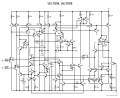
When doing discrete design, we are accustomed to using as few transistors as possible (they're relatively expensive), and no more capacitors than necessary (ditto, plus they tend to be bulky if electrolytic), and as many resistors as we want (they're cheap, even at ±1% tolerance). On an IC, it's quite different: transistors are really, REALLY cheap (because they're small); resistors take up a fair amount of real estate, so are relatively expensive; and capacitors are horrendously expensive because they take up a LOT of room. And on an IC, size is cost because it means fewer die per wafer. Also, resistor tolerances are horrible: ±30% would be typical; and temperature coefficients are horrible, too. Capacitors are a bit better, but still not great.

So on an analog IC we typically see lots and lots of transistors, a modest number of resistors, and only a few capacitors. The following diagram shows the innards of a Linear Technology LT1078 operational amplifier:
lt1078.png
Note that this is a "simplified" diagram; there's a probably a lot on the chip that they're not showing either to protect trade secrets or simply to keep the diagram easy to understand.

Note also that of the 50+ transistors in that circuit, every last one of them is there for a reason.

How does this circuit compare to the various things you've been doing? Similar? Totally different? I leave it up to you to decide.
 

WBahn

Joined Mar 31, 2012
32,706
For WBahn:

First I do not want to hijack this thread, so I'm only asking this one question in this thread this one time.

When I think of IC design, I tend to think of the formiddable, that IC designers are up there with rocket scientists, and you need to know transient analysis to the calculas precision, ect....

I have no intention of changing careers, I'm a selfemployed woodworker, and electronics has always been a hobby for me, and always will be.

However, I always loved designing circuits from scratch at the transistor level.

If you get a chance, could you please look over my blog entries, and see if my understanding of electronics at the transistor level of design, would be something close to what you would have hired a person for in the field of IC design. Just out of curiosity, as I said I have no interest in changing carrers, but if my designs would show the kind of electronics understanding for entry level hiring, it would be nice to know that. If my designs are way to simple and basic for entry level understanding of electronics, for hiring for IC design, then please let me know also.

The only reason I'm asking this is because after reading this entry you made, I just wonder how close my understanding of electronics at the transistor level is to would have been considered for hiring as an IC designer, if I were a college student looking to get into this field. I'm almost 40 years out of highschool so definately not asking this as a college student, and I'm not looking to change my job.

However if my portfolio of designing at the transistor level would be considered looking at to hire in the IC design field, then I would like to take the oppurtunity, to put together some blog material for this forum of transistor circuit design that could help those who would like to get into IC design field. I would not share the material as a professional designer, but only as a hobbyist as I'm learning as I design transistor circuits, because I always like to share the things I'm learning in this field to those who are just starting out in basic transistor circuit design.

Thankyou for your time, and I will not hijack this thread.
I don't have the time to wade through a bunch of circuits you've designed and try to evaluate whether you would have been suitable for doing IC design. There are a number of reasons for that -- including that I simply don't have the time -- but it would also be very difficult to do. It might be easy to conclude from what I wrote previously that IC design is so simple that all it takes is the ability to do sophomore/junior level work. That's not what I meant, however. What we were looking for was people that really understood the basic concepts well enough to solve problems. Our interviews were highly technical and we seldom asked questions that required anything beyond mid-level undergraduate knowledge. But the problems we asked tended to be skewed and outside the box and we wanted to see how the person dealt with them. Did they just try to come up with stock equations and throw at it, or were they willing to go to the basics and apply foundational principles to a problem they've never seen before. It was quite eye opening to see the number of people that couldn't work problems that were fundamentally very simple.

For this reason, just looking at circuits you designed wouldn't tell me much -- I need to see HOW you designed them in order to evaluate whether you would likely be able to design IC circuits. But if your comprehension of the basic concepts of circuit design and analysis were sound and your basic problem solving skills were sound, you could almost surely be taught the specifics of IC design to be a proficient member of a team. Whether or not you could eventually be able to devise novel ways to meet customer needs is a completely different issue -- and that's not what we were looking for in the people we hired. We let that sort itself out naturally over time.

Now, as for IC designers being rocket scientists -- no more so than other types of circuit designers. Good analog designers are probably about the same whether they are discrete circuit designers or integrated circuit designers -- though probably few are good at both, they really are very different critters.

The basic design approach taken is quite different. In discrete circuits you tend to get performance from using tight-tolerance (good accuracy) parts and circuit topologies that exploit them. In integrated designs you can't count on good tolerance, but you usually can count on tight-matching (good precision) between components, particularly if you know how to lay them out to maximize that, so you use very different circuit topologies that rely on matching for performance and are very forgiving of absolute values. Also, in integrated designs you try to use as few resistors and capacitors as you can because they are big and expensive. Instead, you throw lots of transistors at the problem because they are small and cheap.
 

hobbyist

Joined Aug 10, 2008
892
That's good to know then, that my circuits are, and were always at the hobby level, and I never would have been able to be involved in it at a professional level, so nothing loss. I took the right road to keep it at my own personal hobby, and not pursue it any further than that.

Thanks guys for your helpful input.
I'll leave it go at that, so as to not hijack this thread.
 
Top