Capacitor Charging with Pulses

DickCappels

Joined Aug 21, 2008
10,661
The 400X family was designed to be used at power line frequencies (50 Hz, 60 Hz). For this you would be best with a fast recovery diode or even a Schottky diode.

I am sorry if I missed it, but why do you have to diodes (D2 and D3) on the output? One is usually sufficient for this kind of converter.
 

Thread Starter

JulesP

Joined Dec 7, 2018
458
I agree but in practice the 4007 worked better, even than Carbide 0ns devices.
D3 is relevant when a dump battery is connected, otherwise the current going through the coil and active device can find its way to the other battery terminal. I will remove it for this sub circuit to avoid confusion.
 

Thread Starter

JulesP

Joined Dec 7, 2018
458
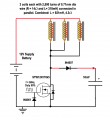
In this scheme, there is no need to use a 1700 V high-voltage transistor. It is quite enough to use a transistor at 80 V. Hysteresis will not accelerate the charge, but only increase losses. I tried to introduce core saturation, but it didn't help. I have set the trigger levels approximately as shown in your drawing.
View attachment 332204
There is no Diode (D1) between the Drain and Ground. There is one between the Gate and Ground. D1 is there to help the Gate discharge. That will change things a lot. I have also removed the diode on the ground line as its use is with the larger circuit. Here is the revised circuit:

Circuit 2.png

Also, earlier in the thread it was agreed that the energy stored in a capacitor charged with pulses, compared to regular DC, is not 1/2 CV^2, which you have in one of your sim .meas calculations. That is probably why your efficiency only came in at 67% whereas it is expected to be around 90% or a bit more.
 
Last edited:

Bordodynov

Joined May 20, 2015
3,431
Don't you know that the MOSFET already has a built-in antiparallel diode? And this built-in diode is usually faster and more powerful than the 1N4007 diode! They get an efficiency of 90% with specialized chokes, and not with surrogate ones, as in this case. And they usually work at much higher frequencies. Especially when you use a 1700 V transistor and shunt it with a 1000 V diode.
 

Thread Starter

JulesP

Joined Dec 7, 2018
458
Yes, even with the parasitic body diode the 4007 gives the best results - but those results are not part of this query. Did you not appreciate, as I didn’t, that the energy stored in a capacitor that has been pulse charged (with an inductor) is not 1/2 CV^2? That has been a major theme in this discussion. Please see posts 4, 14 & 30.
 
Last edited:

MrAl

Joined Jun 17, 2014
13,709
This is absolute nonsense. I am very surprised that you think PWM has an effect on efficiency in an LED + resistor circuit, I guess I need to write a tutorial for you.

e = (useful power) / (power in)

Let’s take your example. Case 1, no PWM.

Vin = 10V
Vf 5V
If = 1A

power in = 10 x 1A = 10W
useful power (in LED) = 5V x 1A = 5W
efficiency = 5 / 10 = 0.5

Now let’s try 50% PWM

In the ON half of the cycle, the calculation is the same as above. Efficiency is 50%.

In the OFF half cycle there is no power supplied or used.

So integrate over the two equal cycles and we get:

avg power in = 1/2 x 10W + 1/2 x 0W = 5W
avg useful power = 1/2 x 5W + 1/2 x 0W = 2.5W

avg efficiency = 2.5W / 5W = 0.5

The average power is reduced by a factor 2 but the useful power is as well. It has no effect in efficiency.

There is no change in the resistance or the current. That is nonsense. Resistance does not average over time.

In your original post, your said the current was reduced to 0.67A. I cannot believe you think that. You can average current or voltage, not resistance, which does not change with time as the voltage and current do.
Ha, you are talking about something else than what I am talking about. Either that alone or you did not read my last reply.
I said that the apparent resistance changes with duty cycle, and that we have to consider the entire resistor string and that includes the LED. That does not mean the efficiency has to change. Maybe you did not read that last post? It's ok no problem.
You even got a 'like' for that (ha ha), so someone else did not read that last post either :)
That's ok though no problem.

Do a quick experiment and use just ONE resistor and one PWM. Note how the AVERAGE current changes with duty cycle. The peak current never changes.
 

MrAl

Joined Jun 17, 2014
13,709
Thank you for the useful summary. However, it doesn’t quite get me to where I need to go, which is to measure or calculate the actual energy being delivered to the capacitor in response to the HV transients.

I now know that measuring the energy stored in the capacitor, via a discharge, can be done accurately using an electronic load, such as with my computerised battery analyser (as shown earlier).

So now the focus is on determining the transfer efficiency from the inductor to the capacitor, via the FET, so that I can work backwards from the accurate discharge energy to know what was actually being delivered to the capacitor. Assuming say a 95% efficiency is not really accurate enough for my research purposes.

One option I have suggested is looking at the current and voltage graphs from a spice simulation (assuming the component models are accurate) and somehow calculating the transfer losses due to the parasitic resistances, made up of the inductor, Rds On for the FET and the connection from the FET Drain to the capacitor. If that is possible then some guidance would be helpful. If not then there may be other possibilities.

Thanks

This kind of calculation can be done as usual there is not much different about it. You can start with a buck circuit.
You are discharging the inductor into the cap and that's what a lot of converter circuits do including buck and boost. That makes this a pretty regular thing.
You can use averaging also where you consider the current or voltage to be the average value, then figure out the losses due to the resistances like the inductor ESR and sometimes the cap ESR also comes into play.
For example, if the average current through the inductor is 2 amps and the ESR is 0.1 Ohms, then you can estimate the power lost in the ESR is 2^2*0.1=4*0.1=0.4 watts.

We can go through a complete analysis if you like. That will get you more familiar with how this works for any circuit that acts like a power converter circuit. It's not too difficult with just one inductor and one capacitor.
 

Thread Starter

JulesP

Joined Dec 7, 2018
458
Thanks for the offer. While I wait to improve my sim circuit with better component models and the various ESR elements, I will lay out the practical steps and numbers to determine the efficiency of converting supply battery energy to that stored in the cap. Basically, I have the stored energy part from a discharge through an electronic load, and the input energy side is just V.I.dt. The former divided by the latter is the working efficiency (no 1/2CV^2 in sight).;)
Then it would be interesting to compare practice with sim predictions, although I am unclear yet if I can achieve those values from the sim. I expect so, I’m just not that familiar yet with post processing the measured node values as required. I also think that accurately modelling the coil ferrite core behaviour, and its hysteresis, could be fiddly.

Besides, with an ‘equinox’ head cold developing, I could swear I have eleven fingers . . . .
 

MrAl

Joined Jun 17, 2014
13,709
Thanks for the offer. While I wait to improve my sim circuit with better component models and the various ESR elements, I will lay out the practical steps and numbers to determine the efficiency of converting supply battery energy to that stored in the cap. Basically, I have the stored energy part from a discharge through an electronic load, and the input energy side is just V.I.dt. The former divided by the latter is the working efficiency (no 1/2CV^2 in sight).;)
Then it would be interesting to compare practice with sim predictions, although I am unclear yet if I can achieve those values from the sim. I expect so, I’m just not that familiar yet with post processing the measured node values as required. I also think that accurately modelling the coil ferrite core behaviour, and its hysteresis, could be fiddly.

Besides, with an ‘equinox’ head cold developing, I could swear I have eleven fingers . . . .
Yes unfortunately it is easier to figure out what an inductor is doing after it is used in a circuit rather than before. The core properties, skin effect, ESR, all that means you have to know a lot about it beforehand and that's probably not practical. In this area theory is used to predict the general behavior of circuits not the exact behavior when there are questionable components involved. Theory can tell you a lot though because you can vary the unknows to see what will happen in a calculation or simulation so you can get an idea what will happen in real life.
In a real-life setting a prototype would be created so measurements could be made. If everything goes well, then more units can be made and then there is a reasonable expectation that those units will behave as the prototype. In many cases you can then scale the design up, but it's always a good idea to create a prototype of any new product and evaluate its performance and any parameters that might be important.

I hope you get over your cold quickly.
 
Last edited:

MrAl

Joined Jun 17, 2014
13,709
I was replying to your post implying I did not understand it.
Hi Bob,

Just to make it clear I had edited out my original remarks on the efficiency as per your replies.
I do not think the efficiency changes either, only the total resistance in the circuit appears as if it changes with duty cycle. When we use averaging this becomes apparent.
 

BobTPH

Joined Jun 5, 2013
11,528
Hi Bob,

Just to make it clear I had edited out my original remarks on the efficiency as per your replies.
I do not think the efficiency changes either, only the total resistance in the circuit appears as if it changes with duty cycle. When we use averaging this becomes apparent.
Okay, now it makes more sense.

The way I look at is, during the off part of the cycle, the resistance literally becomes infinite. How do you average 5 Ohms and ∞ Ohms? You could average conductance (1/R) because it is 0 during the off part of the cycle and that appears to be what you did.

But even if you did, current is not proportional to 1/R. Look at the equation:

I = (Vs -Vf) / R

But as R approaches 0, Vf will rise, non-linearly until it matches Vs. So the current is not proportional to 1/R except over small range.

This is why I objected to the idea of “averaging the resistance.”
 

crutschow

Joined Mar 14, 2008
38,529
earlier in the thread it was agreed that the energy stored in a capacitor that has been pulse charged (with an inductor) is not 1/2 CV^2?
Not possible.
It's basic physics that the energy stored in a capacitor is ½CV².
Makes no difference how that energy is supplied to the capacitor, it only affects the efficiency of how it's done.

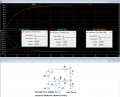
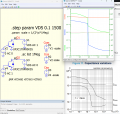
Below is an LTspice sim to show the energies involved in charging a capacitor with a resistor and with an inductor:
I used a switch to shutoff the charge at the peak of the inductor charge to avoid the resonant discharge of the capacitor.
The inductor source charge voltage is 1/2 the resistor source charge voltage for the same capacitor voltage as would be expected.

Note that the source energy from the resistive charge (left window) is twice the source energy from the inductive charge (middle window).
And as expected, the resistive loss (right window) is where 1/2 the energy has gone.

Also note that the ½CV² energy of a 1F capacitor charged to 10V is 50J.


1727100486735.png
 

MrAl

Joined Jun 17, 2014
13,709
Okay, now it makes more sense.

The way I look at is, during the off part of the cycle, the resistance literally becomes infinite. How do you average 5 Ohms and ∞ Ohms? You could average conductance (1/R) because it is 0 during the off part of the cycle and that appears to be what you did.

But even if you did, current is not proportional to 1/R. Look at the equation:

I = (Vs -Vf) / R

But as R approaches 0, Vf will rise, non-linearly until it matches Vs. So the current is not proportional to 1/R except over small range.

This is why I objected to the idea of “averaging the resistance.”
Hi,

As strange as it sounds, you can average 5 Ohms and infinite Ohms but that's not the right way to look at it. It's the average current and it's the on vs off cycle that makes what happens happen. This is the total resistance though. If we had two 5 Ohm resistors in series it would be a total of 10 Ohms, and that at 50 percent duty cycle would act like a 20 Ohm resistor. There is one catch though, and that is that the frequency has to be high enough for most applications or else it will start looking only like a 10 Ohm resistor some times and infinite other times (ha).

So it's better to look at it as just ON and OFF rather than 10 Ohms and infinite Ohms, although infinite Ohms just means during that time there can not be any current flow, and so the current would only flow for half the time (50 percent duty cycle). The average of anything is simple when there are only two states, on and off.
If we have 1000 of something and 1 of something the sum is 1001 and the average is close to 500, which is half of 1000.
If we have 1000ma during the ON time and 1ma during the OFF time the average is 500.5ma. When we go back to calculate the equivalent resistance (with no switching) it would look like the resistance doubled.

I'm not sure what you were trying to show with:
I = (Vs -Vf) / R

I guess you meant an LED with forward voltage Vf and series resistor R, and the current I (or lower case 'i').
Yes, in this case, for one, we have to assume the LED is operating over a relatively small range of operation where the resistance is almost constant. That would give us:
i=Vs/(R1+R2)

and we would have to average with both R1 and R2, not just R1 (the series resistor). So with nonlinear devices, this has limited use, unfortunately.

It is however still interesting to look at the switched circuit with one resistor and one capacitor, and how the switching affects the capacitor charging. If the circuit is OFF for half the time, then the capacitor can only charge for half the time. This would still charge the capacitor, but it would take longer so the equivalent RC time constant would have to be viewed as having increased.

Maybe I can show some waveforms tomorrow.
 

MrAl

Joined Jun 17, 2014
13,709
You don’t have to show me anything. You have basically come around to what I have been saying all along.
I did not necessarily mean that I would show just you in particular, but the reader group in general. There are some interesting variations that come up with switching on and off or switching from the Vs source voltage to ground.
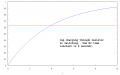
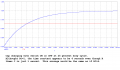
Switching on and off shows the time constant increasing by 1/D, while switching from Vs to ground keeps the time constant as R*C but decreases the average amplitude by a factor of 0.25 percent.

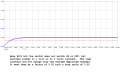
The following waveforms illustrates these variations.
One is just a plain old RC being charged with a source voltage of 1 volt and RC=4 so the time constant is 4 seconds in that waveform.
Another waveform shows what happens with RC=1 and the duty cycle set at 0.25, Vs is still equal to 1 volt. As we can see, the apparent RC time constant increased to 1/D with D the duty cycle.
The lower amplitude waveform is switching with D=0.25 again, but this time the switch switches ON for 25 percent of the time, and for the remaining 75 percent of the time it is switching the resistor to ground.
 

Attachments

Thread Starter

JulesP

Joined Dec 7, 2018
458
Not possible.
It's basic physics that the energy stored in a capacitor is ½CV².
Makes no difference how that energy is supplied to the capacitor, it only affects the efficiency of how it's done.

Below is an LTspice sim to show the energies involved in charging a capacitor with a resistor and with an inductor:
I used a switch to shutoff the charge at the peak of the inductor charge to avoid the resonant discharge of the capacitor.
The inductor source charge voltage is 1/2 the resistor source charge voltage for the same capacitor voltage as would be expected.

Note that the source energy from the resistive charge (left window) is twice the source energy from the inductive charge (middle window).
And as expected, the resistive loss (right window) is where 1/2 the energy has gone.

Also note that the ½CV² energy of a 1F capacitor charged to 10V is 50J.


View attachment 332259
Ok, well explained and presented. So the advantage of charging with an inductor is that far less of the battery energy is wasted in the transfer and therefore, for the same amount of energy delivered by the battery, the inductor-based method will result in a higher resulting capacitor voltage than the DC method - since there is more energy available to equate to 1/2CV^2.
 

Thread Starter

JulesP

Joined Dec 7, 2018
458
I have been advised that "The proprietary intrinsic VDMOS in LTspice does not model recent new geometry MOSFETs well. The stw12n170k5 MOSFET has an extreme variation of Cdg that is very different from the ATAN behaviour used in the VDMOS model, which worked well in conventional low to medium voltage vertical MOSFETs.

So if I can't model it well then the best way to measure the transfer efficiency is a practical one as described earlier - an electronic load measurement (which should equate to 1/2CV^2) and then compared to the battery's input energy. That should be accurate enough for my purposes.
 

MrAl

Joined Jun 17, 2014
13,709
Ok, well explained and presented. So the advantage of charging with an inductor is that far less of the battery energy is wasted in the transfer and therefore, for the same amount of energy delivered by the battery, the inductor-based method will result in a higher resulting capacitor voltage than the DC method - since there is more energy available to equate to 1/2CV^2.
Yes it's kind of interesting how this works. The simple answer is that with a resistor and capacitor, the resistor will always eat up some energy. With an inductor and capacitor, these both store energy and in theory do not dissipate any energy at all. Thus if one transfers to the other (and the cap energy can transfer to the inductor also in various cases) no energy is lost. As you know there are no perfect L and C so there will be a little energy lost, but not nearly as much as with a resistor with a cap or inductor.

You might note that in the definition for a resistor we have:
P=R*i^2=V^2/R

which means it dissipates energy. For an inductor or capacitor, we do not see this kind of formula, instead we see a formula that indicates the STORAGE of energy not the LOSS of energy.
Storage means it is saved for use later like filling a tank with water then using it later for something. Loss means we lose it which is like pouring water down the drain.
 

Thread Starter

JulesP

Joined Dec 7, 2018
458
Glad to see my electrical physics from many years back was not all inaccurate or an approximation after all!
 
Top