Capacitor Charging with Pulses

BobTPH

Joined Jun 5, 2013
11,533
This helps get a clearer picture of what we might have to upgrade to reach some target efficiency like 90 percent.
You missed the entire point. You cannot get better than 50% efficiency in charging a capacitor from a voltage source with a linear circuit. The actual reason is the mismatch between the source voltage and the capacitor voltage.

It is easily understood intuitively by realizing that the power drawn from the battery is the current times the battery voltage, whereas the power going into the capacitor is that same current times the capacitor voltage, which is always lower than the battery voltage. Mathematically, you must integrate both over time and you will see that the energy stored is 1/2 the energy out of the battery.
 
Last edited:

Thread Starter

JulesP

Joined Dec 7, 2018
458
We are not talking about a linear circuit. Perhaps you haven’t actually read the original post? We are talking about what is effectively a Boost Converter and I’m trying to see if it is possible to calculate the transfer efficiency which I am told can be >90%.
 

BobTPH

Joined Jun 5, 2013
11,533
We are not talking about a linear circuit. Perhaps you haven’t actually read the original post? We are talking about what is effectively a Boost Converter and I’m trying to see if it is possible to calculate the transfer efficiency which I am told can be >90%.
He was’t talking about that. He was talking about the assertion, made originally br you, that there was a 50% loss whe charging with only resistance.

No one here questions that you can charge a capacitor more efficiently with what comes down to a buck-boost converter. It has been done that way in power supplies for decades.
 

crutschow

Joined Mar 14, 2008
38,529
so the apparent resistance that MrAI was talking about is to do with the Drain output pulse that is actually charging the capacitor.
No, the MOSFET resistance has nothing to do with charging the capacitor, which occurs when the MOSFET is off.
That resistance adds a slight loss when the MOSFET is on and inductor is charging.

The main loss occurs when the capacitor charges the battery.
 

MrAl

Joined Jun 17, 2014
13,711
You missed the entire point. You cannot get better than 50% efficiency in charging a capacitor from a voltage source with a linear circuit. The actual reason is the mismatch between the source voltage and the capacitor voltage.

It is easily understood intuitively by realizing that the power drawn from the battery is the current times the battery voltage, whereas the power going into the capacitor is that same current times the capacitor voltage, which is always lower than the battery voltage. Mathematically, you must integrate both over time and you will see that the energy stored is 1/2 the energy out of the battery.
Hello,

Seriously Bob, you actually think I do not know that already? You have not been paying attention in my class :)

I don't think I said anything misleading when I talked about both ways of charging, and even took the time to mention the most clear theoretical prototype example that illustrates the charging using an inductor. I think everyone here knows the loss when charging with a DC source and resistor. The question was comparing that to adding an inductor similar to what we have in a boost converter or buck converter.

The reason I mentioned the typical prototype example using the inductor was because when we look at something like a buck converter we know we need true power conversion, but that doesn't actually explain the phenomenon that allows that to happen. The resonance or pseudo resonance is the classical explanation where the inductor can transfer energy to the capacitor losslessly in theory. It's almost like a miracle of nature.
 

MrAl

Joined Jun 17, 2014
13,711
Ok, so the losses in pulse charging are due solely to the resistive aspect, as has been discussed, and the duty for the PWM I used is 50%, which will double the apparent resistance, according to your description. So can one calculate the efficiency by just knowing the resistance between the FET Drain and the capacitor and applying some PWM based factor?
Hi,

Well, to make it easier to understand, imagine you have an ideal transistor that turns on with perfect zero Ohms, and a resistor of known value like 10 Ohms in series with the capacitor. If you make the frequency high enough relative to the time constant, you will see an averaging effect. The resistor ends up looking like a 20 Ohm resistor with a 50 percent duty cycle for the transistor.
What this means is that the capacitor will charge more slowly during each half cycle as the time constant will be double.

[Edited out remarks about the efficiency due to replies from Bob. I made a mistake on the calculation as he indicated. In these problems it's better that we look at actual circuits.]

With the energy transfer question, we have to look at both the energy in the capacitor and the energy going out of the source.
With a 50 percent duty cycle (and fast switching), the average capacitor voltage will only go to 1/2 of the source voltage, and the source voltage will only be on for 1/2 of the time so the average current will also be 1/2 of the full current. If the duty cycle drops to 25 percent, the average capacitor voltage will only go up to 1/4 of the source voltage.
Note this is when the source is switched on and then when off it gets connected to ground. If only one transistor is used to switch the source on, then the cap will charge up to the full source voltage regardless what the duty cycle is.

We can look at some actual simple circuits to see more about how this works if you like.
 
Last edited:

BobTPH

Joined Jun 5, 2013
11,533
A typical application for this is a PWM circuit with an LED as the load.
If we have a 10v source and a 5v LED and a 5 Ohm resistor and we turn the transistor on, the LED draws 1 amp and the loss across the resistor is 5 watts and the LED absorbs 5 watts, and that makes the efficiency right off the bat 50 percent even without any duty cycle. Now if we start pulsing it at 50 percent duty cycle, the resistor starts to look like a 10 Ohm resistor, and with the LED having an internal resistance of roughly 5 Ohms, the current drops to 0.667 amps. The power in the now 10 Ohm resistor is 4.444 watts and the power in the LED is now 2.222 watts, making the efficiency just 33 percent now.
So I was right, you don’t understand. PWM does not change the efficiency at all. Your math is flawed. Try again.

During the 50% on time, the resistor does not act like it is 1/2 the resistance. The current does not change from the one amp. That is patent nonsense. It is still 50% efficient. During the off half no power is used. It is no different than running 100% at 1/2 the current. Do the math.
 

Thread Starter

JulesP

Joined Dec 7, 2018
458
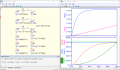
I’ve lost the plot now ☹ I will try and summarise what I do and do not understand when my head’s in the right gear. I need a ‘miracle of nature’ here.
 

crutschow

Joined Mar 14, 2008
38,529
Basic summary:

From a fixed source/load voltage-
  • Charge/discharge the capacitor from an inductor gives high efficiency (ideally 100%).
  • Charge/discharge the capacitor without an inductor gives 50% efficiency
  • PWM has no effect on this.
Here's an interesting thought experiment to look at the stored energy change in a capacitor-
Charge one capacitor to V, giving an energy ½CV².
If you then connect that in parallel to a discharged capacitor of size C, the resulting voltage will be reduced by 1/2 with a combined capacitance of 2C
This gives a new stored energy value of C(½V)² = ¼CV².
So 1/2 the energy has magically disappeared, lost in the parasitic resistance between the two capacitors when they were connected in parallel.

If you understand those statements, you should be better able to understand what happens in your circuit.
 

Thread Starter

JulesP

Joined Dec 7, 2018
458
Thank you for the useful summary. However, it doesn’t quite get me to where I need to go, which is to measure or calculate the actual energy being delivered to the capacitor in response to the HV transients.

I now know that measuring the energy stored in the capacitor, via a discharge, can be done accurately using an electronic load, such as with my computerised battery analyser (as shown earlier).

So now the focus is on determining the transfer efficiency from the inductor to the capacitor, via the FET, so that I can work backwards from the accurate discharge energy to know what was actually being delivered to the capacitor. Assuming say a 95% efficiency is not really accurate enough for my research purposes.

One option I have suggested is looking at the current and voltage graphs from a spice simulation (assuming the component models are accurate) and somehow calculating the transfer losses due to the parasitic resistances, made up of the inductor, Rds On for the FET and the connection from the FET Drain to the capacitor. If that is possible then some guidance would be helpful. If not then there may be other possibilities.

Thanks
 

MrAl

Joined Jun 17, 2014
13,711
So I was right, you don’t understand. PWM does not change the efficiency at all. Your math is flawed. Try again.

During the 50% on time, the resistor does not act like it is 1/2 the resistance. The current does not change from the one amp. That is patent nonsense. It is still 50% efficient. During the off half no power is used. It is no different than running 100% at 1/2 the current. Do the math.
Are we talking about the same thing? I do not think we are.
Did I say that "during the 50 percent on time" the resistor acts like it is 1/2 the resistance or even twice the resistance? I don't think so.


What I did say was that the *average* current will decrease, and that will decrease from what it would be if the transistor was on for 100 percent of the time (100 percent duty cycle).

Did I make a mistake in the calculation of the efficiency for the LED being driven. I'll go over it once more.
 

MrAl

Joined Jun 17, 2014
13,711
So I was right, you don’t understand. PWM does not change the efficiency at all. Your math is flawed. Try again.

During the 50% on time, the resistor does not act like it is 1/2 the resistance. The current does not change from the one amp. That is patent nonsense. It is still 50% efficient. During the off half no power is used. It is no different than running 100% at 1/2 the current. Do the math.
Hello again,

Ok here is the way it works.

[1] If we have a 10v source powering a 10 Ohm resistor the current is 1 amp.
[2] If we have a 10v source powering a 10 Ohm resistor and the duty cycle is 50 percent, the average current is 0.500 amps.
[3] If we have a 10v source powering a 10 Ohm resistor and the duty cycle is 25 percent, the average current is 0.250 amps.

Now in case 1, if we calculate the average resistance, it is 10v/1amp=10 Ohms, as expected.
In case 2, 10v/0.500a=20 Ohms, which is double the resistance of the 10 Ohm resistor, or 10*(1/0.50)=20.
In case 3, 10v/0.250a=40 Ohms, which is four times the resistance of the 10 Ohm resistor, or 10*(1/0.25)=40.

This illustrates how the apparent resistance of the 10 Ohm resistor goes up as the duty cycle goes down, and the factor is 1/D.
Thus, with a resistance of R at a fractional duty cycle D the apparent resistance increases to R/D.

Amazingly, this is the same with a resistor powering an LED, except we have to consider the base value of the resistance of the LED along with the series resistor even though the LED has what we might call infinite resistance when off. That's because when the switch is off both resistances are considered to be out of the circuit as that new topology takes over. It's essentially 0 current for both.

Just to note, the ODE is very simple for this kind of circuit we could look at this in much more detail if needed.
 

crutschow

Joined Mar 14, 2008
38,529
One option I have suggested is looking at the current and voltage graphs from a spice simulation (assuming the component models are accurate) and somehow calculating the transfer losses due to the parasitic resistances, made up of the inductor, Rds On for the FET and the connection from the FET Drain to the capacitor.
If you have an good model for the FET and the inductor parasitics, then you should be able to get a reasonably accurate value for the efficiency of the capacitor charging.
LTspice, for example, will calculate all the currents and voltages, as well as the energy/power to determine the efficiency.
That will likely be more accurate than any hand-calculations you can do.
 

Thread Starter

JulesP

Joined Dec 7, 2018
458
Thanks, it looks like a sim build is on the cards. I assume that the parasitic values for the inductor, and presumably the connections to the capacitor, are just added as lumped components in the connecting tracks in the model.

When I get somewhere with this I will post some details.
 

BobTPH

Joined Jun 5, 2013
11,533
This illustrates how the apparent resistance of the 10 Ohm resistor goes up as the duty cycle goes down, and the factor is 1/D.
Thus, with a resistance of R at a fractional duty cycle D the apparent resistance increases to R/D.
This is absolute nonsense. I am very surprised that you think PWM has an effect on efficiency in an LED + resistor circuit, I guess I need to write a tutorial for you.

e = (useful power) / (power in)

Let’s take your example. Case 1, no PWM.

Vin = 10V
Vf 5V
If = 1A

power in = 10 x 1A = 10W
useful power (in LED) = 5V x 1A = 5W
efficiency = 5 / 10 = 0.5

Now let’s try 50% PWM

In the ON half of the cycle, the calculation is the same as above. Efficiency is 50%.

In the OFF half cycle there is no power supplied or used.

So integrate over the two equal cycles and we get:

avg power in = 1/2 x 10W + 1/2 x 0W = 5W
avg useful power = 1/2 x 5W + 1/2 x 0W = 2.5W

avg efficiency = 2.5W / 5W = 0.5

The average power is reduced by a factor 2 but the useful power is as well. It has no effect in efficiency.

There is no change in the resistance or the current. That is nonsense. Resistance does not average over time.

In your original post, your said the current was reduced to 0.67A. I cannot believe you think that. You can average current or voltage, not resistance, which does not change with time as the voltage and current do.
 

Bordodynov

Joined May 20, 2015
3,431
Thanks, it looks like a sim build is on the cards. I assume that the parasitic values for the inductor, and presumably the connections to the capacitor, are just added as lumped components in the connecting tracks in the model.

When I get somewhere with this I will post some details.
A long time ago, while still a student, I was interested in the issue of losing 50% of energy when charging and discharging a capacitor. I have compiled a differential equation of a circuit containing a capacitor, a resistor, and a voltage source. The capacitor discharge equation turned out to be simple and I solved it. It turned out that the losses on the resistor are 50% and they do not depend on the value of the resistor. The time of the process only depends on this. The value of the resistor was not included in the loss formula.
Then I looked at the discharge of the capacitor through the inductance. I made up an equation and solved it. It turned out that the capacitor will never discharge - there will be endless fluctuations. The energy transfer from the capacitor to the inductance and back.
I received a similar loss of 50% of energy when charging through a resistor. If you charge the capacitor starting from a low voltage, you can significantly reduce energy loss. Much later, I used LTspice and set different laws of voltage variation from time to time on the capacitor (source voltage). I easily calculated the energy losses. Unfortunately, I did not find my calculations. But you can do the analytical calculation yourself. It doesn't take much knowledge. You can also use the Spice program.
 

Thread Starter

JulesP

Joined Dec 7, 2018
458
Thank you. I am having a go at a Spice sim design but have to refresh on how to add an accurate model to a basic M1 MOSFET design, and things like that. I will post something in a short while.
 
Last edited:
Top