Facebook
 Google
 GitHub
 Linkedin

I have some queries regarding capacitor charging using inductively generated HV pulses, in contrast to regular DC.
My understanding is that if the energy supplied by the battery U = QV then the capacitor will always receive and store 1/2 QV (= 1/2 CV^2) due to resistive, inductive and radiative losses.
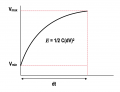
So with a known value of capacitor being charged from a voltage Vmin to Vmax, as seen on a scope trace and drawn here, one can calculate the energy stored and compare it to what was delivered by the battery and this will be fairly precisely 50%.
If the capacitor is then discharged, whatever energy was stored will again incur a 50% loss such that, over a complete charge-discharge cycle, only 25% of the original energy supplied by the battery is available for whatever the discharge energy might be used for.
Looking now at the situation with HV pulses, of the sort produced from the field collapse of a coil (flyback pulses), as in the circuit below, then I understand that, apart from the voltage dependent switch, this is basically a Boost Converter. As such the energy stored in the coil’s magnetic field is very efficiently transferred to the capacitor with an efficiency of let’s say 95%. The high-intensity discharges are simply to enable the reset of the capacitor so that a train of charging curves can be seen and measured.
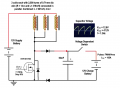
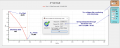
My query is that since the above equation (0.5 CV2) for regular DC charging is clearly not applicable here, is there some other way I can theoretically calculate the energy stored in the capacitor or, if that is not possible, then is the best way to discharge the cap through an electronic load to record the energy dissipated and then to apply the 50% loss factor for conventional discharge? This can be done as shown below, but I would like to be able to compare theory with practice.
Thanks
My understanding is that if the energy supplied by the battery U = QV then the capacitor will always receive and store 1/2 QV (= 1/2 CV^2) due to resistive, inductive and radiative losses.
So with a known value of capacitor being charged from a voltage Vmin to Vmax, as seen on a scope trace and drawn here, one can calculate the energy stored and compare it to what was delivered by the battery and this will be fairly precisely 50%.
If the capacitor is then discharged, whatever energy was stored will again incur a 50% loss such that, over a complete charge-discharge cycle, only 25% of the original energy supplied by the battery is available for whatever the discharge energy might be used for.
Looking now at the situation with HV pulses, of the sort produced from the field collapse of a coil (flyback pulses), as in the circuit below, then I understand that, apart from the voltage dependent switch, this is basically a Boost Converter. As such the energy stored in the coil’s magnetic field is very efficiently transferred to the capacitor with an efficiency of let’s say 95%. The high-intensity discharges are simply to enable the reset of the capacitor so that a train of charging curves can be seen and measured.
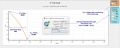
My query is that since the above equation (0.5 CV2) for regular DC charging is clearly not applicable here, is there some other way I can theoretically calculate the energy stored in the capacitor or, if that is not possible, then is the best way to discharge the cap through an electronic load to record the energy dissipated and then to apply the 50% loss factor for conventional discharge? This can be done as shown below, but I would like to be able to compare theory with practice.
Thanks