Capacitor Charging Problem

Thread Starter

SamR

Joined Mar 19, 2019
5,470
1772913848695.png
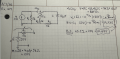
Apparently, I am not interpreting the e^(-t/τ) part of the equation correctly? I am getting a completely different answer than what I know to be correct? In fact, I am getting what I would expect for t=5s or 5τ time constants... Just exactly what is going on here?
 

Thread Starter

SamR

Joined Mar 19, 2019
5,470
Ahhh... I see it now, 1s would be (1s/80ms)τ = 12.5τ which indeed would be 19.9999V! Got it! So, solving it for any t yields the voltage @ t and
20V(1-e^(-80ms/80ms))=12.64V for the first time constant!!!
 
Last edited:

WBahn

Joined Mar 31, 2012
32,702
Just what is it you are trying to find? You don't give a problem statement, which forces us to read between the lines and guess.

You made a mistake because you didn't track your units properly. Sure, you threw an 'ms' onto the 80, to make it look like you were tracking units, but you then completely and totally ignored them, or the fact that your own equation was screaming at you that it was wrong. The argument of the exponential function MUST be unitless! That should have made you take pause when you had 1 / 80ms and forced you to wonder why you had units of inverse time surviving. Had you put your units in there consistently, you would have replaced 't' with '1 s' and had 1 s / 80 ms, which would have prevented you from charging ahead and, instead, made you realize that this is 1000 ms / 80 ms = 12.5.

Bottom line, because you didn't track your units, the argument of your exponential was off by three orders of magnitude. Then, because it IS an exponential, the result was that the resulting term was off by an truly astronomical factor.

You want to get into the habit of properly tracking units at each and every step of your work. After you write each equation, ask if the units work out. If not, STOP! Find and fix the problem before moving on. It won't take long before this process will be second nature and you won't even realize you are doing it, but units inconsistencies will tend to jump off the page into your conscience thought when they occur.
 

Thread Starter

SamR

Joined Mar 19, 2019
5,470
Yes, was looking for the voltage after 1 time constant... Didn't consider the exponent being unitless, DUH... which it is when s/ms cancels out as both t and time constant τ are in sconds.
 

MrAl

Joined Jun 17, 2014
13,667
Ahhh... I see it now, 1s would be (1s/80ms)τ = 12.5τ which indeed would be 19.9999V! Got it! So, solving it for any t yields the voltage @ t and
20V(1-e^(-80ms/80ms))=12.64V for the first time constant!!!
Hi,

Yes that looks like the only mistake. You wrote 1 over 80ms as the exponent which would mean 1 second over 80ms (and negative), but since one time constant occurs at the time of just one time-constant time, you have to write 80ms/80ms which you eventually found. Of course that leads to 1-e^-1 then.
 

MrAl

Joined Jun 17, 2014
13,667
Yes, was looking for the voltage after 1 time constant... Didn't consider the exponent being unitless, DUH... which it is when s/ms cancels out as both t and time constant τ are in sconds.
Hello again,

I forgot to mention that I think it is really, really great that you found your own mistake. That's a big deal because we all make mistakes but if we can discover them, we can always, always, get things perfectly correct.

Learning to find your own mistakes is probably one of the most important things in any kind of analysis. If we can find a second way to calculate the same thing, we can do a second calculation and compare results. If we don't get the same result for both, we know ONE of them is not right so we can go on to figure out which one it is. Eventually we get them both to be the same and then we can be a lot more sure that we got the whole thing correct.

For the kind of analysis you were doing here, it might be hard to find a second way to do it because it just involved a wrong entry value. What helps then is if you can program in some language, even BASIC is ok to use. You can learn to program the functionality of electronic circuits and when you run the program you get that second result. A lot of people probably do not want to do this, so next in line is a circuit simulator. The results should match very closely with the math calculations.

When it does involve an entry value though writing a program helps in another way. You have to physically ENTER in that value into the program, and because your mind is working differently when you do that, you might notice the error in the value right away.

Keeping track of units also helps as we all know. If we go to enter a time value it might dawn on us that it is too high or too low.
 
Top