Capacitor charging and discharging - Multivibrator

Thread Starter

Vihaan@123

Joined Oct 7, 2025
220
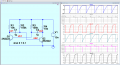
I tried to solve the below multivibrator circuit to know how much i understand on capacitor charging / discharging fundamentals
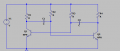
1764398535181.png
The circuit i have considered from net,
I know as initial condition we have to assume one of the transistor ON and the other OFF.
So, initially Q1 is ON and Q2 is OFF
The circuit would become as below
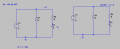
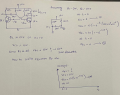
1764398647460.png
C1 will get charged to the voltage of V - IR2 and once it is above 0.7V the Q2 will be turned ON. Similarly, the C2 to be discharged and brought below 0.7 to make Q1 OFF. How C2 will get discharged?
 

WBahn

Joined Mar 31, 2012
32,702
Remember that the voltage across a capacitor can't change instantaneously.

With that in mind, determine the node voltage just before a switch happens and then apply that constraint to see what they start out at right after.
 

MrAl

Joined Jun 17, 2014
13,667
I tried to solve the below multivibrator circuit to know how much i understand on capacitor charging / discharging fundamentals
View attachment 359663
The circuit i have considered from net,
I know as initial condition we have to assume one of the transistor ON and the other OFF.
So, initially Q1 is ON and Q2 is OFF
The circuit would become as below
View attachment 359664
C1 will get charged to the voltage of V - IR2 and once it is above 0.7V the Q2 will be turned ON. Similarly, the C2 to be discharged and brought below 0.7 to make Q1 OFF. How C2 will get discharged?
Hi there,

First off, R2 is usually greater than R1, and R3 is usually greater than R4. With all resistors equal I have a feeling it will not actually oscillate. You can try it though, I guess. More typically if R1 and R4 are both 1k, then R2 and R3 would be maybe 10k or so. You want to make sure the capacitors have enough effect when things are changing, or should be changing.

To start with the analysis, if you say that Q1 is 'on', then figure out what the capacitor voltages are for that state when it first turns on and go from there.
 

ericgibbs

Joined Jan 29, 2010
21,390
Hi V123,
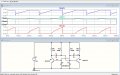
Perhaps this visual display of the voltages may give you a better insight into the operation of the circuit.

E

Also note: in this basic circuit, the Vbase reverse voltage will exceed the breakdown voltage of the Base to Emitter of the transistor.


EG 1854.png
 
Last edited:

MrAl

Joined Jun 17, 2014
13,667
Hello again,

It's actually easier to analyze if you do not add the two clamp diodes. Note the original circuit only had a 5v power supply so the maximum reverse BE voltage would be less than 5v which is the limit for many NPN transistors. Also, and this is a little funny, theoretical transistors do not blow out unless we include that limitation by design :)

If the -5v limit is not observed in practice though, the gain of the transistor could go way down, which means the circuit may no longer work. The damage is accumulative too.

Without a clamp diode, we can start the analysis by assuming one transistor BE as at +0.7v and the other is at -4.3v (or so). That allows us to figure out the initial conditions for the capacitors.

It might also be interesting to start the analysis with everything at zero volts (with the power supply just being turned on at t=0), including the initial cap voltages, because that is when we find out that a perfectly (and I mean perfectly theoretically perfect) symmetrical circuit will not oscillate. There has to be at least some imbalance, and in practice there usually is although there might be a little imbalance insurance to make sure the circuit starts properly. This would come by way of some element purposely set unequal to another like maybe one resistor 90k and the other 100k.

It might also be a little bit interesting that if we did have one transistor different than the other, but had two resistors (and possibly the two capacitors) different such that they counteract the imbalance in transistors, we might again see a point where we reach perfect stability which means we don't get any oscillation. This would require choosing the exact value for the R's and C's though, which although not practical might still be a mathematical curiosity.

@Vihaan@123
I do not see any negative voltages in your solution. If one cap charges up and then that transistor turns on, the other transistor base goes negative. OR, did you just not show that part at all?
 
Last edited:

Thread Starter

Vihaan@123

Joined Oct 7, 2025
220
@Vihaan@123
I do not see any negative voltages in your solution. If one cap charges up and then that transistor turns on, the other transistor base goes negative. OR, did you just not show that part at all?
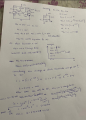
Yes, I made a mistake and i will update it.
One query i have, is it ok that one plate of the capacitor can be at one voltage say (V1) and the other plate at other voltage(V2) and the net voltage on capacitor will be (V1-V2). so, the circuit which maintains V1 and similarly the circuit which maintains V2 should not change instantaneously?
 

MrAl

Joined Jun 17, 2014
13,667
Yes, I made a mistake and i will update it.
One query i have, is it ok that one plate of the capacitor can be at one voltage say (V1) and the other plate at other voltage(V2) and the net voltage on capacitor will be (V1-V2). so, the circuit which maintains V1 and similarly the circuit which maintains V2 should not change instantaneously?
Hi again,

If you mean V1-V2 cannot change instantly, then yes, that is perfectly correct. I like to call that a differential voltage because it arises from two different voltages sources and we see that terminology elsewhere too. For the capacitor, we know that the voltage ACROSS the cap cannot change instantly, so the differential voltage across the cap, which is really just the capacitor voltage Vc itself, cannot change instantly simply because the voltage across the cap cannot change instantly,
This does not stop the TWO voltages V1 and V2 from BOTH changing however, at the same time.
If the cap voltage on the left side is 4v and on the right side is 1v, the cap voltage itself is 3v, and since that 3v cannot change instantly, if the left side quickly goes up by 2 volts then the right side will go up by 2 volts, That means for a very short time the left side will be 6v and the right side 3v. The difference 6-3 is still 3v. If there is a clamp in the circuit (like those proposed diodes) on the right side, then that voltage will be clamped to say 1v, and if that right side impedance is zero or near zero, then the voltage on the left side could never change instantly in such a way as to force the right side up by the same amount if it goes up by an amount greater than the clamp voltage. That means, in most cases, a series resistor would drop more voltage which limits the left side voltage as well.
Example:
Left side is 4v and right side is 0v, the cap voltage is 4v, and there is a series resistor on the left side and a voltage clamp that clamps to 1v on the right side. If the left side voltage beyond the resistor goes up so as to try to push the left side voltage of the cap up to 6v, then the right side would try to go up 2v to +2v, but the clamp will limit that to just 1v, so the left side will be clamped to 5v and will not be able to get to 6v, at least not instantly. So the voltage on the left side will go up to 5v instantly and the right side to 1v instantly, which maintains the cap voltage at 4v which does not change right away.

I hope that is clear I know it's a bit much to take in all at once. If you use a simulator we can set up a simple experiment to demonstrate this action clearly.


THIS NEXT PART IS JUST FOR REFERENCE IF YOU FEEL LIKE THINKING ABOUT IT (don't worry about this too much yet):

The case when say the right side is ground 0v, that means the capacitor voltage cannot change at all, unless by chance there was some non-zero impedance in series with the ground relative to where we tried to change the voltage from.

So the rule is if there is 0v solid on one side, then either side cannot change instantly. If there are other impedances in series with the cap on both leads, then the two sides can change instantly by the same amount, but the voltage across the cap cannot change instantly.

I mentioned the 0v with a possible series impedance because circuit boards usually have a small impedance from one grounded capacitor lead to the actual power supply ground, and that means the 0v lead of the cap could possibly be modulated by a small amount.
 
Last edited:
Top