Capacitor Charging with Pulses

Thread Starter

JulesP

Joined Dec 7, 2018
458
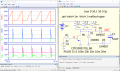
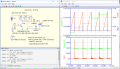
So here is the circuit alongside my sim attempt. I am not that familiar with Spice and need help with a few items, in particular how I add an accurate model to a basic MI MOSFET for the STW12N170K5 (N-channel), or a close equivalent. I think I have to add some code as a Spice directive from some source but don't know where to obtain that.
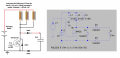
Circuit and Sim Design.png

D1 and D3 should really be IN4001s but again, I can only find the IN4007. Also, do I need to add inductance and resistance values to C1 which is made up of 4 x 15mF 80V low ESR capacitors wired in parallel and with a measured value of 53mF. It may also be appropriate to add some resistance between the Drain and the capacitor as a specific resistor - I estimate a few m.

The FET Gate is then fed by the PWM unit at 50Hz to produce 1.7kV flyback pulses at the Drain to charge the capacitor. My aim is to look at the sim currents and voltages and somehow derive the energy transferred and efficiency.

I would appreciate any help.
 

Bordodynov

Joined May 20, 2015
3,431
Thank you. I am having a go at a Spice sim design but have to refresh on how to add an accurate model to a basic M1 MOSFET design, and things like that. When I eventually get it sorted I will post it here. It will be later next week I reckon.
There is no exact model of the MOSFET. There are different degrees of approximation.
And what new information do you want to convey to others? To advance the theory?
As one smart person said: don't study physics and mathematics at school and the world around you will be filled with wonders.
 

Thread Starter

JulesP

Joined Dec 7, 2018
458
My research is into the effects of HV transients on secondary cells (Pb-Acid and LiFePO4) and I am using capacitors for a reference and a comparison. If you are really interested in that research then I might share the findings so far after I have sorted this issue.

I was under the impression that there were banks of sim models somewhere?

As for the quote - I am a physicist (radiation) and the world is still full of wonders! We have only got our heads around a portion of it all.:)
 

crutschow

Joined Mar 14, 2008
38,529
If you can't find a MOSFET model for the one you are using, then pick a MOSFET with a model that has data sheet parameters close to it.
On-resistance, and gate-charge are two that are important to closely match for a switching application.

Yes, you add all the inductor and capacitor parasitics as lumped values.
Note that one parameter not normally simulated (although it can be done if you search for that) is inductor saturation, so check that the simulated inductor currents are below the saturation current of the inductor you are using.

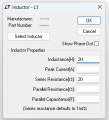
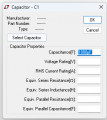
If you right-click on the part symbol, it will pop up a window were you can add the parasitic values (below):

1726937785290.png1726937812216.png
 

Thread Starter

JulesP

Joined Dec 7, 2018
458
Yes, I'm aware of where to put all the information but it's what and how much to put in that's a bit daunting. For example, I'm not clear where to get the parasitic values and the spec sheets are not available so far.
 

Bordodynov

Joined May 20, 2015
3,431
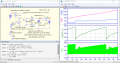
The scheme is not competent. A 1700 V high-voltage transistor is connected in parallel to a 50 V diode!? I do not have the transistor model shown and I took another transistor with similar parameters. The simulation shows that the parallel diode is breaking through. This breakdown limits the output voltage. Was that your goal? TestC.png
 

Thread Starter

JulesP

Joined Dec 7, 2018
458
You’re right, diode D1 should connect between the Gate and ground not the Source and Ground. The diode that is showing on the (incorrect LH circuit) is the internal ‘parasitic’ diode of the MOSFET itself. There are three external diodes. Now the sim should work. The actual circuit has worked well for the last four years.

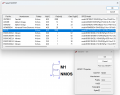
Is that FET model part of the in built options? There is no search facility in the ‘choose a FET’ box.
 

Bordodynov

Joined May 20, 2015
3,431
Some data needs to be clarified. Did you turn on three separate inductors each on its own core? Or is it three windings on one core? The inductors are precisely connected in parallel. The parameters of the control voltage are the magnitude of the amplitude and which source? What is its internal resistance (impedance). Where did the value of 910 mH come from? Is this a calculation or a measurement?
 

Thread Starter

JulesP

Joined Dec 7, 2018
458
The 80V capacitors charge very nicely with the 1600V spikes and when the cap voltage reaches about 40V they dump their charge and energy into a battery with an instantaneous current of about 100A (see trace insert on original diagram). The discharge frequency is typically 1 - 1.5Hz. That is what the VDS, (in the first post circuit and made up of a comparator and high-sided switches) does in the original circuit so I can see a series of charging waveforms and monitor battery effects. There’s nothing illiterate about that!

So the ‘how’ is straightforward, the ‘why’ is another matter and, as I said earlier, is a much broader question not suited to this conversation.

I have approached STMicroelectronics for a more accurate Spice model which I expect they have. When I have that I will update the circuit and post. As I’m not that ‘literate’ with Spice ‘parameter’ instructions, I will copy yours in an attempt to derive the relevant quantities.
 
Last edited:

Thread Starter

JulesP

Joined Dec 7, 2018
458
Some data needs to be clarified. Did you turn on three separate inductors each on its own core? Or is it three windings on one core? The inductors are precisely connected in parallel. The parameters of the control voltage are the magnitude of the amplitude and which source? What is its internal resistance (impedance). Where did the value of 910 mH come from? Is this a calculation or a measurement?
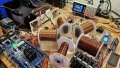
I think you would benefit from looking at the very first post where it is clear what the coil configuration is, i.e. three separate coils with ferrite cores connected in parallel (they formed part of a pulse motor arrangement). Maybe this pic will help clarify:

IMG_0037.jpeg
 

Thread Starter

JulesP

Joined Dec 7, 2018
458
Ok but the ‘cap dump’ frequency is not important and that part of the circuit only serves to repeat the charging cycle while I thinker with operating parameters for maximum capacitor response. The pulse PRF makes a big difference.

The important part is as you had earlier, showing the efficiency of energy transfer to the capacitor. I think the lower spike voltage you got is partly due to the only approximate model used for the active device, and also hysteresis and magnetic effects from the ferrite cores that are not modelled effectively yet.

It’s a pity that one can’t just enter custom values into the FET table.

If you remove S1 and the dump battery and see if you can get closer to the actual flyback voltage measured, that would be helpful while I wait for STM to get back to me.

The current passing through the output diode is miniscule so no issues there. As I mentioned earlier, if I copy your param statements, with the appropriate measurement nodes, then I should get the efficiency.

Modelling the magnetics in the three coils seems more challenging but must surely make a difference.
 

Thread Starter

JulesP

Joined Dec 7, 2018
458
Perhaps another reason why you didn’t see a similar ‘dump’ frequency was the min and max charging voltages, the points where the comparator in the switch opens and shuts? But then your codes used might have addressed that.
 

Bordodynov

Joined May 20, 2015
3,431
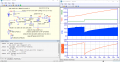
In this scheme, there is no need to use a 1700 V high-voltage transistor. It is quite enough to use a transistor at 80 V. Hysteresis will not accelerate the charge, but only increase losses. I tried to introduce core saturation, but it didn't help. I have set the trigger levels approximately as shown in your drawing.
x3.png
 

Thread Starter

JulesP

Joined Dec 7, 2018
458
Thanks, but that all depends upon what the aim is in using 1.7kV pulses, which is what has been used in other contexts with which I am making comparisons. That’s all I’m saying here as I’m not expending a large amount of time and energy explaining stuff not directly related to the query; it confuses the issue. If you are genuinely interested then it will have to wait till this query is fully resolved, and then elsewhere.
 
Last edited:
Top