Many many times Ian... the most recent IIRC was the guy who was most indignant to find out an 18Ah battery isn't... when discharged at 2 or 3x C-rate...
Thank you for your answers. I think i am missing something here. The energy storage will not be the same, i will use only one 12v 60ah car battery, 3 of them will be heavier and will cost higher. The same is valid for more powerful car battery right?
The guys beat me to it on the capacity front... but there is another advantage of increasing voltage/reducing current and that is reducing the peukert effect that is intrinsic to any given chemistry... basically more volts, less amps = less losses. Its why most E-bikes are 36 or 48v (and why 36v motors are cheap) and most e-cars are running at 300 - 400v... So you get more energy out of a higher voltage pack... and you don't lose the 10% conversion overhead.
3 x 12v 22Ah SLA weigh 19kg and take up 7000cc v a typical 12v 60Ah SLA at 21kg and 8300cc
But there is another trick you are missing... and that is changing battery chemistry...
A 36v 20Ah Li-Po E-bike pack will give you nearly 1.5x the actual run time, will weigh 4.5kg and has a volume of 1840cc, and it'll charge in 4h v 16+h
It will cost a little more up front, about 30-50% currently, but will last 10 years v 18months - 2y for the SLA, so overall cost of ownership is >50% cheaper...
Its an obvious choice for this application... and no boost converter needed....
Boosting 12V to 36V from single battery will require 3 times more amps than you need from 3 x 12V battery therefore you need 3 times more capacity. You can use 1/3 of the capacity batteries if you have 3 in series to achieve the same energy. Boosting the voltage up will eat 10% in conversion too... that's what the guys try to tell here...
Thank you for your answer. But the amp will be 3 times less. Input will be min 12V 60A output will be 36V 20A, neglecting the losses, in theory of course.
Yes you are, if you use 3 batteries in series, each can be 1/3 of the size. And, they would kast longer since you are not wasting any energy in conversion.
Gentlemen I think we are getting out of context here. The design parameters which i have given is 12V-60A to 36V 20A with perfect conditions. I am not allowed to change them since the battery will not be in our responsibility. And for the feedback and control purposes i need to design a boost converter, not simply attach 3 batteries together. I would use a 36V 20Ah li-po with a sensing circuit though, it is more logical, but it is not the design parameter.
Gentlemen I think we are getting out of context here. The design parameters which i have given is 12V-60A to 36V 20A with perfect conditions. I am not allowed to change them since the battery will not be in our responsibility. And for the feedback and control purposes i need to design a boost converter, not simply attach 3 batteries together. I would use a 36V 20Ah li-po with a sensing circuit though, it is more logical, but it is not the design parameter.
A 60A input current project is hard. Another approach is to use two supplies in parallel or four supplies in parallel. A 12V 15A to 36V 5A project is much easer. Then parallel 4 supplies.
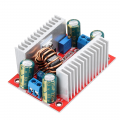
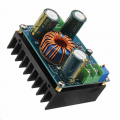
Here is a picture of a supply that can do 12 to 36V at 15 to 5A.
Look at what other people did.
A 60A input current project is hard. Another approach is to use two supplies in parallel or four supplies in parallel. A 12V 15A to 36V 5A project is much easer. Then parallel 4 supplies.
I will probably take feedbacks from output voltages and change mosfet's gate input duty cycles. Output will not be the same but they can be in equivalence.
Both... each supply will see the averaged joint-voltage and will adjust its output accordingly. If one is a higher voltage than the other due to transmission losses then it supplies more current which will cause its output to drop and other supplies will take up the load. Ideally the feedback sense input for all PSU will be tied to the same location at the load...
It's been spec'd piecemeal by management, not thought through as a system by those that know... so they go for profit and end up with something that won't be great... I can't imagine anyone specing a car battery as a power source these days... (except wheelchair manufacturers...) and then they'll realise the mistake and throw an expensive off-the-shelf lithium 'replacement' brick in there that fails miserably because its internal BMS is at loggerheads with the intended system operation....
ask me how I know.... no don't, its all too painful
It's been spec'd piecemeal by management, not thought through as a system by those that know... so they go for profit and end up with something that won't be great... I can't imagine anyone specing a car battery as a power source these days... (except wheelchair manufacturers...) and then they'll realise the mistake and throw an expensive off-the-shelf lithium 'replacement' brick in there that fails miserably because its internal BMS is at loggerheads with the intended system operation....
ask me how I know.... no don't, its all too painful
Thank you for your answers. With higher input currents design needs much higher saturation current in inductance at once. I searched lots of inductors in the current market with high stocks. Parallel converters with lower inductor current might be a cheaper solution then one with higher one. Same goes with the mosfets and diodes.That is why i will consider it.
Paralleling: Lets say there are four supplies. 36.0V, 36.1V, 36.2V, 36.3V. If the load is light and can be lifted by one supply the 36.3V one will be supplying the load. If the load is over what one supply can do, then it will be at 36.2V and one supply will be at current limit.
Option, Build one supply like normal. Build the next three with the input to the error amplifier at ground. This will cause the error amplifier to lift as high as it can. (almost any PWM but not the TL494) Most error amplifiers pull down strong but lift up poorly. Now wire all four error amp output pins together. Now all four PWM will run at the same current level. (same current if a current mode like the 3842 or same duty cycle like the voltage mode PWMs) This is common practice.

 Facebook
 Google
 GitHub
 Linkedin