Design of a Non-Inverting Synchronous Buck-Boost Converter

Thread Starter

Trisna

Joined Jun 30, 2025
1
Here's a detailed analysis of your non-inverting synchronous buck-boost converter design, translated into English for an international electronics forum.
Hello everyone,
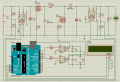
I'm a student currently working on my final project, which focuses on "Design of an Integrated Non-Inverting Synchronous Buck-Boost Converter with Incremental Conductance MPPT and PID Control." I'd appreciate your expert analysis of my buck-boost converter schematic, specifically regarding component placement, component values, and overall circuit performance.
Here are the specifications for the solar panel I'm using:
  1. Rated Max Power (Pmax): 100 W
  2. Open Circuit Voltage (Voc): 22.3 V
  3. Short Circuit Current (Isc): 5.82 A
  4. Current at Pmax: 5.49 A
  5. Voltage at Pmax: 18.2 V
  6. Normal Panel Temperature: -45°C ~ +80°C
  7. Maximum System Voltage: 700 V
  8. Max Series Fuse Rating: 10 A
  9. Number of Cells: 36
And here are the specifications for the Buck-Boost converter:
  1. Input Voltage: 0-18 V
  2. Output Voltage (Setpoint): 13.6 V
  3. Input Current: 0-5 A
  4. Output Current: 5 A
Further design constraints include: I'm using two TLP250 MOSFET drivers, one for the Buck stage and one for the Boost stage. If the input voltage (from the solar panel) is detected as less than 13.6 V, the converter switches to Boost mode and outputs a stable voltage of 13.6 V. Conversely, if the input voltage is detected as greater than 13.6 V, the converter switches to Buck mode and outputs a stable voltage of 13.6 V.
My questions are:
  1. Are my component selections suitable for designing a non-inverting synchronous buck-boost converter, based on your expertise?
  2. Are the configurations of my current sensors, voltage sensors, and particularly the TLP250 MOSFET drivers appropriate?
  3. I'm using an IRF9540N for the Buck mode MOSFET and an IRFZ44N for the Boost mode MOSFET. Are these suitable choices?
Thank you in advance for any input, suggestions, and critiques you can offer on my project.
Cuplikan layar 2025-06-30 225808.png
 

ronsimpson

Joined Oct 7, 2019
4,647
  1. Input Voltage: 0-18 V
It is hard to get any output when the input is 0V.

Q2 is being driven correctly.
Q3 is not right. The MOSFET is off then the G-S voltage is near zero. The MOSFET is on when the G-S voltage is negative some voltage, like 5V. You are driving the MOSFET with a 0 to 12V but the Source is at "0 to 18V".
I will say it another way, When the input is 18V, and the Gate driver puts out the max voltage of 12V, there will be 6V of turn on voltage for the MOSFET. It can not be turned off.

[quoate]
  1. Maximum System Voltage: 700 V
[/quote]
What?

U3, U4, what are they? I can't read the numbers.

Can you get the TLP250? I do not see any in production. I don't see a datasheet for it. It seems very slow. How fast are you switching? (frequency) It takes 500nS for the Gate Driver to turn on.
 
Last edited:

MisterBill2

Joined Jan 23, 2018
27,180
One caution is that in the simulation none of the connections include any resistance or inductance, nor is there any magnetic field interaction between any conductors. So when the simulation is working perfectly, the easy part is done. producing the product for the real world will be the challenge.
 

Ian0

Joined Aug 7, 2020
13,097
Generating the MOSFET drive signal using a microprocessor is not an easy task. Why do you think there are so many switched-mode controller ICs available?
 

ronsimpson

Joined Oct 7, 2019
4,647
Software power supplies:
I have been asked to "save" too many software power supplies. Most came from university projects. Just because your computer has a "PWM" output does not make it a power supply controller.
Some software has "soft PWM" that is done in code not in hardware. I have seen those go 100% duty cycle for a while. (or 0%) Very bad idea. It may not be clear, in the code, when you ask for a PWM you might get a soft or hard PWM.
A hardware PWM will at least remain working at the last duty cycle when the code is off doing something time critical.

Most software error amplifiers are designed by people that don't understand that an error amplifier does. Most I have seen are very slow in responding. They have problems with overshoot. When the line voltage or the load changes the amplifier does not respond well. I have seen cases when the computer is talking to the radio, the error amplifier code is not running. (radio=WiFi, Zigbee, serial, network, etc.) The error amplifier should not be abandoned when writing to EEPROM or to an LCD.

I find it very common for a 3.3V computer to directly connect to the Gate of a MOSFET that does not turn on well and responds slowly. The point of a "switch" in a switching power supply is to turn on & off very fast.

I am a hardware guy and don't trust software. When your 5V supply can make 0 to 12V it is likely you will kill all low voltage ICs sometime during testing. I had a project where any lightning strike with 1 Km would smoke the entire board. They spend good money on overvoltage protection. I proved over voltage was not the problem. The computer stopped working, causing the power supply to not regulate.
 

Ian0

Joined Aug 7, 2020
13,097
Software power supplies:
I have been asked to "save" too many software power supplies. Most came from university projects. Just because your computer has a "PWM" output does not make it a power supply controller.
Some software has "soft PWM" that is done in code not in hardware. I have seen those go 100% duty cycle for a while. (or 0%) Very bad idea. It may not be clear, in the code, when you ask for a PWM you might get a soft or hard PWM.
A hardware PWM will at least remain working at the last duty cycle when the code is off doing something time critical.

Most software error amplifiers are designed by people that don't understand that an error amplifier does. Most I have seen are very slow in responding. They have problems with overshoot. When the line voltage or the load changes the amplifier does not respond well. I have seen cases when the computer is talking to the radio, the error amplifier code is not running. (radio=WiFi, Zigbee, serial, network, etc.) The error amplifier should not be abandoned when writing to EEPROM or to an LCD.

I find it very common for a 3.3V computer to directly connect to the Gate of a MOSFET that does not turn on well and responds slowly. The point of a "switch" in a switching power supply is to turn on & off very fast.

I am a hardware guy and don't trust software. When your 5V supply can make 0 to 12V it is likely you will kill all low voltage ICs sometime during testing. I had a project where any lightning strike with 1 Km would smoke the entire board. They spend good money on overvoltage protection. I proved over voltage was not the problem. The computer stopped working, causing the power supply to not regulate.
An excellent summary.
For a switched mode supply to be stable, the phase response of the error amplifier has to be well controlled up the switching frequency. That needs a thorough understanding of DSP, Z-transforms and Bode's stability criteria, and a processor several orders of magnitude more capable than what is in an arduino. I've seen very few designers attempt a switched-mode supply in software with anything less than a TMS320.
 
Top