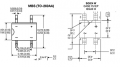
Bridge rectifier disaster

Tonyr1084

Joined Sep 24, 2015
9,744
Perhaps if they had half-moons at the side they might have stood out as being weird, prompting us to visit the datasheet.
It has long been my experience that when you hire an assembler - that's what they do - they assemble. When working for MacDonnell Douglas (Long Beach CA) on the commercial line, wing nacelle lights were 100% of the time wired incorrectly. The assemblers asked a very intuitive question: "Which wire goes on which screw?" (of the nacelle light {two terminals}). They were correctly told that it doesn't make a difference which wire goes on which screw. So the assemblers armed with the new found knowledge wired both hot and ground to the same screw. Every time I ran Exterior Lighting Function I had to open the nacelle and move the ground wire off the power wire. Otherwise it tripped the breaker every time.

Assemblers only do what they're told to do. They don't consult data sheets. Even if they did - would they know what they were reading? I could tell you TONS of stories of assemblers who didn't know what they were doing - only that they WERE doing. Most assemblers don't understand that when something deviates that it is a red flag. Some do. Some don't. The "Colleagues" mentioned might not have the same knowledge as someone who understands orientation of chips. Even then when you come across a half moon in an odd location - what do you do ? ? ? Some will ask, some will just assume that someone told them pin 1 is next to the half moon and end up installing it backwards. Of course this is all conjecture. But I've seen people too afraid to ask questions at the fear of looking like they don't belong doing the job. It happened long before I entered the manufacturing world, it went on all through my career, and it will go on for the rest of humanity. As long as there are humans assembling there will be human error.
 

MrAl

Joined Jun 17, 2014
13,707
It has long been my experience that when you hire an assembler - that's what they do - they assemble. When working for MacDonnell Douglas (Long Beach CA) on the commercial line, wing nacelle lights were 100% of the time wired incorrectly. The assemblers asked a very intuitive question: "Which wire goes on which screw?" (of the nacelle light {two terminals}). They were correctly told that it doesn't make a difference which wire goes on which screw. So the assemblers armed with the new found knowledge wired both hot and ground to the same screw. Every time I ran Exterior Lighting Function I had to open the nacelle and move the ground wire off the power wire. Otherwise it tripped the breaker every time.

Assemblers only do what they're told to do. They don't consult data sheets. Even if they did - would they know what they were reading? I could tell you TONS of stories of assemblers who didn't know what they were doing - only that they WERE doing. Most assemblers don't understand that when something deviates that it is a red flag. Some do. Some don't. The "Colleagues" mentioned might not have the same knowledge as someone who understands orientation of chips. Even then when you come across a half moon in an odd location - what do you do ? ? ? Some will ask, some will just assume that someone told them pin 1 is next to the half moon and end up installing it backwards. Of course this is all conjecture. But I've seen people too afraid to ask questions at the fear of looking like they don't belong doing the job. It happened long before I entered the manufacturing world, it went on all through my career, and it will go on for the rest of humanity. As long as there are humans assembling there will be human error.
Hi,

Oh yes assemblers just do what they are told to do, so tell them to look for another job :)

I've delt with assemblers a lot in the past. When wire wrap was still around, I had to show where each and every wire went. Wasn't that fun :)

The main thing here is that people interpret things differently when there is limited information. That requires a corrective action of some kind.
 

MrAl

Joined Jun 17, 2014
13,707
It would have been, but there was no half moon on the side. The datasheet says it is optional.
Hi,

I am just curious now, how did you get the old parts, and how did you get the new parts?
Did you order from a place online or two places online?
 

Tonyr1084

Joined Sep 24, 2015
9,744
When wire wrap was still around,
Yeah, I remember that. Got my hands on some failed wire wrap guns. Fixed them. Also got hands on scrapped wire spools. Don't think I ever did anything useful with that stuff.
Wouldn’t that be a corollary for Murphy’s Law?
If something can go wrong, it will?
More like making something idiot proof. Do that and someone will make a better idiot.
Half moon on side should be enough to say "hmmm, lets check the datasheet". No?
Yeah, unfortunately, some of the people I worked with in a place that does Defense Contract work was staffed with ranchers. Not actual "Ranchers" but people who worked on a ranch. Or in a dairy. I lovingly referred to them as "Cheese Herders."

One woman I recall vividly was doing wire harnesses all day long, day in - day out - - - week in - um - year out. She also had her radio constantly on some religious channel. You'd think with all that experience she'd know a thing or two. But no matter how hard you tried, she just didn't get it. I once spoke about her saying "Jesus couldn't teach that girl to crimp."

When it comes to "Common Sense" I define it this way: "Common sense is the level of sensibility common to your contemporaries. If your contemporaries are idiots - guess who you are." To me a phrase that would better fit is "Good sense". That's not common anymore.
 

DC_Kid

Joined Feb 25, 2008
1,242
It would have been, but there was no half moon on the side. The datasheet says it is optional.
Ahh, ok, so just the bevel, right? Or is the bevel also an optional "option", can it come w/o any indicator?

If you use the bevel as indicator, then it's the same pinout. Bevel side seems to be on the DC side of these packages. So if I align bevel the same orientation, the pinout is identical. That's from a package perspective.

If the datasheet shows pin numbers differently, then I think you can say the onsemi pin numbering is odd.

However, to install the onsemi rotated 180deg it would seem you would have to consult datasheet to find pin #1, but at that point I think you would also see that pin numbering appears to be rotated 180deg.

Is my assessment logically correct?


Yeah, unfortunately, some of the people I worked with in a place that does Defense Contract work was staffed with ranchers. Not actual "Ranchers" but people who worked on a ranch. Or in a dairy. I lovingly referred to them as "Cheese Herders."
Well, in this case the package did not have the half moon option indicator, it had the bevel. So if you are used to the bevel as an indicator then I think you would just install it the same way as other packages that had bevel, which would work electrcially since the bevel is the DC side and "pin4" is DC+.

I can see where the onsemi becomes an install issue if you quickly consult the dataeheet looking for pin1 and installed it from that, which would place the package 180deg from correct.

Hence why I am a bit baffled as to how the install confusion came about.
 
Last edited:

Tonyr1084

Joined Sep 24, 2015
9,744
In this case it appears the bevel side does not follow conventional practices. What I would have called pin 1 happily and consistently would have actually ended up being pin 4.
The datasheet says (the half moon) is optional.
This is unconventional, causing confusion. Some chips may have been manufactured backwards and failed QC. These faulty parts could have been auctioned off as “Good” chips. I’ve seen this with LED’s marked differently on Amazon. Testing revealed the cathode marking was on the anode side. It’s a possiblity this is the case.
 

DC_Kid

Joined Feb 25, 2008
1,242
In this case it appears the bevel side does not follow conventional practices. What I would have called pin 1 happily and consistently would have actually ended up being pin 4.
It's conventional from a "DC" side of the package. If you align the packages with bevel on same side, the pinout electrically is identical.

The pin numbering from datasheet may however be wonky.

They are the same from a bevel indicator view.
bridge.png
 
Last edited:

Jon Chandler

Joined Jun 12, 2008
1,597
Y'all are missing a key points. This is from a Vishey datasheet for this part:

Screenshot_20250127_083759_Edge.jpg

The polarity is marked on the case. This is what I have observed on EVERY bridge rectifier I have seen.

+


AC or ~

AC or ~


Screw pin 1. Mark the terminals in the silkscreen as above. Do not indicate pin 1, a half moon or bevel. Add an assembly note "Bridge rectifier polarity as shown on silkscreen."

Of course, I did mention this three pages ago.
 

Tonyr1084

Joined Sep 24, 2015
9,744
The polarity is marked on the case. This is what I have observed on EVERY bridge rectifier I have seen.
Yes.
But:
In an assembly process, the person looking at the tiny part looking for tiny plus signs and minus signs as well as the AC Tilda's ( ~ ) becomes so monotonous that it can easily be swapped around.

It was also shown via link to the conventional means of marking pin 1 on chips. Where one chip has pin 1 as the plus another chip has pin 1 as one of the AC inputs. See post #35.
 

DC_Kid

Joined Feb 25, 2008
1,242
The chip must have an indicator to orient it in assembly. The only way I see confusion is if the chip came with half moon on side. If there was no matching moon on board then I guess it's a referral to designer or datasheet, that's only if the assembly actually knew the pinout on the PCB.

Silkscreens typically have a moon shape to match the chip being used, sometimes a double line on side to indicate the bevel.

There's many scenarios where placing the dip/smd could go wrong.

Maybe asking for hard standards for packages is a better argument?
 

Thread Starter

Ian0

Joined Aug 7, 2020
13,132
It's conventional from a "DC" side of the package. If you align the packages with bevel on same side, the pinout electrically is identical.

The pin numbering from datasheet may however be wonky.

They are the same from a bevel indicator view.
View attachment 341350
If the chamfer marks the pin 1 side, then the half moon is in the wrong place. Whenever has anyone put the half-moon at the opposite end to pin 1.
 

DC_Kid

Joined Feb 25, 2008
1,242
If the chamfer marks the pin 1 side
I think the bevel indicates the DC side of the package, and not an indicator of pin numbering. From the traditional end-moon pin count (counter clockwise), pin3 seems to always be DC+ and pin4 DC-

The two packages are identical if you orient the bevel the same way on the PCB.

Beyond that (the half moon mid package, or a datasheet that numbers the pins "oddly"), two packages that are "not exactly" the same in terms of datasheets or optional indicators.

If there's no moon indicator, I would perhaps orient the IC's bevel side up and then call pin1 the lower left pin, pin2 lower right, and then hope the PCB has some sort of indicator on it for pin1. If in my logic the PCB had pin1 marked in upper left, then that should indicate a conflict between IC and PCB.
 

Tonyr1084

Joined Sep 24, 2015
9,744
U thus case, it appears to e meaningless.
That's the point.
The polarity marks ARE ALWAYS CORRECT
I agree. However, they can be quite small. Assemblers with poor eyesight might THINK they see a marking and orient it accordingly - or they might just not care, thinking 'It'll get caught in test.' But with AQL sampling it's rare that they find everything wrong. Things DO slip past.

Back in the 80's I worked a job where the test department typically tested one module every week. Something happened and the line got backed up. One day I got six modules all at once. As I looked over the test data I noticed a peculiarly common set of readings. Having all six test data sheets on my bench I looked closer. ALL SIX MODULES WERE TESTED THE EXACT SAME TIME - down to the minute, second and micro-second. Was then that I looked back at the sheets and found that ALL the test numbers were exactly alike. In other words, someone wasn't doing their job. The human factor at work.

The result was engineering decided to no longer require that test. I have no idea why that came about. Perhaps someone was in a hurry to get those modules out to the field. To prevent any further delay they may have decided to do away with the test data. Or maybe even the test.

You can't count on people unless you count on them to screw up or take shortcuts. Typically the bevel indicates the pin 1 side, starting left most and counting around the clock anti-clockwise. That's conventional. That's also why I wonder if maybe these are scrapped chips that someone bought wholesale and turned around and put them into the market. But that's all conjecture.

I have a FWBR chip that under 3X magnification I can BARELY see the + sign. And to see it I have to tilt it until it reveals itself.
 

Tonyr1084

Joined Sep 24, 2015
9,744
Just found a board with a MB10F chip. It's half moon is between + & -. As for finding the + & - - under 10X it wasn't easy.
[edit]
The device under discussion were bought from either RS, Farnell or Mouser.
Probably RS. If by RS you mean Radio Shack.
[end edit]
 
Top