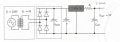
Hello. I need to design the circuit so that the output power is 1W, but I'm not sure what values to use for Rs and Cout. Could you explain how to calculate them?
To actually calculate them, you need more information that you have provided since the values depend on the interactions with other devices in the circuit.
Even then, there are (at least potentially) considerations that are specific to the internals of the IC you are using.
This is why the first place to start is the manufacturer's data sheet for that IC. What does it have to say about the capacitor values?
What is the purpose of Rs? Why might you want it to be anything other than zero ohms?
To actually calculate them, you need more information that you have provided since the values depend on the interactions with other devices in the circuit.
Even then, there are (at least potentially) considerations that are specific to the internals of the IC you are using.
This is why the first place to start is the manufacturer's data sheet for that IC. What does it have to say about the capacitor values?
What is the purpose of Rs? Why might you want it to be anything other than zero ohms?
Actually, I didn’t design this circuit myself; it’s a school assignment.
The purpose of this calculation is simply to determine the values of Rs and Cout so that the output power becomes 1W, so there isn’t a specific purpose behind it.
The output power depends on Vout and the output current value of 200 mA.
To achieve this, I’m not exactly sure what the value of Rs should be.
I just hope that Rs is a value that allows the output power to be 1W.
I think these values do not impose any constraints on Cout.
The output power depends on Vout and the output current value of 200 mA.
To achieve this, I’m not exactly sure what the value of Rs should be.
I just hope that Rs is a value that allows the output power to be 1W.
I think these values do not impose any constraints on Cout.
Hello. I need to design the circuit so that the output power is 1W, but I'm not sure what values to use for Rs and Cout. Could you explain how to calculate them?
This is an unusual question because the capacitor Cout only sees a DC voltage not a varying voltage where a capacitor is usually needed. You might have to ask about that.
You can start by writing a simple equation for the output power assuming you actually knew the output load resistor, call it maybe RL for example. The solution will then have both Rs and RL in it. You can only get a numerical solution though when RL is known, perhaps at a later date.
There is no need to calculate the load resistance. Yes, it needs to be a specific value, but there is no reason to ever calculate what that value happens to be.
I'm not sure about that now. If we know the current and the power in RLoad we can calculate the only possible RLoad, and once we know the RLoad we can calculate the required voltage across RLoad, then we can calculate the require Rs resistance.
I don't want to mention the 'range' of Rs though just yet
I updated by previous reply also.
I'm not sure about that now. If we know the current and the power in RLoad we can calculate the only possible RLoad, and once we know the RLoad we can calculate the required voltage across RLoad, then we can calculate the require Rs resistance.
I don't want to mention the 'range' of Rs though just yet
I updated by previous reply also.
The TS has stated that 1 W has to be delivered when the current is 200 mA.
Do you REALLY need to know what the load resistance is in order to figure out what the voltage Vout has to be in order to deliver 1 W when the current is 200 mA?
If you know what Vout is and you know what the current is and you know what the output of the 7805 regulator is (at least nominally), how hard is it to determine, by inspection, what the only possible value of Rs is?
I don't know that it's so much a trick question as a pointless one and one that likely indicates that the person that crafted it has never designed a circuit that had to work anywhere but on paper.
The TS has stated that 1 W has to be delivered when the current is 200 mA.
Do you REALLY need to know what the load resistance is in order to figure out what the voltage Vout has to be in order to deliver 1 W when the current is 200 mA?
If you know what Vout is and you know what the current is and you know what the output of the 7805 regulator is (at least nominally), how hard is it to determine, by inspection, what the only possible value of Rs is?
Oh yes you are of course 100 percent correct, but I think in the course of proving what the value of Rs should be, we have to do a little more math and that, I believe, should include actually calculating the value of Rs. It would end with a math statement like Rs=N where N was whatever the calculation came out to be resulting from the previous calculations.
Maybe we can say that what you are suggesting *is* enough proof though, that's a possibility I agree.
What is unusual though is the capacitor as it's a pure DC circuit. Could that have the same type of 'proof'.
Oh yes you are of course 100 percent correct, but I think in the course of proving what the value of Rs should be, we have to do a little more math and that, I believe, should include actually calculating the value of Rs. It would end with a math statement like Rs=N where N was whatever the calculation came out to be resulting from the previous calculations.
Maybe we can say that what you are suggesting *is* enough proof though, that's a possibility I agree.
What is unusual though is the capacitor as it's a pure DC circuit. Could that have the same type of 'proof'.
This is an unusual question because the capacitor Cout only sees a DC voltage not a varying voltage where a capacitor is usually needed. You might have to ask about that.
The data sheet will also point out that placing a capacitance there suggests adding a reversed bias diode across the regulator, to protect the regulator. Otherwise, if power is removed, the capacitor discharges back through the regulator and this can destroy it.
This is commonly overlooked and people get away with it but every 7805 data sheet I've seen mentions it.
The data sheet will also point out that placing a capacitance there suggests adding a reversed bias diode across the regulator, to protect the regulator. Otherwise, if power is removed, the capacitor discharges back through the regulator and this can destroy it.
This is commonly overlooked and people get away with it but every 7805 data sheet I've seen mentions it.
For someone with zero knowledge of electronics, the question is irrelevant.
For someone with introductory knowledge of electronics, the question is trivial, to the point of being pointless.
Where does the TS stand? Or what is the level of expertise of the instructor?
The data sheet will also point out that placing a capacitance there suggests adding a reversed bias diode across the regulator, to protect the regulator. Otherwise, if power is removed, the capacitor discharges back through the regulator and this can destroy it.
This is commonly overlooked and people get away with it but every 7805 data sheet I've seen mentions it.

 Facebook
 Google
 GitHub
 Linkedin