Is it necessary to calculate the LED resistor value.

Thread Starter

Techmaster31415

Joined May 30, 2024
14
Hi, when we are driving an LED the current limit resistors are needed. But is it necessary to calculate the exact value using these so-called LED resistor calculators? Is int it always best to drive them with a higher-value resistor like 1k or something?
 

Ya’akov

Joined Jan 27, 2019
10,226
This is a very strange question. The “so called” calculators are called so because they use Ohm’s Law to determine what value of resistor will result in the amount of current that lights the LED to the desired brightness.

Randomly selecting a resistor value is not better than properly calculating the correct one.

What makes you ask this?
 

Alec_t

Joined Sep 17, 2013
15,101
Satisfactory brightness of a LED is somewhat objective and depends on the environment. So the exact value of the resistor isn't critical. Too little current and the LED will be seen as dim. Too much and you burn out the LED.
The datasheet for the particular LED you have should tell you the maximum continuous and pulsed currents that the LED can handle.
 

Jerry-Hat-Trick

Joined Aug 31, 2022
775
I'm not sure what you mean by "so called LED resisistor calculators" but I'd urge you to get your head around doing the calculation yourself. Modern high brigtness LEDs are more than bright enough in most ambient light conditions at significantly lower currents than the maximum specified in datasheets.

The voltage drop across LEDs varies according to colour, from around 1.8V for red to 3.3V for blue and as long as the supply voltage is reasonably larger than the LED voltage drop then simply applying ohms law where the voltage across the resistor is the supply voltage minus the nominal LED voltage and the resistor value is that voltage divided by the current you want.

The voltage across the LED is nominal as it does increase with current through it - it's not a very sharp knee, which is why it's best to have a supply voltage at least a few volts more than the LED voltage. And when driving an LED from a processor watch out that you don't try to exceeed the current the processor can deliver. For example, I think the Arduino UNO R3 can drive 20mA but the R4 is limited to 8mA so a 220R resistor with an R3 is well safe but you'll need maybe 470R with the R4

You suggested 1K fits all is not a good idea. With a 24V supply you could be exceeding 20mA
 

WBahn

Joined Mar 31, 2012
32,702
Hi, when we are driving an LED the current limit resistors are needed. But is it necessary to calculate the exact value using these so-called LED resistor calculators? Is int it always best to drive them with a higher-value resistor like 1k or something?
You want to become familiar enough with why the resistors are there and what determines the ideal value for a given situation instead of just plugging some values into some online calculator and having it do your thinking for you. If you do that, you will quickly get a sense for "typical" resistor values that are in the ballpark for different situations and also for how close to the "ideal" value you need to be in order to be "good enough".

But, to answer your question, no, you can't just always go with "a higher-value resistor like 1k or something". In some cases that value will be too high and you will not get enough current to light up the LED enough for your purposes, while in other cases it would not be high enough and you will destroy the LED and possibly other things.
 

Thread Starter

Techmaster31415

Joined May 30, 2024
14
Hi, Thanks everyone for your input. I was not talking about selecting some random value. I was mentioning under-driving the LEDs. Most of the time the brightness is more than enough. For example, with a logic level of 5V if we drive a red LED with 1K, the LED will get a current of around 3.3mA, which gives more than enough brightness for most applications.
 

WBahn

Joined Mar 31, 2012
32,702
Hi, Thanks everyone for your input. I was not talking about selecting some random value. I was mentioning under-driving the LEDs. Most of the time the brightness is more than enough. For example, with a logic level of 5V if we drive a red LED with 1K, the LED will get a current of around 3.3mA, which gives more than enough brightness for most applications.
Except when it doesn't.

Or when it is too much.

Many LEDs today want no more than a fraction of a milliamp and driving three milliamps may be too much.

Other LEDs are intended to operate with hundreds of milliamps, or even more.

You example of a 5 V driving signal underscores the point that you can't come up with a specific resistor value that is a safe one-size-fits-all resistance for driving LEDs. What if you are using 3.3 V logic? What if you are using 12 V logic? What if you are driving you LED direct from 230 V mains?

There is nothing in your original question that precludes any of these situations.
 

MrAl

Joined Jun 17, 2014
13,667
Hi, Thanks everyone for your input. I was not talking about selecting some random value. I was mentioning under-driving the LEDs. Most of the time the brightness is more than enough. For example, with a logic level of 5V if we drive a red LED with 1K, the LED will get a current of around 3.3mA, which gives more than enough brightness for most applications.
Hi,

There are calculations for just about everything and they are created for a good reason. The current for an LED is just one out of many. We need these in order to get a component value to meet the application demands, and that may involve several factors.
Consider calculating the half life of some LED. It's a calculation that can give you some idea how long the LED will last and still have a reasonable brightness. Without that we might overdrive the LED by accident.

The kind of calculation you are talking about is there just so you can get some idea what you are dealing with. I know it seems arbitrary because if you calculate one value on the web it may seem to high or too low because your application demands some different value, or can work with some different value. If that's the case, it just means that there is another factor in the problem that you did not yet consider, or just simply overlooked it.

Your example with 3ma while some calculators will tell you 10ma or 20ma is a good one I think. You see 10 or 20 yet you believe something close to 3 would be good enough, therefore you conclude that the calculator is bogus. Well, that's true to a certain point. The calculator may be assuming something that the designer of the calculator did not take into account, like actual brightness. If you do not need full brightness, you can lower the current quite a bit with the newer high brightness LEDs. That means a higher value resistor like you quoted, 1k. The calculator might tell you 330 Ohms, but for longer life 1k will be better as long as the brightness is acceptable for your application.

If a calculator does not give you a value that does not seem right you have to investigate the problem a little deeper, which is just what you did, and you are now getting answers that will help you get past this issue.

Just to note, I've driven LED's at very low current, like maybe 100ua, and not only that, maybe only turn them on once every 10 minutes for a very short time like 50ms or so. That's in an application that needs to have the batteries last a long time and the indication the LED is giving the user does not have to provide constant feedback to the user, once every 10 minutes is ok.
In contrast, another application I had driven them at 5ma because it was powered from a wall wart and it was good to show the status of a battery charger constantly.

So there we have two applications both using (perhaps) the same LED, yet for each application the LED was driven not only with much lower current, but also for a much shorter time. This would put many calculators out of business, and this is why careful consideration of the application is an important facet of the design process.
 

dl324

Joined Mar 30, 2015
18,216
For example, with a logic level of 5V if we drive a red LED with 1K, the LED will get a current of around 3.3mA, which gives more than enough brightness for most applications.
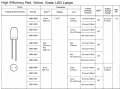
There are different categories of brightness for LEDs. Old LEDs from the 1970's had brightnesses of less than 20 mcd at 20mA.
1718375815812.png

This is for a relatively recent yellow LED:
1718375559123.png
1718375574406.png
You can see that even for a "standard" brightness LED, there's a fairly wide range of brightness.

Data for an early blue LED:
1718375674923.png

The high brightness/ultrabright LEDs are so bright that it hurts my eyes to look at them.
 
Top