Bridge rectifier disaster

Thread Starter

Ian0

Joined Aug 7, 2020
13,097
The MB6S is a useful little 800mA bridge rectifier in a 4-pin surface mount package. I use quite a few of them, but I was beginning to wonder why my colleague has a hard time getting them on the pcb the right way round, especially as if I switch in the power without noticing it is wrong, it blows a track off the board.
Then I looked at the datasheet:
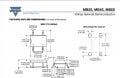
F0DA20CC-85A9-4D72-92EC-795E99395950.jpeg
Vishay: Pins 1 and 2 are the AC input pins.
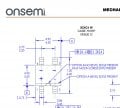
8A76C2A1-E57D-4F28-AF02-8B009D9BECFB.jpeg
OnSemi: Pins 1 and 2 are the output pins.
 

WBahn

Joined Mar 31, 2012
32,703
I don't recall ever seeing the half-moon pin-1 marker placed in that location.

I can certainly see how the discrepancy between those two parts is a recipe for disaster.

Who originated that line of rectifiers?
 

MisterBill2

Joined Jan 23, 2018
27,175
What you see is the opposite of following a standard: It is very intentionally making products non-interchangeable. Previously it was the multitude of different coaxial power connectors, the the spread of other types, At which point embedded logic keeps preventing interchanging 19 volt computer supplies.
And it is not possible, usually, to swap battery packs between brands of power tools.
 

Thread Starter

Ian0

Joined Aug 7, 2020
13,097
I don't know where they originally came from.
I surveyed the rest of the manufactures on Mouser:
Diodes inc. and Taiwan Semiconductor: No indication of pin 1, but DC pins are labelled + and - (that's no help if you are in the habit of labelling the pcb as to which is pin 1)
Diotec: Pin 1 is DC+
Micro Commercial Components: Pin1 is AC
 

AnalogKid

Joined Aug 1, 2013
12,043
What you see is the opposite of following a standard: It is very intentionally making products non-interchangeable.
They are interchangeable. Rotate 180.

Check the datasheets to see if they have the same electrical orientation in an SMT reel. If yes, then there is no real (!) problem. The robots don't care about pin 1 designators.

Links to both datasheets - ?

ak
 
Last edited:

MrAl

Joined Jun 17, 2014
13,667
The MB6S is a useful little 800mA bridge rectifier in a 4-pin surface mount package. I use quite a few of them, but I was beginning to wonder why my colleague has a hard time getting them on the pcb the right way round, especially as if I switch in the power without noticing it is wrong, it blows a track off the board.
Then I looked at the datasheet:
View attachment 341089
Vishay: Pins 1 and 2 are the AC input pins.
View attachment 341090
OnSemi: Pins 1 and 2 are the output pins.
Hi,

Refer to the attachment.
What I see right away here is that the two packages have a different identification number. When we see that with parts with different package outlines it usually doesn't matter that they do the same thing. What matters most is that we look at the data sheet and find out where the pins are relative to the various markings. This has been the case for a long time now.
There are some standards for some parts, but there's no guarantee. The data sheet tells the story.

If we look at the attachment, in the top diagram we can see the difference. Each part has an entirely different part number and package type. If we look at the bottom illustration, we can also see that if they did not number the pins, we probably would not even question it. It's just another package marking that's all.
In fact, if we saw the second package (blue) and did not know the first package existed, we probably would not even think to question it.

The real problems come in when they use the same part number and package style for the same part that has a different pinout. I've seen this cause big problems because some of the PC boards get made with a part that has perhaps input and output pins actually swapped. There's no way to know (I don't think) without looking at the new data sheet, and I am not sure if there is any warning beforehand.

So maybe we see this as a problem because we just happened to look at two different packages and started to make a comparison. If we think about comparing a 7805 IC to a 7905 IC we might be tempted to say the same thing, but then why would we be comparing these two pinouts. One reason might be because we thought that they should be the same especially since the package types are the same (both TO220 or both TO3 or whatever they both are). I actually witnessed this problem in real life one time a long time ago. The designer thought that the two packages should have similar pinouts but of course they did not.
 

Attachments

AnalogKid

Joined Aug 1, 2013
12,043
Rotating 180 degrees probably works OK for you or me on our bench. But it might not work so well if sending 100 boards out to a contract assembler.
A CMS will use only parts that the customer supplies or approves. That approval includes limiting the acceptable component sources and substitutions, and part-specific assembly instructions such as rotation.

ak
 

Tonyr1084

Joined Sep 24, 2015
9,744
The MB6S is a useful little 800mA bridge rectifier in a 4-pin surface mount package. I use quite a few of them, but I was beginning to wonder why my colleague has a hard time getting them on the pcb the right way round, especially as if I switch in the power without noticing it is wrong, it blows a track off the board.
In the manufacturing world a customer approved BOM (Bill Of Materials) will specify what chip to use. Along with that the manufacturer will (or should know) which way around to place the chip. Automated PnP (Pick and Place) robots will pick up a chip from the spool and insert it in a particular orientation. IF there's a parts change - one that results in the orientation being changed - that notification must be pre-approved by the customer. If the customer approved the change in parts then the machinery should be reprogrammed to install it correctly oriented. IF they are using both style parts in a mixed bag then all bets are off. Whomever decided to mix & match the parts would be responsible.
However, you don't mention manufacturing. You mention:
I was beginning to wonder why my colleague has a hard time getting them on the pcb the right way round.
As a hobbiest, it falls upon me to make sure the parts I use and orient are used correctly. Nobody can say why your colleagues have a hard time getting them on the right way around. Getting it right versus getting it wrong is a reflection of how much attention each of us pays to our craft.

Which are we discussing? Manufacturing or hobby builds?
 

ElectricSpidey

Joined Dec 2, 2017
3,312
Sounds like a viable solution to me, at least as far as checking the datasheets for proper placement, certainly in the case where the parts are not a drop-in replacement.
 

Thread Starter

Ian0

Joined Aug 7, 2020
13,097
I am a tad confused.
I see two pics, one is a TO-269AA and the other is a 751EP.
So I guess it matters which one you buy?
Check the dimensions - they are two names for the same thing. Just like SC74 is the same as SOT26 which is the same as SOT457 which is the same as TSOP6
 

Thread Starter

Ian0

Joined Aug 7, 2020
13,097
In the manufacturing world a customer approved BOM (Bill Of Materials) will specify what chip to use. Along with that the manufacturer will (or should know) which way around to place the chip. Automated PnP (Pick and Place) robots will pick up a chip from the spool and insert it in a particular orientation. IF there's a parts change - one that results in the orientation being changed - that notification must be pre-approved by the customer. If the customer approved the change in parts then the machinery should be reprogrammed to install it correctly oriented. IF they are using both style parts in a mixed bag then all bets are off. Whomever decided to mix & match the parts would be responsible.
However, you don't mention manufacturing. You mention:

As a hobbiest, it falls upon me to make sure the parts I use and orient are used correctly. Nobody can say why your colleagues have a hard time getting them on the right way around. Getting it right versus getting it wrong is a reflection of how much attention each of us pays to our craft.

Which are we discussing? Manufacturing or hobby builds?
It is commercial, and it is a board which is assembled on the manual P&P machine because it is only used in small quantities.
The pcb legend is drawn with a half-moon at the pin 1 end, because KiCad's "line next to pin 1" is too easy to miss. My colleague assembles the boards with the pin 1 on the IC to match pin 1 on the legend, so the OnSemi part gets assembled the right way round and the Vishay gets reversed. The are both MB6S bridge rectifiers. I would never have expected to buy a generic part (it is made by at least 6 manufacturers) and find that they don't all use the same pinout.

The datasheets don't say how the parts are packaged in tape and reel. If I were to send the board I could find that one manufacturer puts them in the opposite way round to the others.
 
Top