The paralell RC in line before the bridge rectifier.

Thread Starter

000G

Joined Jan 23, 2026
17
Hi community,

I hope you are well, I have a problem of understanding the reason of why there are parallel RC circuit before the bridge, figure 1. And why also upside there are 2 capacitor, 2 resistors whereas at the downside there are just 2 resistors.
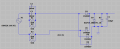
1775743692880.pngFigure 1: The design of the system.

And my second question is, when I first designed this circuit, figure 2, this gave me nothing, as long as when I put a resistor whether upside or downside doesn't matter, this AC was rectified, figure 3.

1775743897618.pngFigure 2: The first design.

1775743860774.png Figure 3: At this design, the input is rectified.
 

Thread Starter

000G

Joined Jan 23, 2026
17
hi 0G,

I hope you are aware that these non-isolated mains rectifier circuits are potentially lethal?

E
Yeah, I also thought about this. But what should I do then to make a 220V AC to 100V DC, about 1000W at the output
 

wayneh

Joined Sep 9, 2010
18,090
Where did the fig. 1 circuit come from?
About the only thing I can think of is that the upstream RC components are there to limit current, and to dissipate heat over more components. It looks like a hack to me.

Your figure 2 issue may be an artifact of the simulation. Try placing a small load on the DC side.

Are those two zeners able to handle the current they will see if you are in fact passing 10A to the DC load? C1 is far too small to have any significant effect on the ripple seen by the 10A load. It actually increases the AC load.
 
Last edited:

panic mode

Joined Oct 10, 2011
4,871
at 100V, 1000W load draws 10A.
its internal resistance is 100V/10A=10 Ohm.

having 10k in series 10 Ohm forms voltage divider. so to get 100V output, supply would need to be 100000V. note that getting near it has its challenges.

suppose you change that 10k for 12 Ohm.
then your circuit would be 12 Ohm + 10 Ohm from the load =22 Ohm. 220VAC/22 Ohm = 10A.
but there is a rub. this 12 Ohm resistor is radiating a lot of heat (1200W), although in grand scheme of things this is ... usable...

you would want to use transformer.
 

wayneh

Joined Sep 9, 2010
18,090
Agreed. There are other ways, but they are orders of magnitude more difficult. For instance you can rectify to peak AC voltage and then chop that DC voltage to feed a transformer, which can be a lot smaller due to the higher frequency, and then rectify the transformer's AC output back to DC. A feedback circuit is used to control the chopper in response to the output DC voltage.
 

MrAl

Joined Jun 17, 2014
13,671
Hi community,

I hope you are well, I have a problem of understanding the reason of why there are parallel RC circuit before the bridge, figure 1. And why also upside there are 2 capacitor, 2 resistors whereas at the downside there are just 2 resistors.
View attachment 365782Figure 1: The design of the system.

And my second question is, when I first designed this circuit, figure 2, this gave me nothing, as long as when I put a resistor whether upside or downside doesn't matter, this AC was rectified, figure 3.
View attachment 365784Figure 2: The first design.

View attachment 365783 Figure 3: At this design, the input is rectified.
Hello there,

As others have said, you have to be very careful when dealing with mains voltages like 120vac and 230vac. That's because if you make one mistake you can get a really bad shock that can actually kill you. This has happened numerous times in the past.
They say when measuring voltages you keep one hand in your pocket too, and don't stand on wet ground or even on ground at all outside.

That said, we can make some sense of that first circuit I think.
It looks like a low power transformerless power supply that would typically be used for an LED that was completely enclosed so you don't ever get a shock. It's also been used to power microcontrollers but again the package completely encloses the circuit so nobody can get a deadly shock.

The main idea is that the capacitor(s) on the input reduces the voltage without consuming very much power and so you get a voltage drop at somewhat high efficiency, but it is much higher than using just resistors.
The resistors also limit the voltage and current that can get to the output which helps during operation and especially when the circuit is first plugged in. The surge current can be very high when plugged in, but with the resistors it limits that surge current. The caps cannot do that very well, they mainly limit the output voltage.

The main design point is to set the cap value(s) so that enough current and voltage can reach the output but without damaging the zener or other parts on the output. This is mainly for low power (maybe 5 watts max) but more typically maybe 200mw or even less. That is because getting very high power like say 100 watts would require a capacitor(s) that is most likely too high in value and too big.
For example, with 230vac 50Hz input and 11.5vac output at 100 watts, the capacitor would be about 120uf or so. Now that's not that big for DC filtering, but for AC that's kind of big.
For the same output at 1000 watts, the cap would be about ten times that, about 1205uf which is very large for an AC rated capacitor.

For that kind of power normally a transformer is used. That's the simplest although heavy.
Alternately, a frequency converter that takes AC input, converts that to DC, then back to AC at reduced (or increased) voltage. It's lighter in weight than a transformer but more complicated in design.
There's also the motor/generator or motor/alternator approach, but that's partly mechanical and subject to earlier breakdown. Probably the least favorite for modern design.
 
Top