Battery Paralell Wiring variation - will it work ?

Thread Starter

SouthEastRay

Joined Nov 29, 2022
20
I have 2 x 12 volt batteries in a container, currently wired in Series to produce 24 volts.
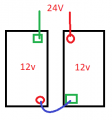
BatterySeries.png

For other Projects , it would be handy to revert back to 12 volts (Parallel) .
Ordinarily, I would expect to wire a 12 V (Parallel) version like this
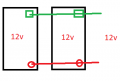
Battery12vParalellNormal.png

My questions

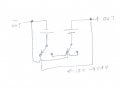
(1) is, could I just leave the batteries in place to get Parallel 12 volts, by wiring them like this, and use them as a 12v source ?
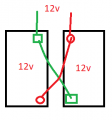
Battery12vParalellVary.png
(2) , could I recharge both batteries at once with a 12v charger, in either of the Parallel wiring variations ?

Any thoughts or comments greatly appreciated.
 
Last edited:
MisterBill2

Joined Jan 23, 2018
27,186
the suitability of Connecting batteries in parallel depends on both the type of batteries and the condition of the batteries. Sp the very short answer is "It Depends".
Some battery chemistries work better than others for parallel operation.
 

Tonyr1084

Joined Sep 24, 2015
9,744
That looks a little like OverKill.

The single most important factor is how much amperage COULD flow through the switch. If they are relatively small 12V batteries, say something like 7Ah with a dead short current of 105A Max Discharge Current (5 sec.) such as THIS ONE (see data sheet attached) will need to be handleable by the switch. Unless you use a fuse to limit the current to (say) 10 amps, then you need a switch that can handle 10 amps. I'd recommend a switch that can handle 15 amps with a 10 amp fuse. That way you don't burn the contacts or experience arcing inside the switch.

If you're using it to switch substantially higher current then the switch will need to be robust enough to handle the current. And just because a switch claims it can handle X amps at some AC voltage - that does not mean it can handle the same amperage running on DC. There's a world of trouble you can get into by selecting the wrong switch. Ask about that some time.
 

Attachments

BobTPH

Joined Jun 5, 2013
11,463
I have 2 x 12 volt batteries in a container, currently wired in Series to produce 24 volts.

View attachment 313134

For other Projects , it would be handy to revert back to 12 volts (Parallel) .
Ordinarily, I would expect to wire a 12 V (Parallel) version like this

View attachment 313135

My questions

(1) is, could I just leave the batteries in place to get Parallel 12 volts, by wiring them like this, and use them as a 12v source ?
View attachment 313136
(2) , could I recharge both batteries at once with a 12v charger, in either of the Parallel wiring variations ?

Any thoughts or comments greatly appreciated.
Th two parallel arrangements are the same, The relative orientation of the batteries is not of any consequence as long as each pair if like terminals are connected together.
 

nsaspook

Joined Aug 27, 2009
16,251
Th two parallel arrangements are the same, The relative orientation of the batteries is not of any consequence as long as each pair if like terminals are connected together.
#2 is better (as a model of wiring lengths and connections) for long term usage of parallel batteries because it equalizes connection voltage drops and current flows during repeated charge/discharge cycles.
 
Last edited:

MisterBill2

Joined Jan 23, 2018
27,186
In several instances I have seen the two batteries stuck quite well with double sided foam tape. It appeared that the UPS was to be "serviced as an assembly" when the batteries failed.
 

Thread Starter

SouthEastRay

Joined Nov 29, 2022
20
Just for future reference, I came across what seems to be the definitive answer to my question

BatteryWiring.png

I found it in this video, very well explained
 

WBahn

Joined Mar 31, 2012
32,706
Charging batteries in parallel is generally not a problem, provided the batteries are compatible in terms of terminal voltages. The higher capacity batteries will simply consume more of the current. The same is generally true for using them as a power source in parallel -- they will each drain in proportion to their capacities.

Where things can go sideways is that the different batteries will generally not heat up at the same rate, and having batteries at different temperatures can cause problems, ranging from inefficiencies to fire/explosion hazards if not managed well, depending on the battery technology involved.

This is not the case if you try to charge them in series -- there it is much more important that both batteries be of the same type and at the same level of discharge, unless you have some kind of balancing circuit in play (in which case they aren't really being charged in series). In theory, if you start out with two completely different batteries in series, you can draw current from them and then recharge them in series because you are always removing the same amount of charge from both and always putting the same amount back. You effective capacity is then limited to that of the battery with the lowest capacity. Looks fine on paper, but in the real world the two batteries will drift apart over time, causing problems down the road.

Another issue that you need to consider, particularly with batteries that are capable of delivering substantial currents, is that when you switch from a series connection to a parallel connection, you can get significant current flow (and hence heating and the good, old fire/explosion concerns) if the terminal voltages aren't very close to the same.
 
Yes, connecting two 12-volt batteries in parallel like that effectively creates a 12-volt source with increased capacity. You can charge both batteries simultaneously with a 12-volt charger when they are connected in parallel. This setup allows for balanced charging and discharging between the two batteries. Just ensure that the charger you use is suitable for charging both batteries in parallel.
 

MisterBill2

Joined Jan 23, 2018
27,186
When connecting new high capacity wet cells in parallel the manufacturer suggests matching voltages of the new batteries prior to connecting. Within about ten millivolts is what is reasonable to achieve.
 
Top