Facebook
 Google
 GitHub
 Linkedin

This thread is for those who might be interested in the topic.
I recently started looking into Li-ion 1.5V AA rechargeable batteries as a replacement for NiMH types when I found some that had a comparable cost (frugal person that I am).
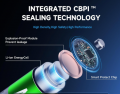
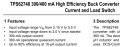
These have an internal Li-ion battery of typically about 3.7V, which is then dropped to a regulated 1.5V output by an internal buck switching regulator to be more compatible in devices that are designed for the 1.5V nominal of an alkaline primary cell as compared to the 1.2V of an NiMH.
Their Ah rating is generally comparable or slightly better than NiMH, but their Wh rating is significantly greater (close to the 3-4 Wh of alkaline) due to their higher constant-voltage output, (which may or may not be significant in use, depending upon the device being powered).
They are also rated for more lifetime charge-discharge cycles (2 to 3 times). Of course that's only really significant if the battery is used in a high power application where it frequently needs to be recharged (of which I have none).
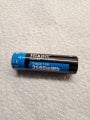
So I ordered the ones below from amazon to try them out.
They seem rather cheap so I'm interested in seeing if they work well, or if some of the other brands cost more for a good reason.
One difference is that these batteries don't have a USB-C charge-port as many of the others do, as they use the included charging station instead, and thus don't need a multi-plug USB cable to charge more than one battery at a time.
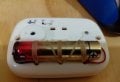
Another possible advantage of not having that charge port is it gives a little more room for the Li-ion battery inside the package.
I suppose not having that socket in each battery would reduce the cost some, but not necessarily enough to account for the significant difference in price between brands.
A primary reason for my buying them (besides curiosity) is that I have an electronic front-door lock using four AA batteries that stops working at about a 1.2V/battery voltage since it is designed for 1.5V alkalines, thus NiMH's only last a few months (they start at slightly over 1.3V when fully charged but then drop to 1.2V well before their typical discharged voltage of about 1V).
Hopefully these Li-ion's, which maintain a constant 1.5V output until discharged, will last longer in that application (at least comparable to the alkalines).
So I'll report back here with my experience with them as I put them to use.
Cheers.
I recently started looking into Li-ion 1.5V AA rechargeable batteries as a replacement for NiMH types when I found some that had a comparable cost (frugal person that I am).
These have an internal Li-ion battery of typically about 3.7V, which is then dropped to a regulated 1.5V output by an internal buck switching regulator to be more compatible in devices that are designed for the 1.5V nominal of an alkaline primary cell as compared to the 1.2V of an NiMH.
Their Ah rating is generally comparable or slightly better than NiMH, but their Wh rating is significantly greater (close to the 3-4 Wh of alkaline) due to their higher constant-voltage output, (which may or may not be significant in use, depending upon the device being powered).
They are also rated for more lifetime charge-discharge cycles (2 to 3 times). Of course that's only really significant if the battery is used in a high power application where it frequently needs to be recharged (of which I have none).
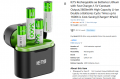
So I ordered the ones below from amazon to try them out.
They seem rather cheap so I'm interested in seeing if they work well, or if some of the other brands cost more for a good reason.
One difference is that these batteries don't have a USB-C charge-port as many of the others do, as they use the included charging station instead, and thus don't need a multi-plug USB cable to charge more than one battery at a time.
Another possible advantage of not having that charge port is it gives a little more room for the Li-ion battery inside the package.
I suppose not having that socket in each battery would reduce the cost some, but not necessarily enough to account for the significant difference in price between brands.
A primary reason for my buying them (besides curiosity) is that I have an electronic front-door lock using four AA batteries that stops working at about a 1.2V/battery voltage since it is designed for 1.5V alkalines, thus NiMH's only last a few months (they start at slightly over 1.3V when fully charged but then drop to 1.2V well before their typical discharged voltage of about 1V).
Hopefully these Li-ion's, which maintain a constant 1.5V output until discharged, will last longer in that application (at least comparable to the alkalines).
So I'll report back here with my experience with them as I put them to use.
Cheers.
Last edited: