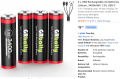
1.5V AA Li-ion Rechargeable Battery Discussion

Irving

Joined Jan 30, 2016
5,195
One downside of these, if the device using them has battery level monitoring, it will no longer work. They either give 1.5v or give up.
I've not found this an issue with my Danfoss TRVs. On alkaline batteries they show 100% for a few weeks, then 40% for several more, then 0% for at least another 8 - 10 weeks, sometimes longer. The actual endpoint is when the temp regulation goes to pot. So having it show 100% most of the time and 0% when actually dead is a bit of a revelation!
 

JohnSan

Joined Sep 15, 2018
130
I've not found this an issue with my Danfoss TRVs. On alkaline batteries they show 100% for a few weeks, then 40% for several more, then 0% for at least another 8 - 10 weeks, sometimes longer. The actual endpoint is when the temp regulation goes to pot. So having it show 100% most of the time and 0% when actually dead is a bit of a revelation!
Maybe the Drayton Wiser iTRV's in use here have better battery monitoring.
Using alkaline batteries, they drop from 100% in 20% steps. At least one device was still showing 20% at 12 months. So, still working, but really needed replacements.

Using the Lipo type, it's either 100% or no communication. So you don't even get to see 0%..... :)
 
Maybe the Drayton Wiser iTRV's in use here have better battery monitoring.
Using alkaline batteries, they drop from 100% in 20% steps. At least one device was still showing 20% at 12 months. So, still working, but really needed replacements.

Using the Lipo type, it's either 100% or no communication. So you don't even get to see 0%..... :)
Did you ever try to pry open the dead ones to see what is the voltage reading from the cell itself (before the module)? Maybe charging them a bit directly will bring them back to life. If there is a tiny module as shown in post #8, the protection chip shuts down the battery to protect it from dropping lower, but it makes the battery useless. It is not uncommon to overlook these scenarios in today's world designing
 

Ya’akov

Joined Jan 27, 2019
10,274
Received the Li-ion cells shown in my first post.
Using my free Harbor Freight multimeter, they all measured slightly over 1.5V after being charged.
Installed them last night in my front-door SimpliSafe electronic lock where they seem to be working fine, operating its internal motor to open and close the dead-bolt remotely, which likely takes about an ampere peak (typically these 1.5V Li-ion cells have a 2A average current rating with a peak of 3A).

Now, nothing much left to do but wait to see how long they last in this low (average) power application. :cool:
You might want to consider primary lithium cells (Lithium/Iron Disulfide, Li/FeS₂). While they are more expensive than Alkaline chemistry cells, their much greater capacity, low self discharge, and superior low temperature tolerance make then well worth the differential if your application benefits from it.

The Energizer L91 is a good choice. Given the potential lifetime of inexpensive secondary Li cells, particularly when exposed to heat, the cost of Li/FeS₂ cells may actually be lower.

Energizer L91 Datasheet
Energizer Lithium/Iron Disulfide Handbook
Energizer L91 on Amazon
 

Thread Starter

crutschow

Joined Mar 14, 2008
38,627
You might want to consider primary lithium cells (Lithium/Iron Disulfide, Li/FeS₂). While they are more expensive than Alkaline chemistry cells, their much greater capacity,
Don't know your definition of "much" but the L91 has perhaps 15-20% higher Ah capacity than a good alkaline, and at over $2/ea, are definitely not cost effective for any of my primary cell applications.
As noted, I am interested in rechargeable cells to avoid having to periodically dispose of dead primary cells.
And heat/cold is not of concern, since all my applications are inside my house.
 

Ya’akov

Joined Jan 27, 2019
10,274
Don't know your definition of "much" but the L91 has perhaps 15-20% higher Ah capacity than a good alkaline, and at over $2/ea, are definitely not cost effective for any of my primary cell applications.
As noted, I am interested in rechargeable cells to avoid having to periodically dispose of dead primary cells.
And heat/cold is not of concern, since all my applications are inside my house.
The capacity is heavily dependent on both temperature and discharge rate.
1779748302042.png

They also have a 25 year shelf life.
 

Thread Starter

crutschow

Joined Mar 14, 2008
38,627
The capacity is heavily dependent on both temperature and discharge rate.
True.
But nearly all my applications are very low drain, in a temperature controlled room ambient.
The only application where I've used the L91's is in my outside weather station electronics, where I have to go up on the roof for their replacement.
Edit: Remarkably, they are now going on 6 years without being changed.
 
Last edited:

Thread Starter

crutschow

Joined Mar 14, 2008
38,627
How often do you use it?
Not often, perhaps a few times per month, since I mostly go through the garage door, so the drain is mainly from the lock's RF electronic's quiescent current and the self-discharge of the batteries.
The quiescent current discharged standard alkalines in about a year.
 
Last edited:
Top