Wall Clock Power Source using C945 Transistor

Thread Starter

MkenyaMmoja

Joined Jan 23, 2025
1
I'm trying to build a rechargeable system for my wall clock. I need it to output 1.5V from a li-ion cell.

I am using a C945 NPN transistor because that is what I can find. Unfortunately, there is no output at the Emitter. What am I getting wrong? Someone please help.

My circuit diagram is attached (PS: The value of R2 will prob not give me 1.5v at the output, but I will adjust it in the final version. I just need an output first).
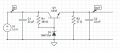
Screenshot 2025-01-21 130547.png

I have tried the following

- Replacing the transistor
- Using a 240ohm resistor for R2
- Removing the capacitors and testing the circuit without them

I'm hoping someone can point out to me what i'm doing wrong.
 

Ian0

Joined Aug 7, 2020
13,097
A 5.1V zener should still give an output of 0.6V less than the supply.
What voltage do you Measure across the Zener?
Try a green LED instead of the zener.
 

MisterBill2

Joined Jan 23, 2018
27,164
Indeed the 5.1 volt zener diode will not conduct , and so the 3.5 vols DC will be applied to both the collector and the base of the transistor, and so it should be biased into conduction. IF it is connected correctly. BUT it will not be biased on very strongly, I don't think.
 

boostbuck

Joined Oct 5, 2017
1,033
'No output at the emitter' means the transistor is blown OR the circuit is miswired in some way.

By using an appropriate zener (such as the LED suggested) the low value resistor across the output is not necessary, and is just wasting power.
 
Using a common TL431 refference:

The diode thermally compensates the Vbe drop, so when temperature rises/falls both drops (Vf a Vbe) shifts together and Vout stays about the same.

By fine-tuning the 2k2 resistor (like 1.5-3k) you can set the precise Vout as you want.
IMG_1507.jpeg
 
Last edited:

MisterBill2

Joined Jan 23, 2018
27,164
Now my question is if the 3.7 volt supply is mains powered or a battery power source. The reason being that the regulator circuit shown poses a constant current , whiich will lead to frequent battery recharging requirements.
 
None of this makes a lot of sense. An alkaline D cell should run the clock for years, while a LiIon battery is likely to self-discharge faster than that. R2 will make it discharge even faster. Your 1N4733 zener will do nothing. If you insist on powering your 1V5 clock from a LiIon battery use an LDO regulator such as this (I did not spend a lot of time to look for one with the lowest drain current but this should be good): https://www.digikey.com/en/products/detail/texas-instruments/TLV74115PDBVR/7604406
 

Ian0

Joined Aug 7, 2020
13,097
An alkaline D cell should run the clock for years, while a LiIon battery is likely to self-discharge faster than that.
Probably he's collecting batteries from discarded vapes.

A clock will run from a fully charged battery at 1.6V right down to about 1,1V when it can no longer get past 8:45 and 45 seconds, so regulation doesn't have to be that good.
A green LED will make a perfectly adequate reference for a series regulator.
Or even simpler, put the LED in series with the clock. It might even flash every time the motor pulses!

Or use a silicon diode and two clocks in series.
 

MisterBill2

Joined Jan 23, 2018
27,164
Only the much older wall clocks have a motor that rewinds every few minutes. That scheme was copied from the early mechanical car clocks of the early 1960's. The more recent wall clocks use a motor similar to a stepper motor, sort of, but with only one winding. That kind might also flash a series LED if a 3+volt battery were used. Quite an interesting concept, the series LED.
 
Top