Convert 1.5V AA device (Braun Face) to 3.7V 18650 rechargeable

Thread Starter

conandrum

Joined Mar 10, 2024
108
Hi all,
I need your ideas again.
I am trying to convert a trusty 8 year-old device (Braun Face) from an AA battery into a rechargeable. (they make rechargeable versions of this now).
(It is too much hassle opening and closing the battery compartment on these. You need a coin to twist the base. So even using a rechargeable AA battery requires you to open the compartment and recharge the battery every 1 or 2 uses)

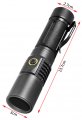
I found a rechargeable flashlight on Ali with the right dimensions (3cm head) to accept the Braun motor and tip.
Also I chose this UV flashlight because it has only ON/OFF switch functionality (no SOS etc).
The switch will make it simpe to use, but the BRAUN switch will still be needed for forward and reverse rotation of the head.
https://www.aliexpress.com/item/1005005791680770.html
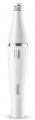
2024-12-26_23-10-44.jpg2024-12-26_23-18-21.jpg

When I receive it next week, I will begin the process of tranfering the motor by first removing the lense and UV LED.

The obvious problem now is Voltage - 1.5V to 3.7V.
I already tried running the motor with a 18650 and it works fine, but rotates at the speed of light LOL

MY IDEA :
I thought I could use a small potentiometer in series with the motor and regulate the speed of the motor, before hiding it, under the motor, inside the flashlight head.
I suppose I should use a potentiometer that can handle the wattage of the motor (I do not know how many watts until I see the model no. or measure the current it pulls under some load).

Do you have some better idea?
 

crutschow

Joined Mar 14, 2008
38,316
I thought I could use a small potentiometer in series with the motor and regulate the speed of the motor,
That will require a high power potentiometer and waste over half (about 60%) of the battery energy in heat, as would a linear regulator.

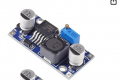
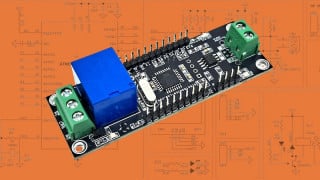
For best efficiency, you can use a small switching buck-converter (example Size: 45 * 20 * 14 mm below), which should waste only about 10% of the power.
1735324756643.png
 
Last edited:

Externet

Joined Nov 29, 2005
2,624
Use a 14500 Li-ion cell, and a couple diodes tucked inside to drop from 4.2V to 3V or one from 3.7V to 3V in your existing Braun device. Last resource a tethered 18650 or several in parallel plus the diodes.

1735267521441.png
 

Aejazwani

Joined Oct 6, 2020
3
A small buck converter would work best to step down the 3.7V from the 18650 to 1.5V efficiently, without wasting power as heat like a potentiometer would. If space is tight, you could use a couple of diodes in series to drop the voltage, but make sure they can handle the motor's current.
 

Thread Starter

conandrum

Joined Mar 10, 2024
108
hey guys thanks for your ideas.
The buck converter seems huge and I do not think there is any space for it.
I would rather waste 60% energy than accommodate for the buck.

The other option would be to change the motor with a 4V motor right? Do you see a problem with this?
 

crutschow

Joined Mar 14, 2008
38,316
Yes a PWM driver should work.
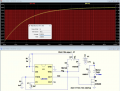
You just need a 555 configured as an oscillator with a variable duty-cycle output driving a MOSFET (LTspice sim of example circuit below):
It uses a CMOS version of the 555 to give better efficiency at the low battery voltage.
U1 pot adjusts the PWM duty-cycle to give an average 1.5V across the motor (shows 1.507V) from the 3.7V battery.

Edit: But note that this circuit only reduces the voltage similar to a resistor or diode, it does not regulate the motor voltage as the battery voltage drops during discharge.
An op amp can be added in a feedback loop to stabilize the average output for that battery voltage change if desired.


1735365349007.png
 
Last edited:

Thread Starter

conandrum

Joined Mar 10, 2024
108
Much appreciate the effort.
However, please remember that the solution would have to be small enough to fit into the head of the flashlight with enough room for the motor to fit in there also.
I was informed that the flashlight has arrived, so I will pick it up and post photos tomorrow so we know what we are dealing with.
 

MrAl

Joined Jun 17, 2014
13,667
Much appreciate the effort.
However, please remember that the solution would have to be small enough to fit into the head of the flashlight with enough room for the motor to fit in there also.
I was informed that the flashlight has arrived, so I will pick it up and post photos tomorrow so we know what we are dealing with.
I like the diodes in series solution unless you have room for the buck converter.

Also, the 14500 cells are smaller and so don't last nearly as long as an 18650. If you have the room, go with an 18650. One cell might be enough but you'll have to test that of course.
 

Thread Starter

conandrum

Joined Mar 10, 2024
108
Yes, the flashlight is already 18650 rechargeable by itself.
The idea is to remove the reflector and LED and stick the motor assembly in there.
If diodes take too much space, I may have to change the motor itself.

 
This is the smallest footprint I came up. It uses the LM317L (100mA TO-92 package) to output a consistent 1.25V over the full discharge range of a Li-Ion battery (4.3V -> 3.0V).

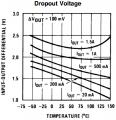
The dropout voltage / headroom for LM317 depends on the temperature and current. Assuming your motor draws 100mA @ 1.25V, this circuit should provide adequate regulation over a modest temperature range of 10-30C. You can probably get away without the input and output filter capacitors as well.

ICFoT.png

lm317 1.25v.png
 

Thread Starter

conandrum

Joined Mar 10, 2024
108
That looks promising. The LM317 is only 16x11mm without its pins (20mm should be enough).
I am sure I could easily accommodate a couple of resistors with it, in the available space.
1. Is there a reason you went for 1.25V instead of 1.5V?
2. Do I understand correctly that the 1.25V OUT is measured across R2?
3. Will this setup need a heatsink?
 

MrAl

Joined Jun 17, 2014
13,667
That looks promising. The LM317 is only 16x11mm without its pins (20mm should be enough).
I am sure I could easily accommodate a couple of resistors with it, in the available space.
1. Is there a reason you went for 1.25V instead of 1.5V?
2. Do I understand correctly that the 1.25V OUT is measured across R2?
3. Will this setup need a heatsink?
You also have to carefully consider the heat sink requirement for the LM317. It may have to be large, which would make it harder to fit into your required package size. Without a heatsink it may not work very well when the cell is low.
 
That looks promising. The LM317 is only 16x11mm without its pins (20mm should be enough).
I am sure I could easily accommodate a couple of resistors with it, in the available space.
1. Is there a reason you went for 1.25V instead of 1.5V?
2. Do I understand correctly that the 1.25V OUT is measured across R2?
3. Will this setup need a heatsink?
LM317L is a TO-92 package capable of 100mA output current or 625mW power dissipation. There is no place to attach a heatsink unless you upgrade to the TO-220 package. A TO-220 package is probably better because the circuitry will be heated by your hand. Knowing the motor current would help give better answers.

And I chose 1.25V for two reasons:

a) Shorting ADJ to the output avoids using an extra resistor. 1.25V is the minimum the chip will output in this configuration which close to the average voltage produced by an alkaline or NiMH battery.

b) According to my simulation, there is just barely enough headroom with a 1.25V output. Increasing this to 1.5V will be pushing the chip and it may not regulate when the battery gets close to 3V.

One more thing, how you are monitoring when the battery becomes drained? It would be wise to implement some sort of over-discharge protection.
 

Ya’akov

Joined Jan 27, 2019
10,226
The existing switch is a momentary one, it is connected to the LEDs driver board and has no inherent modes. You don't need to choose a light based on the modes advertised.

Depending on the construction of the particular light, the switch may be mounted directly on the driver PCB which may mean you will have no switch at all when you gut the light. It would be better to look for a host, that is, a mostly unpopulated shell intending for building flashlights as a hobby. Particularly one that uses a tail switch, such as this one (only an example, not an endorsement).

The tail switch makes it possible to install a push-on-push-off style switch that doesn't depend on electronics.
 
Top