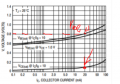
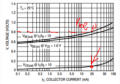
Hello ,from figure 9 of the data sheet if we take the Ic=20mA so Ib=2mA point in Saturation state our Vce=0.1V and Vbe_sat =0.8V given 20mA.
Assuming i am correct i have a problem with the KCL in the base junction.
I know the Ib=2mA and i have voltage divider.
how do i combine the two to know what current flows at R1?
Thanks
You don’t use a voltage divider. You don’t set the voltage, you set the current and whatever the resulting voltage is, it is. The current is not critical, if it is 10 mA or 40 mA it will barely change the operation.
First, remove R3, it serves no purpose and just complicates the calculation.
Next, remove R1, R2 and and V1. They are not needed.
Now put a resistor Rb from the base to ground. Calculate Rb to give 20mA of base current assuming Vbe is -0.6V as follows:
Rb = (5-0.6) / 0.020 = 220
This is the same calculation you use for current in an LED, which is no accident since you are calculating the current through a diode.
Hello WBahn,I am trying to understand the logic ,
you picked a point in figure 9 of the data sheet in which Ic/Ib=10 and Vce_sat=100mV
Ic=20mA Ib=2mA
this is my saturation conditions. In saturation i cannot assume Vbe=0.6 volts.
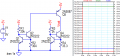
in the circuit bellow(please disregard the resistor value) i can controll the Vb voltage because its a voltage devider.
so Ic/ib Is the HFE (beta) value? correct?
there is also the Vbe sat plot .
So i take 20mA line up to the Vbe sat plot and get that given Ic=20mA my Vbe(sat) will be 0.8 V?
Correct?
Do NOT try to control the bias current by directly establishing a value of Vbe. Remember, that plot is for a TYPICAL transistor that has a junction temperature of 25°C. It's highly unlikely that the transistor that you will put in your circuit will be typical. The transistor you actually use may have a significantly different Vbe at this operating point. You need to design your circuit so that the specifics of this relationship have little effect.
You first circuit (the middle attachment) will not allow the transistor to ever go into saturation. As others have said, you MUST have a load of some kind in series with the collector or emitter (two very different circuits, depending on which you choose). Otherwise, you will just be trying to short the supply and bad things will happen.
In your second circuit, if you are trying to create a voltage divider with R1 and R2, the total current in your divider is only a little over 3 mA, but your base current is going to be about 2 mA, so that is going to pull the base voltage well away from your nominal voltage divider value.
You want to design your circuit so that, when it's supposed to be in saturation (and if you want 20 mA of collector current when it's in saturation) that your base current can be at least 2 mA, but you also have to keep in mind that it might be significantly less than that for the particular transistor you are using.
Hello ,from figure 9 of the data sheet if we take the Ic=20mA so Ib=2mA point in Saturation state our Vce=0.1V and Vbe_sat =0.8V given 20mA.
Assuming i am correct i have a problem with the KCL in the base junction.
I know the Ib=2mA and i have voltage divider.
how do i combine the two to know what current flows at R1?
Thanks
You have the base current going the wrong direction. For a PNP, the base current is coming OUT of the base.
You've stated that your goal is to put the transistor into saturation.
Will 20 mA of collector current do that?
With 20 mA of collector current, the voltage drop across R4 will be 2 V.
Assuming that the device is in saturation to a degree that the beta has been reduced to 10, that means that the base current would be 2 mA, making the emitter current 18 mA. Thus the voltage across R3 would be 1.8 V, making the Vce of the transistor 1.2 V, which means it is NOT in saturation. Even with infinite beta, the Vce would still be 1 V, placing it still in the active region.
You don’t use a voltage divider. You don’t set the voltage, you set the current and whatever the resulting voltage is, it is. The current is not critical, if it is 10 mA or 40 mA it will barely change the operation.
First, remove R3, it serves no purpose and just complicates the calculation.
Next, remove R1, R2 and and V1. They are not needed.
Now put a resistor Rb from the base to ground. Calculate Rb to give 20mA of base current assuming Vbe is -0.6V as follows:
Rb = (5-0.6) / 0.020 = 220
This is the same calculation you use for current in an LED, which is no accident since you are calculating the current through a diode.
If R3 is removed and R4 is left as 100 Ω, then even with Vce = 0 V, the max collector current would be 50 mA. A base current of 5 mA should be more than sufficient to place it firmly in saturation. You can hedge that a bit by not taking the Vbe into account when sizing the base resistor and make it 5 V / 5 mA = 1 kΩ.
Assuming that the device is in saturation to a degree that the beta has been reduced to 10, that means that the base current would be 2 mA, making the emitter current 18 mA. Thus the voltage across R3 would be 1.8 V, making the Vce of the transistor 1.2 V, which means it is NOT in saturation. Even with infinite beta, the Vce would still be 1 V, placing it still in the active region.
Hello WBahn, I am trying to use the data sheet shown bellow
in figure 9 i saw Vbe sat and Vce sat curves an i choke their values at 20mA.
Why its wrong?
How to properly find values?
Thanks.
You have the base current going the wrong direction. For a PNP, the base current is coming OUT of the base.
You've stated that your goal is to put the transistor into saturation.
Will 20 mA of collector current do that?
With 20 mA of collector current, the voltage drop across R4 will be 2 V.
Assuming that the device is in saturation to a degree that the beta has been reduced to 10, that means that the base current would be 2 mA, making the emitter current 18 mA. Thus the voltage across R3 would be 1.8 V, making the Vce of the transistor 1.2 V, which means it is NOT in saturation. Even with infinite beta, the Vce would still be 1 V, placing it still in the active region.
We think of bipolar transistors as current operated devices and field effect transistors as voltage operated devices.
I have never had trouble figuring out how much base current I need for a given collector current. I suspect that the dependence upon base voltage is highly variable. Take voltage variation of the forward-biased PN junction as a function of temperature as an example (2 millivolts per degree C).
Yef smith - I assume that you want to design a BJT-switch - and you are free to select an appropriate design, correct?
In this case, you should not use any emitter resistor and not a voltage divider at the base node.
You only need a collector resistor Rc and a suitable collector current Ic that creates a voltage drop Ic*Rc which is large enough to open the base-collector junction - because THIS is the definition for saturation!
That means: When the base potential is at Vb=Vdd-Veb, the collector potential must be Vc>(Vdd-Veb).
(Saturation: Base-collector junction biased in forward direction).
Therefore, due to this additional current out of the base node the observed total base current Ib is much larger than expected using the factor B=Ic/Ib which is valid for linear operation only.
Assuming Ve=Vdd=+5V and Veb=0.7V we, therefore, require Vc=Ic*Rc>4.3V.
Therefore, select values for Ic and Rc which safely can meet the above condition.
Now - to be on the "safe side" (due to the uncertainty of the asumption Veb=0.7V) - we should design the base resistor Rb for a base current Ib which belongs to a collector current Ic that safely can meet the above condition (Vc>4.3V).
This is the reason for using the factor 10=Ic/Ib (instead of the factor B as given in the data sheet).
As the last step, the base resistor is found using the voltage divider rule (with switching voltage Vs): Rb=(Vs-4.3V)/Ib.
Hello WBahn, I am trying to use the data sheet shown bellow
in figure 9 i saw Vbe sat and Vce sat curves an i choke their values at 20mA.
Why its wrong?
How to properly find values?
Thanks.
No PN junction is actually a constant-voltage junction. As the current increases, the voltage increases. When the transistor is in saturation, more base current is needed for the same collector current, thus the Vbe will be higher.
Never forget the "typical" values given in the datasheet are just that -- values averaged over lots of devices. Any given device may deviate significantly from the typical values. Your circuit needs to be designed with that in mind.
Also, remember that the Vce and the Ic are not determined solely by what you do at the base. It is a balancing act between making the base-emitter circuit behavior consistent with the collector-emitter circuit.
Thus, if you happen to have a "typical" transistor, the Vce would be about 100 mV with a collector current of 20 mA WHEN that is consistent with the rest of the circuit. But if you have a 5 V supply and a 100 Ω collector resistor (no emitter resistor), then 20 mA of collector current results in a Vce of 3 V (5 V minus the 2 V developed across a 100 Ω resistor that has 20 mA flowing through it). Therefore that transistor is NOT in saturation.
No PN junction is actually a constant-voltage junction. As the current increases, the voltage increases. When the transistor is in saturation, more base current is needed for the same collector current, thus the Vbe will be higher.
...higher than what?
I think - as mentioned in my answer (post#32), the drastic increase in the base current is caused by the base-collector junction which during saturation mode is also biased in forward direction (in addition to the base-emitter junction).
The voltage Vbe will only slightly be increased (in comparison to linear operation) - and can be still approximated with Vbe=0.7-0.75 volts.
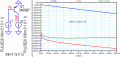
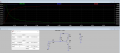
Hello ,I have swept the X resistor value shown bellow.
using VCE i know that when its small then its saturated.
but the saturation current is very small.
also Ic/Ib is about 2.
How do i increase the Ic current?
How do i increase the HFE?
Is there some intution to get my Ic/ib=10 in the circuit bellow
Thanks.
REF: When the transistor is in saturation, more base current is needed for the same collector current, thus the Vbe will be higher.
For a given transistor, under a particular set of conditions, if you have some particular collector current (let's use 20 mA for discussion sake) and the transistor is not in saturation (i.e., has a particular Vce well above Vcesat), there will be a particular Vbe that matches those conditions. If you then start lowering the Vce until the device is in saturation (while maintaining the same Vbe), the collector current will decrease. To get back to the same collector current, you then need to increase the Vbe. So the Vbe will be higher, for the same collector current, for a transistor that is in saturation than for that same transistor, under otherwise identical conditions, that is not in saturation.
There are a number of ways of coming at it, but I think the above makes a claim that is pretty hard to argue against.
I think - as mentioned in my answer (post#32), the drastic increase in the base current is caused by the base-collector junction which during saturation mode is also biased in forward direction (in addition to the base-emitter junction).
The voltage Vbe will only slightly be increased (in comparison to linear operation) - and can be still approximated with Vbe=0.7-0.75 volts.
Hello ,I have swept the X resistor value shown bellow.
using VCE i know that when its small then its saturated.
but the saturation current is very small.
also Ic/Ib is about 2.
How do i increase the Ic current?
How do i increase the HFE?
Is there some intution to get my Ic/ib=10 in the circuit bellow
Thanks.
If you are trying to explore the saturation behavior of the transistor, get rid of things that just complicate stuff. Get rid of R1 and R3 and tie the emitter directly to Vdd.
You might also replace V1 and R2 with a current source (be sure to orient the source so that it is pulling current out of the base). Now make R4 a reasonable value such that, in hard saturation, it will have about 50 mA flowing through it. So if Vdd is 5 V, make R4 a fixed 100 Ω.
Now run a transient simulation in which the current source ramps from 0 mA to, say, 20 mA. Plot Vce versus Ic/Ib and see what it looks like.
Hello , As you can see bellow i got a better result is saturation region with much higher IC current.
Hfe=3
I need some physical intution which would get me the same 45mA Ic current with HFE=10?
Is there some theoretical explanation which could help me?
Thanks.
@BobTPH said "First, remove R3, it serves no purpose and just complicates the calculation.Next, remove R1," @WBahn said "Get rid of R1 and R3 and tie the emitter directly to Vdd."
Why do you still have R1 and R3? R3 is preventing the collector current from increasing.

 Facebook
 Google
 GitHub
 Linkedin