Hello , i am asking a totally other thing.
what is the physics of HFE in saturation state?
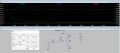
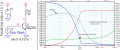
I got a good current but my HFE is only 3 instead of 10,as shown bellow.
i am keeping the resistor just for extra general parameter to play with.
REF: When the transistor is in saturation, more base current is needed for the same collector current, thus the Vbe will be higher.
For a given transistor, under a particular set of conditions, if you have some particular collector current (let's use 20 mA for discussion sake) and the transistor is not in saturation (i.e., has a particular Vce well above Vcesat), there will be a particular Vbe that matches those conditions. If you then start lowering the Vce until the device is in saturation (while maintaining the same Vbe), the collector current will decrease. To get back to the same collector current, you then need to increase the Vbe. So the Vbe will be higher, for the same collector current, for a transistor that is in saturation than for that same transistor, under otherwise identical conditions, that is not in saturation.
To me, the two (highlighted) statements don't really fit together.
The basic question is: What is the physical reason for the observed drastic increase of the base current (example: Ib=Ic/10) ?
I think, primarily it is the fact that there is an additional portion of current into the base due to the base-collector junction which is forward biased during saturation.
This can be illustrated by the following "mind experiment"
Lets assume that a transistor with a fixed voltage Vbe has a collector resistance Rc which brings the transistor not into saturation. Now we are increasing the Rc value until the collector potential Vc falls below the base potential Vb.
That means (for grounded emitter with Ve=0) we now have saturation with Vce<Vbe and a base current that is much larger than before (B-C junction open), but the voltage Vbe remains unchanged.
To me, the two (highlighted) statements don't really fit together.
The basic question is: What is the physical reason for the observed drastic increase of the base current (example: Ib=Ic/10) ?
I think, primarily it is the fact that there is an additional portion of current into the base due to the base-collector junction which is forward biased during saturation.
This can be illustrated by the following "mind experiment"
Lets assume that a transistor with a fixed voltage Vbe has a collector resistance Rc which brings the transistor not into saturation. Now we are increasing the Rc value until the collector potential Vc falls below the base potential Vb.
That means (for grounded emitter with Ve=0) we now have saturation with Vce<Vbe and a base current that is much larger than before (B-C junction open), but the voltage Vbe remains unchanged.
But you need to explain why a PN junction becoming forward biased results in more current flowing in the reverse direction through it.
Even if the current were flowing forward through it, it is not forward-biased enough to account for anywhere near the amount of additional current that is flowing.
But you need to explain why a PN junction becoming forward biased results in more current flowing in the reverse direction through it.
Even if the current were flowing forward through it, it is not forward-biased enough to account for anywhere near the amount of additional current that is flowing.
1) When the base potential Vb is larger than the collector potential Vc (Vbc>0) the pn-junction is forward biased (npn case), correct?
Why do you expect a current in the "reverse direction"? We have two portions for the current Ib into the base (Ib=Ib1+Ib2): Ib1 through the B-E junction and Ib2 through the B-C junction. Of course, the second portion Ib2 reduces the net collector current Ic from C to E (opposite direction for Ic and Ib2) . This is another reason for the reduction of the factor B which now is B=Ic/(Ib1+Ib2) with Ic smaller and (Ib1+Ib2)>Ib1. What is wrong with this consideration?
2) Comment to your last sentence: In my simulation the current into the base node has increased from 21µA to 260µA (Vbe remains constant during transition from non-saturated to saturated). What is your explanation for this increase - if not the additinal current Ib2 from B to C ?
The datasheet says that a typical device will require 0.85V Vbe to achieve saturation, which is about 100mV more than for linear use.
A typical diode has an exponential coefficient of about 60mV/decade, so that’s about a decade and an half more current, which suggests that the effective hfe in saturation should be about 1/30 of the linear value.
When the base potential Vb is larger than the collector potential Vc (Vbc>0) the pn-junction is forward biased (npn case), correct?
Why do you expect a current in the "reverse direction"? We have two portions for the current Ib into the base (Ib=Ib1+Ib2): Ib1 through the B-E junction and Ib2 through the B-C junction. Of course, the second portion Ib2 reduces the net collector current Ic from C to E. This is another reason for the reduction of the factor B which now is B=Ic/(Ib1+Ib2) with Ic smaller and (Ib1+Ib2)>Ib1.
* case 1 ( no saturation, Rc=1k): Ic=4mA, Ib=21µA, B=Ic/Ib=190, Vce=6V ;
* case 2 (saturation, Rc=3k); Ic=3.3mA, Ib=260µA, B=Ic/Ib=12.7, Vce=620mV.
The base-emitter current when Vbe = 700 mV and Vbc = -5.3 V is 21 µA. Presumably the base-collector current (your Ib2) is effectively zero. Correct?
Now you adjust the collector resistor so that Vbe = 700 mV and Vbc = 80 mV. Since the base-emitter junction still has the same voltage across it, the base-emitter current is presumably unchanged, correct? That means that the additional 239 µA of base current is flowing through the base-collector junction with just 80 mV of forward bias? So with roughly 1/10 the voltage across the junction we get more than 10x the current through it? Even though with lower voltage across a PN junction the current decreases exponentially?
What is the beta if you adjust Rc so that Vce = 700 mV?
Hello , i am asking a totally other thing.
what is the physics of HFE in saturation state?
I got a good current but my HFE is only 3 instead of 10,as shown bellow.
i am keeping the resistor just for extra general parameter to play with. View attachment 291953
Remember that there is nothing magical about a beta of 10. As the collector-emitter voltage drops approaching saturation (for a constant collector current), the beta decreases. Let's say that it is 100 when Vce is well above saturation. At some Vce it will drop to 50. At a lower Vce it will drop to 20. At some Vce it will drop to 10. At yet a lower Vce it will drop to 5. At yet a lower voltage it will drop to 1. Below that it will drop to 0.5.
There's no magical point where you suddently switch from active to saturation -- it is a continual change in device behavior. By convention, transistor manufacturers long ago chose to characterize the saturation characteristics of small-signal transistors at an operating point where the beta happens to be 10. They could have chosen a different value (and for power transistors, which tend to have much lower betas to begin with, they usually do).
If you want to operate your transistor so that it's beta is 10, then you need to carefully adjust the circuit parameters to make that happen. Move your cursor to the right just a bit until you get to the point where the beta is 10. That's the point that you need to operate the device at if you want it to have a beta of 10 (for that collector current at that temperature).
Also, look at the collector current trace when it's at about 40 mA. Do you see that sharp change in behavior (and similar sharp changes in the other traces at that point? That's not real. That's an artifact of the transistor model you are using as it transitions from one set of parameters to another. The actual device behavior is going to have softer transitions than that.
The base-emitter current when Vbe = 700 mV and Vbc = -5.3 V is 21 µA. Presumably the base-collector current (your Ib2) is effectively zero. Correct?
Now you adjust the collector resistor so that Vbe = 700 mV and Vbc = 80 mV. Since the base-emitter junction still has the same voltage across it, the base-emitter current is presumably unchanged, correct?
That means that the additional 239 µA of base current is flowing through the base-collector junction with just 80 mV of forward bias? So with roughly 1/10 the voltage across the junction we get more than 10x the current through it? Even though with lower voltage across a PN junction the current decreases exponentially?
What is the beta if you adjust Rc so that Vce = 700 mV?
* In both cases ("correct"?) my answer is: Yes - correct!
* Your last question (Vce=700mV) is really an interesting one.
Here are the simulation results (all parameter as before) with Rc=2.327k and Vce=Vbe=700mV (Vbc=0) :
Ib=21.21µA (practically the same value as for Rc=1k without saturation, Vbc=-5.3V)
Ic=3.996mA ((practically the same value as for Rc=1k without saturation, Vbc=-5.3V).
Please, let me state that I did nothing else than to present some simulation results - with an attempt to interprete these results.
When we try to interprete the results we must (a) not forget the doping profile of the BJT and (b) not use the typical Ib=const curves because in the presented simulations the current Ib was not kept at a constant value (we have Vbe=const).
Final question: Do you have other explanations for the Ib increase than given in my posts#45 and #47 ?
* In both cases ("correct"?) my answer is: Yes - correct!
* Your last question (Vce=700mV) is really an interesting one.
Here are the simulation results (all parameter as before) with Rc=2.327k and Vce=Vbe=700mV (Vbc=0) :
Ib=21.21µA (practically the same value as for Rc=1k without saturation, Vbc=-5.3V)
Ic=3.996mA ((practically the same value as for Rc=1k without saturation, Vbc=-5.3V).
Please, let me state that I did nothing else than to present some simulation results - with an attempt to interprete these results.
When we try to interprete the results we must (a) not forget the doping profile of the BJT and (b) not use the typical Ib=const curves because in the presented simulations the current Ib was not kept at a constant value (we have Vbe=const).
Final question: Do you have other explanations for the Ib increase than given in my posts#45 and #47 ?
Trying to draw detailed conclusions from simulation results is very difficult, especially in regions where the behavior is changing from one operating region to another. It all comes down to the quality of the sim models in that region and most off-the-shelf discrete transistor models are pretty simple cases of using curve fitting to select parameter values at selected operating points and then letting the chips fall where they will. They don't really care about getting a particularly close match during the transitions between regions because it really doesn't matter -- the variations from one transistor to another will swamp out any benefit from doing so.
As for a better explanation, the details are deep in the solid state physics.
For one thing, you can't really describe the behavior of a BJT transistor in terms of two opposite-facing PN junctions that happen to share the center region. The charge-transport mechanisms are SO much more complicated than that.
Keep in mind that it's now been more than three decades since I've been through this, so I'm going to miss a lot of details (and get some stuff wrong, I'm sure).
It's all about the lifetimes of the carriers as they diffuse in close proximity to the junction. The "diffusion length" is essentially the expected distance that a minority carrier will travel before it recombines and goes away. In a BJT transistor operating in the active region, the forward-biased base-emitter junction causes minority carries to be injected into the base region from the emitter (the emitter "emits" minority carries, hence the name). In a simple PN diode (or if a BJT transistor were made with a wide base region, thus making it behave like two back-to-back diodes), these would recombine and result in diode current at the base connection, since the. But because the base region is so much thinner than the diffusion length, most of these minority carries diffuse into the collector region (which "collects" them) resulting in collector current through the reverse-biased collector-base region instead. Because the base is lightly doped and the emitter is heavily doped, almost all of the carries are minority carriers. This process is identical to the reverse current that results from optically-generated electron-hole pairs in a photo-diode, except that the minority carriers are electrically injected instead of optically generated, with the result being that the reverse current through the collector-emitter junction is largely independent of the collector-emitter voltage, but instead controlled almost entirely by the rate at which minority carriers are injected into the base region from the emitter.
But as the degree of reverse-bias is reduced (and eventually becomes slightly forward biased), the fewer carriers get swept across base-collector junction because the concentration gradient has been reduced. This results in the carries sticking around in the base region long enough to get recombined within that region and shuffled off out of the device through the base connection, hence the base current goes up.
So to summarize thus far.
In the active region, a voltage is applied that forward biases the base-emitter junction (let's call it 700 mV). Just like in a PN diode, this results in current flowing through the junction. But instead of being a more-or-less equal combination of electrons flowing in one direction and holes flowing in the other, the highly-asymmetric doping profile of the base versus collector regions results in the current being largely minority carries coming from the emitter region to the base region. If the collector were unconnected, these would recombine in the base region and result in a base-emitter current of some particular value (let's call it 100 mA to have a number to work with). However, because the base is so thin, most of those carriers (say 99% of them) survive long enough to diffuse across the reverse-biased collector-base junction and produce a corresponding reverse current that is largely independent of the degree to which the collector-base junction is reverse biased. So you end up with 99 mA of collector current and 1 mA of base current making up the 100 mA of emitter current.
In essence, and with quite a bit of simplification involved, a particular Vbe results in a particular emitter current. How that emitter current is divided up between the base and the collector is dictated by the collector-emitter voltage. If it results in the collector-base voltage being reverse-biased, most of the carriers from the emitter make it to the collector and you draw only a tiny fraction of them off through the base. We perceive this as a current gain because we normalize things to the base current because that is most useful from an application standpoint. As the device moves into saturation, a smaller fraction of the carriers emitted into the base from the emitter diffuse into the collector region and the higher the fraction of them that become base current (which we perceive as a lowering of beta).
Trying to draw detailed conclusions from simulation results is very difficult, especially in regions where the behavior is changing from one operating region to another. It all comes down to the quality of the sim models in that region
Of course, I do not "blindly" trust simulation results. On the other hand, I am sure that the models used within such tools are much more exact than the simplified models we are using for our "pencil-and-paper"-calculations. But, of course, you are right when you are sceptical in such a case.
In the active region, a voltage is applied that forward biases the base-emitter junction (let's call it 700 mV). Just like in a PN diode, this results in current flowing through the junction. But instead of being a more-or-less equal combination of electrons flowing in one direction and holes flowing in the other, the highly-asymmetric doping profile of the base versus collector regions results in the current being largely minority carries coming from the emitter region to the base region. If the collector were unconnected, these would recombine in the base region and result in a base-emitter current of some particular value (let's call it 100 mA to have a number to work with). However, because the base is so thin, most of those carriers (say 99% of them) survive long enough to diffuse across the reverse-biased collector-base junction and produce a corresponding reverse current that is largely independent of the degree to which the collector-base junction is reverse biased. So you end up with 99 mA of collector current and 1 mA of base current making up the 100 mA of emitter current.
As the device moves into saturation, a smaller fraction of the carriers emitted into the base from the emitter diffuse into the collector region and the higher the fraction of them that become base current (which we perceive as a lowering of beta).
For my opinion, here you have mentioned a rather important additional effect which contributes to the observed reduction in the factor B=Ic/Ib. That means, now, we have in summary three contributors for this reduction under saturation condition:
* Higher fraction of Ie into the base (increase in Ib due to the effect as describend above),
* Additional current Ib2 into the base due to the B-C junction (forward biased),
* Reduction in Ic due to Ib2 which is in opposite direction to Ic.
Without moving deep into transistor physics, these three effects could be responsible for the observed reduction in B during saturation.
EDIT (added later): Here is an excerpt from "Art of Electronics" (Horowitz/Hill):
Quote: "The basic idea is that the collector-base junction is a big diode with a high Is, so that it has a lower on-voltage for a given current than the base-emitter diode. Therefore, at small values of the collector-to-emitter voltage (typically 0.25V or less), some of the base current will be "robbed" by conduction of the collector-base diode. This lowers the effective hfe and makes it necessary to supply relatively large base currents."

 Facebook
 Google
 GitHub
 Linkedin