Facebook
 Google
 GitHub
 Linkedin
I am designing a custom audio/video signal routing for use with retro game consoles (specifically using composite and component video signals in standard definition). I'm also using this project as an opportunity to learn electrical engineering concepts. My background is in mechanical engineering but I very nearly did electrical.
I think I'm finally getting my head wrapped around the basics of analog signals and would appreciate some feedback on my design. Here's my schematic showing one of the eight inputs routed through a mux to a buffer and then to the output. The other seven inputs would have the same two resistors and one capacitor per channel. Power supply and logic for controlling the mux is not shown. Also note that some values may not be finalized as this is a work in progress.
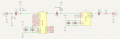
Starting on the left we have the input RCA connector with a 75Ω termination (J1 and R1).
C1 is the AC coupling cap used to remove any DC offset coming from the game console. From what I can tell this is common practice.
After that R2 on the 2.5V rail reestablishes a known DC offset at the middle of the power and ground rails. This is to lift up the signal to ensure it passes cleanly through the mux chip (ADG708). With a single 5V supply it can only accept signals between 0 and 5V per the datasheet and video signals will dip below 0V. The choice to go with a single supply was primarily to avoid introducing switching noise but I am open to revisiting that.
After the mux we have C2 and R3, which are included per the buffer chip's datasheet. Populating C2 only puts the buffer chip in AC Sync Tip Clamp mode, which is appropriate for composite video and the Y signal of component video. Populating C2 and R3 puts the buffer in AC Bias mode which is what the datasheet recommends for Pb and Pr component video signals.
Note that my finished build will have four of these boards. One for composite and three for component. R3 is populated or not based on which channel is being routed. That lets me order one PCB design for all channels.
Last we have the buffer chip (THS7314) with another AC coupling cap on the output and a 75Ω resistor to send out the signal with the correct impedance.
I'm open to any and all advice and constructive criticism but I also have some specific questions:
1. If I went to a dual supply on the mux it could accept signals between -5V and +5V. Could that eliminate the need for the 2.5V biasing?
2. Again, if I went with dual supplies could I skip AC coupling entirely on the input side? It's still getting AC coupled to the buffer.
3. I think the ADG708 chip is overkill and its expensive. I prioritized low Ron when selecting the chip but I'm sure its more nuanced than that. Any suggestions are welcome.
If you've made it this far thanks for reading through it all. I hope my design is at least partially correct as I am still learning a lot with this.
For reference here are the datasheets for THS7314 and the ADG708.
I think I'm finally getting my head wrapped around the basics of analog signals and would appreciate some feedback on my design. Here's my schematic showing one of the eight inputs routed through a mux to a buffer and then to the output. The other seven inputs would have the same two resistors and one capacitor per channel. Power supply and logic for controlling the mux is not shown. Also note that some values may not be finalized as this is a work in progress.
Starting on the left we have the input RCA connector with a 75Ω termination (J1 and R1).
C1 is the AC coupling cap used to remove any DC offset coming from the game console. From what I can tell this is common practice.
After that R2 on the 2.5V rail reestablishes a known DC offset at the middle of the power and ground rails. This is to lift up the signal to ensure it passes cleanly through the mux chip (ADG708). With a single 5V supply it can only accept signals between 0 and 5V per the datasheet and video signals will dip below 0V. The choice to go with a single supply was primarily to avoid introducing switching noise but I am open to revisiting that.
After the mux we have C2 and R3, which are included per the buffer chip's datasheet. Populating C2 only puts the buffer chip in AC Sync Tip Clamp mode, which is appropriate for composite video and the Y signal of component video. Populating C2 and R3 puts the buffer in AC Bias mode which is what the datasheet recommends for Pb and Pr component video signals.
Note that my finished build will have four of these boards. One for composite and three for component. R3 is populated or not based on which channel is being routed. That lets me order one PCB design for all channels.
Last we have the buffer chip (THS7314) with another AC coupling cap on the output and a 75Ω resistor to send out the signal with the correct impedance.
I'm open to any and all advice and constructive criticism but I also have some specific questions:
1. If I went to a dual supply on the mux it could accept signals between -5V and +5V. Could that eliminate the need for the 2.5V biasing?
2. Again, if I went with dual supplies could I skip AC coupling entirely on the input side? It's still getting AC coupled to the buffer.
3. I think the ADG708 chip is overkill and its expensive. I prioritized low Ron when selecting the chip but I'm sure its more nuanced than that. Any suggestions are welcome.
If you've made it this far thanks for reading through it all. I hope my design is at least partially correct as I am still learning a lot with this.
For reference here are the datasheets for THS7314 and the ADG708.