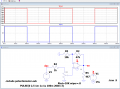
Basic electronics, configuration of OPAMP circuit on breadboard

Thread Starter

OPTSimon

Joined Mar 24, 2021
33
hi,
By faster I mean a higher frequency sine wave, not a higher voltage.

Can you say exactly what you are trying to do with the Duo part of the project, it would help us to understand.

Basically the DAC voltage Step function you are using to test the DAC is OK, BUT it is not suitable for the AC amplifier.
E

Update:
Link.
https://www.arduino.cc/en/Tutorial/DueSimpleWaveformGenerator
Okay, i will try to explain it abit.

I basically wants to use the arduino as a trigger, but the output of the arduino is to low - hence the need for the OPAMP.
I want to supply a voltage between 0-10V to my equipment in pulses / durations of 20ms to maximum 1 sec.
For it to work proper( for my equipment) i would need the output to be fairly stable, else i my optical power would flutuate as well.

So from the arduino i would need to be able to adjust the output of the pin, such that the amplified signal would vary as well. Since it is directly correlated to the amount of power my equipment would emit.

In the script you saw i just checked high and low, but it could in theory be anywhere in between as well - since it depends if i would need maximum optical power or something less in my test.

- dont know if that helped at all ?
 

Thread Starter

OPTSimon

Joined Mar 24, 2021
33
Possibly also worth mentioning that the supply voltage for the amplifier will need to be greater than 10V in order to get a 10V output.
that part i have figured out, i am currently supplying it with 12V from the external power supply.

But a solid note tho, took me a little while to figure that one out in the beginning.
 

ericgibbs

Joined Jan 29, 2010
21,465
Hi S,
That On Period of 20mSec thru 1 Sec will not be correctly amplified by that AC amplifier.
You require a variable Gain DC amplifier.
Note also with a single supply voltage amp, you will not a true 0V out, close but not zero.

Do you follow OK.?
E
 

Thread Starter

OPTSimon

Joined Mar 24, 2021
33
Its properly worth mentioning, that i have tried to put together the circuit Eric supplied me with, and it does indeed amplify
Hi S,
That On Period of 20mSec thru 1 Sec will not be correctly amplified by that AC amplifier.
You require a variable Gain DC amplifier.
Note also with a single supply voltage amp, you will not a true 0V out, close but not zero.

Do you follow OK.?
E
Hi Eric,

Hmm i presume its because its to long the period right ?
Any way can get "close" to the amplification i need with this AMP ?
- So if i understand it correctly it wont be possible with my current components.

If it was close enough to 0 i would be able to make it work, but its noted.

I just tested the circuit you sent, and it does indeed amplify my signal, but not in a "manor" that i would expect - specially since it doesnt return down to 0 (or any where near it) so i believe i must have done something wrong in the setup of the circuit.
Once i adjusted, the adjustable the resistor i saw the gain of the signal, but it also ment that i would never get back to 0 tho.
 

Thread Starter

OPTSimon

Joined Mar 24, 2021
33
Here is the problem with the analog amplifier module you have:

Okay so because there are capasistores infront of the inputs, they will block DC ?
thanks for the clarification - always nice to understand why it is as it is.


I am currently trying to build the circuit Eric sent yesterday.
After this i really need to find my old electronic books, i really need a refreshment in the basic rules etc.
 

Audioguru again

Joined Oct 21, 2019
6,826
Yes, a series capacitor passes AC but blocks DC.
Eric's latest circuit will have a maximum gain of 5.67 for AC and DC. The original module has a maximum gain of 100 for AC.
 

Thread Starter

OPTSimon

Joined Mar 24, 2021
33
Yes, a series capacitor passes AC but blocks DC.
Eric's latest circuit will have a maximum gain of 5.67 for AC and DC. The original module has a maximum gain of 100 for AC.
Okay thanks, i learn something new all the time :)

yah i am currently talking with eric about it, since i have had some difficulties putting it together/ getting the proper readout.
gain wise it should be more then enough - since i only need 0-10V output. and the 5x gain will get be over the 10V so.
 
What I gather is that you want 0-10V to be 0-100% AND you want to "GATE" the output for Various times.

What MIGHT pay out better is a 0-10V reference and a TTL pin to do the gating. The 0-100% could be computer controller or just an adjustable reference (potentiometer) or use the DAC. Just don't modulate and set the power level using just the DAC.
 
Last edited:

Thread Starter

OPTSimon

Joined Mar 24, 2021
33
Hi OPT.
Like this diagram.
E
Reposted.
View attachment 233662
Hi E,
Repost.
I though that was what i had done - if you look at the image i sent you just before?
I linked the GND pin from the arduino, in the breadboard negative row, where the input from the power suply also comes in, and from that row i take a jumper to pin 4 on the OPA.?
Also when i measure the output on the multimeter - i measure with the the output from pin 1 and pin 4 on the OPA on the A side.

IF it makes it easier, i can grab some images of how the current circuit it wires, and where i measure and how the arduino due is connected to board ?
 
Top