i have no idea how you calculated that 16V, but here is another version that indeed give a 16V and -16V
If i exclude the capacitors and keep 1k resistors OR make the Resistors value like 100 ohms and keep 10uF caps, it goes 12V to -12V.
I got rid of the bridge rectifier and it does ok without it indeed.
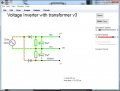
Ive added the V0 wire that it was supposed to stay at 0V but it is fluctuating between 12V and -12V as you can see in the image.
Try adding a ground symbol to the node between the two caps so the simulator will know where your ground reference is. LTspice won't even run without a ground symbol.
The peak voltage of a 12VAC sinewave is 12V x the root of 2= 17V. Then the forward voltage drop of the diode reduces the output to about 16V to 16.4V depending on the output current.
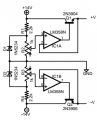
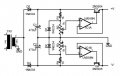
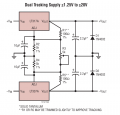
@q12x Here's a circuit you can try. It should work even with your uA741's (don't use more than +/- 16V supplies).
If you don't have any transistors, you can leave them out; you just won't be able to get more than about 20mA. The transistors are good for up to 200mA, but watch the power dissipation. You can use any zener diode up to ~9-10V (1N5234 are 6.2V). The values for R1 and R4 aren't critical. Just make sure that the zener current is still in the 5mA range when you subtract the current in the pot. You can use a larger value pot; I just happened to have 1k handy (I breadboarded the circuit; I used the simulator between my ears).
Try adding a ground symbol to the node between the two caps so the simulator will know where your ground reference is. LTspice won't even run without a ground symbol.
Not correct. Ground is used on DC power sources. This is AC. power source.
If you pay more attention, I have there an AC power source. Adding diodes it will swing from + to - and from - to + , 50 times per second. So... in the eyes of a simulator, my AC is still a power source and it is functioning fine on my PC. It should function fine in LTspice as well. Make a test and will thank me later. You must pay more attention, it happens to me too, no problem.
I also love your new circuit you made there with the 2 opamps, though is awfully complicated. It is pushing forward my understanding and familiarity of the opamp , thanks to you, so i thank you ! Its very good. Im more a practical man, and i tend to simplify to the basics. :] Your new approach is very exciting to me.
- But I cant understand its usage. Until now, practically/in reality, i can not obtain -12V from my transformer. I did obtaining it, only in simulator, and that gives me som stange results : higher voltage, 16 or 24V above my normal 12 that my transformer is giving at the moment.
So... your circuit assumes that i have already deal with the -xV but in fact I am still stuck at it:
I already (also thanks to your older circuit) compile a workable solution but i dont completely like it
because, is giving me higher voltages 16V in this case or 24V if i remove the caps, above my normal 12V that my transformer is giving. And also, if you pay attention on V0, it is not 0V but +12 when V+ is at peak and -12 when V- is at it's peak.
I am not familiar with this behavior at all, and it seems suspect. Im not saying the simulator is wrong, but the circuit is.
I will try it nevertheless if i will not have other options left because at least i can milk its -xV from it. Theoretically ;]. And im thinking, if the peak is 16V, and V0 is at 12V that means I will get 16-12= 4V? So it will be +4 0 -4 ?Im not completly sure, its a hunch it crossed my mind. I must build it first and comment later.
For your last circuit, the one with the opams, I can NOT put it in practice until i will resolve the negative voltage part, which is the problem that i am addressing right now. So let's stay focused on this problem to resolve it first, and then, we will play with the opams.
I do have a pretty big stock of transistors, but i dont have ALL types for sure. I only gathered what i though necesary. Also some fished from boards that now are good to go into a museum probably. (i have transistors that are marked with a blob of color, before ones with printed numbers on them) Very odd ones indeed. I also have a ton of resistors all put on categories. Also an entire set of zener diodes 30values, ranging from 2 to 39. And not so many IC's. I still have to make someday this step, in filling up all the important IC's we talked about them some years ago, if you still remember, I have put that list in a safe folder and when it will come the time, I will make use of it. But until i can be able to purchase all that list..eehee.
Im not an electronist, im an artist who does electronics for hobby. But im not the hobyist with a bag of components. I have drawers, meticulous arranged on categories and stuff like that. Not an entire room but a good part is dedicated to electronics.
I am correct. You have to ground one side of the secondary to make a bipolar supply.
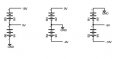
In the examples below, where you define the ground reference to be determines the relative voltages. With two batteries in series, you can have all positive, bipolar, or all negative voltages.
EDIT: made descriptions match order in the schematic.
In general lines, I do, but in this case, with V-, i got a bit confused ,i admit.
Thank you very much for the redrawn !!! Im very glad you understand me.
I just figure out an error in the original circuit. And i finally obtain the V- in the circuit. But is not a correct V- value.
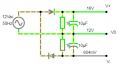
My transformer gives me 12Vac. By ADDING 2 diodes i obtained this circuit:
I got the V- part, Finally! after this minor adjustment.
But i get +6V (as it should) at V+, and -2.5V (which is not good) at V-.
I tested quickly on opamp and it should bring to -xV its output, but is on the + side.
I also made a movie to see what i did so far and also, as you requested before, to show you how i measured the thing.
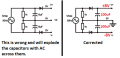
You made a dangerous error with the capacitors and diodes. The polarized capacitors have AC across them instead of filtering the rectified AC. also, the value of 10uF is too low, use 100uF instead for better filtering and 8V instead of 6V with a lot of ripple.
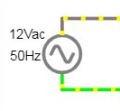
Not correct. Ground is used on DC power sources. This is AC. View attachment 217993 power source.
If you pay more attention, I have there an AC power source. Adding diodes it will swing from + to - and from - to + , 50 times per second. So... in the eyes of a simulator, my AC is still a power source and it is functioning fine on my PC. It should function fine in LTspice as well. Make a test and will thank me later. You must pay more attention, it happens to me too, no problem.
I also love your new circuit you made there with the 2 opamps, though is awfully complicated. It is pushing forward my understanding and familiarity of the opamp , thanks to you, so i thank you ! Its very good. Im more a practical man, and i tend to simplify to the basics. :] Your new approach is very exciting to me.
- But I cant understand its usage. Until now, practically/in reality, i can not obtain -12V from my transformer. I did obtaining it, only in simulator, and that gives me som stange results : higher voltage, 16 or 24V above my normal 12 that my transformer is giving at the moment.
So... your circuit assumes that i have already deal with the -xV but in fact I am still stuck at it: View attachment 217992
I already (also thanks to your older circuit) compile a workable solution but i dont completely like it View attachment 217995
If you build this circuit as shown above, NOT as you show it in message #128, it WILL work. The circuit in #128 has AC voltage applied directly across 2 electrolytic capacitors, because the diodes are in the wrong places in the circuit. Try modifying your hardware and try it out!
You made a dangerous error with the capacitors and diodes. The polarized capacitors have AC across them instead of filtering the rectified AC. also, the value of 10uF is too low, use 100uF instead for better filtering and 8V instead of 6V with a lot of ripple.
Yes, I was testing a lot of permutations. I also observed that the polarized capacitors are directly on the AC line. but as you see from the video, the diodes are on the breadboard in testing phase. Now, I put them correctly, before the capacitors and also change them as 100uF as you suggested. Now is showing correctly, +7V and -7V on both ends, relative to the ground. The total sum, if i measure directly V+ and V- it gives me 13.xxV.
And the winner is, @Audioguru again !
I also tested on the opamp and is giving me +2V at output instead of -xV, measuring from V- to output; while I power it from V+ and V- of the power source. If I measure from V+ and output, it gives me +11.xxV
I also tested on the opamp and is giving me +2V at output instead of -xV, measuring from V- to output; while I power it from V+ and V- of the power source. If I measure from V+ and output, it gives me +11.xxV
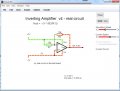
well, in this case, as you observed already, I dont mention much about ground, because its easy!! but is wrong in this configuration, where we have this V- element which is lower than ground ! We actually dont have any ground in my opamp circuit, only a higher than 0 voltage , which is V+ and a lower than 0 voltage, which is V-. But no actual 0V or ground - inside this opamp circuit.
Here is the opamp circuit that I have on the test board:
But...
I dont get that -5V on its output.
When the opamp is rali-to-rail output, you should expect an output voltage of - 7 Volts.
What opamp is used in the simulation?
An 741 will not get down to - 7 Volts.
If you're using uA741, its common mode input range (CMIR) doesn't include the negative supply. If you violate the CMIR, you can't count on the opamp functioning correctly.
If you analyze the circuit, the output should be -21V.
The way you analyze the circuit is you use the "zero input differential" theorem. Using that theorem, if the voltage at the non-inverting terminal is at -7V, the other terminal will also be -7V (if the opamp is operating in its linear mode). That gives 14V across R1, giving a current through it of 1.4mA. Since according to Kirchoff''s current law, the current in R2 will be 1.4mA. The voltage drop across R2 will be 14V, so the output would have to be -21V.
Since the opamp isn't operating in it's linear region, the simulation results are bogus.
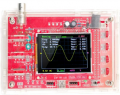
If you're going to do electronics as a hobby, in this day and age, there's no reason for not having an inexpensive oscilloscope. You can buy this one for $20:
It's good enough that I've stopped using my more expensive equipment from the 70's/80's. My favorite Tektronix scope (SC502) blew a fuse and I just received replacement fuses so I can troubleshoot. This new toy saves wear and tear on my better equipment.
When the opamp is rali-to-rail output, you should expect an output voltage of - 7 Volts.
What opamp is used in the simulation?
An 741 will not get down to - 7 Volts.
My opamp that i curently have (20pcs because they were cheap) is uA741. And is also the only opamp model i have. I will buy other newer ones as you all suggested to me and i trust you, but... i dont have that much money, especially as an artist.
The one in simulation is the same uA741.
At the moment is giving me +2V at output instead of -2V, measuring from V- (-7V) to output; while I power it from +7V and -7V from my (finally) finished power source.
Are you certain the opamps are good? Cheap doesn't imply functional. If you bought them from Amazon, eBay, or anyplace in China, they're likely counterfeit, salvaged, and/or rejects.
You should stop working on circuits and read the uA741 datasheet until you understand it's specifications.
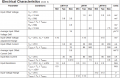
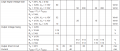
If you're operating with +/-7V supplies, the valid input range is -4 to 4V. The guaranteed output range for a lightly loaded output (>=10k) is -3 to 3V. Some parts will work outside of those ranges, but that isn't guaranteed.
@dl324 , please dont rotate the knife in my wound with the oscilloscopes.
This is a very big deal to me to have, I dream on one for maybe more than 20 years. I never got the money or the chance to buy one. I also watched like tens of videos about them, and try to learn them from others presentations. Because is such a big deal to me, i have to shoot straight when i will buy one. I dont want to risk and get a shitty one, and then discover that are better ones and better functionalities, and my money are gone forever. Even today, after doing my homework in some degree, i still cant tell much about their functions because is not the same thing watching others and having and touching one. In a word, i really dont know what to buy and im afraid it will be too disastrous. What i think i need, is to retain the peak of a wave or spike or oscilation or frequency. That i think is very important to have in an osciloscope. And i am not sure if some very basic functions (like the peak one) are available in those little handheld osciloscopes like the sample you show.
I cant argue with you at this point. I certainly must make a circuit tester for my opamps functionality.
It is in plan as well. But I need 1 to make it work first. Until now we deal with the power supply that should have been simple, but it was a bit of challenge. Now that we finished this chapter, I will concentrate on the opamp itself. I will probably, as you say, lower the voltage sources to 4V from 7V.

 Facebook
 Google
 GitHub
 Linkedin