About opamp.

Thread Starter

q12x

Joined Sep 25, 2015
2,227
Thank you for your feedback mister @Audioguru again
So, you say that any opamp is never going over 200 gain ? Or over 200 000 gain? Everywhere is said that is between 100000 and 1milion. And in theory is treated as infinite gain. Why only 200? That is very strange. Unless you are refering to something i dont understand yet.
 
Last edited:

Audioguru again

Joined Oct 21, 2019
6,826
An opamp with no negative feedback is almost uncontrollable, produces distortion and has a flat frequency response up to only 10 Hz as shown on the graph I posted from the datasheet. Its voltage gain without negative feedback is "only" 20,000 to one million (200,000 for typical ones) for an old 741 opamp, but for modern audio opamps is from 200,000 to unmeasurable (but 1 million for typical ones).

With negative feedback producing an accurate gain of 200,000, a typical old 741 opamp has a flat flat frequency response to about 8kHz which muffles all high audio frequencies but a typical modern audio opamp is flat to 80kHz. The output of the old 741 opamp with a gain set to 200 will be full of noise (hiss) and some distortion. Modern audio opamps are designed to have very low noise and very low distortion.

If you want more voltage gain than 200 then use two opamps in series. 200 x 200= a voltage gain of 40,000 times.
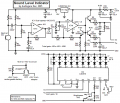
I designed and use a sound level indicator circuit that has three opamps in series producing a total voltage gain of 1820 times, but the gain becomes reduced to only 182 times for loud sounds.
Medical heart and brain monitor circuits use very high voltage gain, because the weak signal is on the person's outside skin.
 

MrChips

Joined Oct 2, 2009
34,814
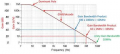
Opamp bandwidth is stated for a gain of 1.
Gain of 100,000 - 1,000,000 is stated for DC.
In the example chart shown below, a gain of 100 is good to 100kHz.
Hence you would need to cascade two opamps at gain of 100 each for an overall gain of 10,000 if you want 100kHz bandwidth.


1600780972536.png
 

Thread Starter

q12x

Joined Sep 25, 2015
2,227
Ok, so putting in series 2 (or more) opams will increase the frequency of the last opamp output.
Lesson acquired.
Mister @Audioguru again, can you share your circuit for the sound level indicator that has three opamps in series producing a total voltage gain of 1820 times ?
 

MrChips

Joined Oct 2, 2009
34,814
Ok, so putting in series 2 (or more) opams will increase the frequency of the last opamp output.
Lesson acquired.
No. Maybe you need to rephrase that.

The overall bandwidth is determined by the bandwidth of the stage with narrowest bandwidth. Adding an extra stage increases the gain, not the bandwidth.

You can only increase the frequency with some kind of frequency compensation circuit with gain stage (treble boost, for example).
 

Audioguru again

Joined Oct 21, 2019
6,826
Ok, so putting in series 2 (or more) opamps will increase the frequency of the last opamp output.
Lesson acquired.
Mister @Audioguru again, can you share your circuit for the sound level indicator that has three opamps in series producing a total voltage gain of 1820 times ?
Not really. Putting opamps in series does not increase the bandwidth. But reducing the voltage gain of each opamp with negative feedback increases the bandwidth. Opamps in series increase the total voltage gain.

My Sound Level Indicator circuit is a VU Meter that displays the loudness of sounds. Its display IC is an LM3915 that is obsolete today. It displays 10 steps at 3dB apart. The electret microphone feeds the first opamp that has a voltage gain of 101 and a bandwidth over 20kHz. The second opamp has a gain of 1.8. The third opamp is inside the LM3915 and has a gain of 10 but is switched to have a gain of 1 when there are loud sounds detected.
 

Attachments

Thread Starter

q12x

Joined Sep 25, 2015
2,227
rephrasing: putting in series 2 (or more) opams will increase the gain of the last opamp output. So the gains are cumulative using multiple opamps.
So... if the maximum is 1milion gain for my uA741, putting 2 in series will create a super opamp of 2milion gain?
I think that is what you (both) are saying.
Aha, thank you mister @Audioguru again for your circuit. THe more circuits I see with opamp, the more i figure it out. You are an immense help to me. And also congratulation to be able to make such a complicated circuit.
 
Last edited:

MrChips

Joined Oct 2, 2009
34,814
rephrasing: putting in series 2 (or more) opams will increase the gain of the last opamp output. So the gains are cumulative using multiple opamps.
So... if the maximum is 1milion gain for my uA741, putting 2 in series will create a super opamp of 2milion gain?
I think that is what you (both) are saying.
Again, NO.
You don't run the opamp with open loop gain of 100,000 (uA741) (at DC only) because of instability. You need negative feedback to control the beast.

Two 100,000 gain stages in series is 100,000 x 100,000 = 100,000,000,000 (theoretically) but totally useless because the output will saturate at the rails just from opamp internal noise.

You multiply the two gains. You add the gains if the gains are given in dB units. For example, 100dB + 100dB = 200dB.
 

Thread Starter

q12x

Joined Sep 25, 2015
2,227
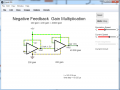
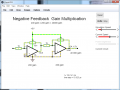
re-rephrasing: putting in series 2 (or more) opams in negative feedback configuration, will increase the gain of the last opamp output by multiplying their gains.
1600786391681.png
 

Thread Starter

q12x

Joined Sep 25, 2015
2,227
hello mister @bertus , and thank you for your pdf, its very nice. I like it.
I just fly over it now. Ill have to read it soon.
 

Audioguru again

Joined Oct 21, 2019
6,826
The datasheet for a lousy old 741 opamp shows than some of them have an open-loop voltage gain of 20,000 but a gain of 200,000 is typical. Nobody uses an opamp open-loop.

A comparator is used open-loop.
 

Thread Starter

q12x

Joined Sep 25, 2015
2,227
Update on my progress:
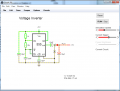
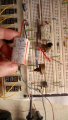
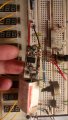
I managed to build this voltage inverter (invertor) in reality. It works as in simulation, with a bit more loss. Here in simulation its output is -4V but in reality is -3V. I think is because some very old and used capacitors. But is working, not perfect but good enough.
Is working fine in air, uncoupled to opamp pin4 (Vs-).
1600948972584.png
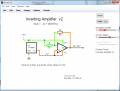
I try it on 2 different opamp modes:
[Inverting Amplifier mode] and
1600949194688.png
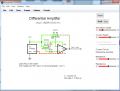
and [Differential Amplifier mode]
1600949296985.png
And it failed miserably.
My invertor when is in contact with Vs- from opamp, instead of showing -3V as it is measured in air, it shows +1V, or close to it.
I increase the overall voltage up to 12v and still, no minus sign on either Vs- or Vout of the opamp; and -Vcc of the invertor is increasing as well. What im doing wrong and i dont see it? Maybe this invertor i made is not that fit to drive an opamp? maybe is more like a signal than a voltage source?
It just crossed my mind now, to measure invertor -Vcc output current to the opamp, and is showing a mindblowing 140uA (microA) ! Yep, i think is more a signal generator than a power source, what a bummer. I didnt cross my mind it can be like this. In simulator is showing 7mA.
- How can i create a serious voltage invertor power supply? Give me a circuit if you can.
IMG_20200924_153114.jpgIMG_20200924_153138.jpg
 
Last edited:

Thread Starter

q12x

Joined Sep 25, 2015
2,227
Supply current. Can your inverter supply the -3mA that your uA741 needs?
I already mentioned it. But not at all, I measure it in circuit and it gives me 140uA (microA) ! And i wasnt smart enough to test it before making the finished board. Lesson learned then. Im also thinking adding bigger capacitors. Now they are 10uF... maybe with 100 or more uF will boost the current as well? Ill have to test it.
I am actually looking right now for positive and negative power supply. From what i see so far, it looks pretty much as the 2 bateries in series and the ground in the middle formula. 2 transformers in series is the next thing i should try pretty soon. But i really wanted to be from 1 transformer. Eh well, im adapting until it makes sense, right? If you find 1 power supply circuit that gives pos and neg voltages, and at reasonable current, feel free to post it here. Thank you for your attention.
 
Last edited:

dl324

Joined Mar 30, 2015
18,328
If you find 1 power supply circuit that gives pos and neg voltages, and at reasonable current, feel free to post it here.
I posted a circuit in post #63.

The timer circuit you posted is never going to provide much current.

Another option is to use a transformer. You won't get much efficiency from the transformer, but you can build a bipolar supply with two half wave rectifiers. Then you can use something like an LM7905 to regulate the voltage.
 

Audioguru again

Joined Oct 21, 2019
6,826
Again and again, your schematics have no part numbers for the ICs.
Maybe the 555 is a low power Cmos one (LMC555, TLC555 or ICM7555)?
Maybe the ICs are fake ones from ebay?
 
Top