40 LED Cascaded Decade Counter

dl324

Joined Mar 30, 2015
18,350
It was lighting up one of the LEDs on the second 4017 and then jumping to the fourth 4017 so a section in the middle went dark.
That doesn't make sense because the second counter enables the 3rd and the 3rd enables the 4th.

To troubleshoot, you just need to follow the reset/enable signals. What type of test equipment do you have?
At that point I just started over which is probably for the best now that I know I was pushing too much amperage through the 4017s.
You mean you unsoldered everything and started over?

Routing wires over the IC's and not using sockets must have made replacing the counter a PITA.
 

Thread Starter

Brotron

Joined Aug 8, 2024
27
To troubleshoot, you just need to follow the reset/enable signals. What type of test equipment do you have?
It was jumping on pinout 4 of the second IC to pinout 7 of the forth IC, it made no sense to me, I kind of thought I might have cracked one of the ICs when I was tweaking the board into place since they were soldered directly to the board, and I might have torqued it a bit more that I should have when screwing down the second corner. I only have a basic volt meter. Haven't gotten an oscilloscope yet.
You mean you unsoldered everything and started over?
Routing wires over the IC's and not using sockets must have made replacing the counter a PITA.
No I just started a new board and yes replacing the counter was a pita, that is why I am adding sockets and making ribbon connectors on the new one.
 

Thread Starter

Brotron

Joined Aug 8, 2024
27
The CD4017Bs output pins cannot safely support 5mA output drive current using a 5v supply voltage, so there is risk of damage to the chips. You'll need to use a transistor driver connected to each output that then drives its LED.
How about using five of the ULN2803 Eight-Way NPN Darlington Transistor arrays chips to power the LEDs? That seems to fit the specs, and will save me some board space... maybe overkill? https://www.ti.com/lit/gpn/ULN2803C
 

eetech00

Joined Jun 8, 2013
4,709
How about using five of the ULN2803 Eight-Way NPN Darlington Transistor arrays chips to power the LEDs? That seems to fit the specs, and will save me some board space... maybe overkill? https://www.ti.com/lit/gpn/ULN2803C
I recommend an NMOS mosfet array. They are similar to the uln2803 except they are mosfets. I don’t remember the part number at the moment. You can search google “mosfet array”.
 

sarahMCML

Joined May 11, 2019
698
If you use Superbright High Efficiency LED's you can run them quite happily with less than 1mA of current and get good light output. I run mine Red ones from 5V LS TTL logic, to ground, with a 22k resistor in series!
 

dl324

Joined Mar 30, 2015
18,350
It was jumping on pinout 4 of the second IC to pinout 7 of the forth IC, it made no sense to me
Makes no sense to me either because that should have required many clocks.
thought I might have cracked one of the ICs when I was tweaking the board into place since they were soldered directly to the board
That's not very likely.
I only have a basic volt meter. Haven't gotten an oscilloscope yet.
Get a logic probe that can catch single pulse events. I use HP 545A. They cost several hundred dollars when new in the 1970's, but you might be able to get one on eBay for under $30. Or a complete set of HP 545A, 546A Logic Pulser, 547A Current Tracer, and 548A Logic Clip.

EDIT: just checked eBay for grins. They're listed for around $100. Some idiots are trying to charge $50 for just the manual, which is a free download at Agilent IIRC.
I am adding sockets
I always use sockets for IC's. I've rarely had to replace IC's in my breadboards, but the sockets are cheap insurance against aggravation.
 
Last edited:

eetech00

Joined Jun 8, 2013
4,709
How about using five of the ULN2803 Eight-Way NPN Darlington Transistor arrays chips to power the LEDs? That seems to fit the specs, and will save me some board space... maybe overkill? https://www.ti.com/lit/gpn/ULN2803C
I recommend an NMOS mosfet array. They are similar to the uln2803 except they are mosfets. I don’t remember the part number at the moment. You can search google “mosfet array”.
Part number is Toshiba TBD62083A, an 8 channel NMOS drive array. The NMOS inputs require a tiny amount of drive current, so drive current from the CD4017B is not a concern. The TBD62083A outputs are specs to drive up to 500mA, but I wouldn't do that, at least not without a heat sink. They can drive your LEDs with no problem.
 

Thread Starter

Brotron

Joined Aug 8, 2024
27
Part number is Toshiba TBD62083A, an 8 channel NMOS drive array. The NMOS inputs require a tiny amount of drive current, so drive current from the CD4017B is not a concern. The TBD62083A outputs are specs to drive up to 500mA, but I wouldn't do that, at least not without a heat sink. They can drive your LEDs with no problem.
Thanks! I ordered in some of the TBD62083A chips. If my understanding is correct, each output pin will act as a switch that keeps the LED power from going to ground until the corresponding input receives the gate threshold voltage. So I run the VCC to the LED and resistor before going into the output pin and in parallel with the VCC going to the com pin. So my output is acting as a drain instead of outputting power, does that sound right?
 

eetech00

Joined Jun 8, 2013
4,709
Thanks! I ordered in some of the TBD62083A chips. If my understanding is correct, each output pin will act as a switch that keeps the LED power from going to ground until the corresponding input receives the gate threshold voltage. So I run the VCC to the LED and resistor before going into the output pin and in parallel with the VCC going to the com pin. So my output is acting as a drain instead of outputting power, does that sound right?
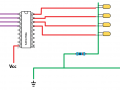
Yes. The COM pin should be left disconnected. See below.
The drawing is intended to be "typical" for 5v LED supply and standard 2v@20mA LEDs. You may need to adjust the resistor values for the LEDs you are using.

1726085777402.png

EDIT: Corrected TBD62083 symbol.
 
Last edited:

Thread Starter

Brotron

Joined Aug 8, 2024
27
Yes. The COM pin should be left disconnected. See below.
The drawing is intended to be "typical" for 5v LED supply and standard 2v@20mA LEDs.
Thanks, thats helpful. Do you need a resistor for each LED or can you add it before all the LEDs? I guess its safer, incase multiple LEDs fire at once, but is that much of a worry with this array?
 

Thread Starter

Brotron

Joined Aug 8, 2024
27
In your case, you only need one resistor because only one LED will be on at a time.
Realizing now that I already have all 35 of the LED grounds soldered together within the structure itself, am I totally screwed for using the TBD62083A? Any work around? Thanks1725650170396.png
 

Thread Starter

Brotron

Joined Aug 8, 2024
27
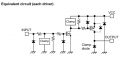
One thing I'm still not clear on but I think is correct by looking at the driver circuit... If I send a gate voltage within specifications to the TBD62783APG-ND will it only draw the amperage it needs to switch high and achieve saturation, or do I need to control the exact VA sent? Is it totally isolated from the on state of the output? Thanks for any illumination on this. BTW I found a great overview of the 4017 if any noobs like myself are interested in a deeper breakdown of the chip. According to this I could have used the chip as a buffered LED driver for up to 10 mA, and it has a interesting diagram using Nand gates for the cascade with Nor gates for the clock reset signal https://www.jotrin.com/technology/d...o-cd4017-decade-counter-datasheet-application
 

eetech00

Joined Jun 8, 2013
4,709
One thing I'm still not clear on but I think is correct by looking at the driver circuit... If I send a gate voltage within specifications to the TBD62783APG-ND will it only draw the amperage it needs to switch high and achieve saturation, or do I need to control the exact VA sent? Is it totally isolated from the on state of the output?
While the input voltage level is more important to turn on the output, the 62783 input pin only requires about 100uA to turn on its output. The input current is limited internally, so you can connect the output of the 4017 directly to the 62783 input pin.
 

Thread Starter

Brotron

Joined Aug 8, 2024
27
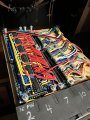
New protoboard awaiting the TBD62783APG chips for the additional power handling. 3 10uf bypass caps on the VCC spaced around the board and 104 caps at every power pin going into the 4017s Hopefully it will be just plug and play this time. Was a tight fit to get the additional 5 ICs into the existing structure, looking like 1970s telecom, If I have to do another one I'm definitely out sourcing a printed board.
 

Attachments

Top