Why won't my linear stepper motor work?

Thread Starter

Ben Varvil

Joined Apr 30, 2018
197
I wound new coils today, waiting for them to cure. I wired up the control circuit and used the broken coils as a place holder.
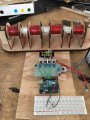
IMG_1825.JPG

I tried putting those green sheets seen in the videos...
Image-1 (4).jpg

I'll spare the video. Nothing happens.

Here is a coil pulling a section of cue stick:


Seems pretty weak
a 16" stroke gets 9 pulls like this. Doesn't seem enough to accelerate the 2lb cue to break speed.
 

Sensacell

Joined Jun 19, 2012
3,785
Looks pretty awesome from here!

The hard part is making the movement CONTROLLABLE, not just spastic jerking around.
That's where the level of sophistication jumps substantially, first you need a position feedback system that tells you exactly where the cue is at all times, then you can use that data to commutate and modulate the coil current to achieve smooth position control.
 

shortbus

Joined Sep 30, 2009
10,050
Still say you should have done more 'homework' on what you're trying to do. As a teacher, what grade would you give a student that refuses to do the homework? A simple Google on "tubular linear actuator" will get so many hits with good information. And none of them have coils wound like yours. Sorry for being a downer all of the time, but really don't think your sincere on doing this anymore.
 

DNA Robotics

Joined Jun 13, 2014
670
Last edited:

Thread Starter

Ben Varvil

Joined Apr 30, 2018
197
You forgetting something
You cut power to the coil next coil kicks in then next.
You braking in your Video you pull then are holding
I agree. The "next coil" was severed during fabrication so I couldn't test passing the steel between coils. Once I get the new set of coils installed, I'm excited to experiment with exactly what you're suggesting.
 

Thread Starter

Ben Varvil

Joined Apr 30, 2018
197
The hard part is making the movement CONTROLLABLE, not just spastic jerking around.
That's where the level of sophistication jumps substantially, first you need a position feedback system that tells you exactly where the cue is at all times, then you can use that data to commutate and modulate the coil current to achieve smooth position control.
I'm going to try open loop control first and, yes, I expect most results to be spastic. However, I might get lucky and find a pulse routine that does something interesting.

I agree that position feedback is next. I see a course, simple method and a finer, more complicated method:
Simple/course: Detect steel vs wood at three strategic positions along the cue. With a homing routine and by monitoring how the steel/wood data changes, I should be able to register direction of motion and position of the cue to within one steel length (1.75"). This might be enough, considering my step resolution is 1.75" to begin with. I need to read up on induction sensors, but I'm pretty sure I can make them easily... yes?

Fine resolution/ complicated: Put a striped strip on the cue and read it optically. Or these magnetically sensitive linear encoders placed away from the coils. Other ideas?

Thanks for the feedback.
(oh man, I didn't mean that pun, but I'm leaving it...)
 

shortbus

Joined Sep 30, 2009
10,050
He is getting good movement. With 9 of those coils timed right, he will get a lot of movement.
Moving one is just a simple solenoid. It just seem funny that if this was this easy, getting power, speed and position control, from doing it this way, companies making them would do it like this. Again for his sake I hope to be proven wrong.
 

Sensacell

Joined Jun 19, 2012
3,785
Moving one is just a simple solenoid. It just seem funny that if this was this easy, getting power, speed and position control, from doing it this way, companies making them would do it like this. Again for his sake I hope to be proven wrong.
Suspend disbelief- think of this as "Art"- not commerce.
Doing this in a round-about-impractical way is what the OP has chosen, I have accepted this idea.

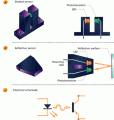
For the next phase of experiments: I suggest using an optical retro-reflective sensor to detect the movement of the rod.
retro.gif
You could use bands of black and white tape on the rod as index marks.
Avoid the temptation to use magnetic sensors, you will have problems with interaction between sensing and the coil magnetic fields.
We call this "cross domain design" - light sensors are not going to care about the magnetic fields.

With this setup, you should be able to get some dramatic yet poorly controlled linear motion.
 

be80be

Joined Jul 5, 2008
2,395
There's one problem here I see first off it's not that simple. We are at 314 post here.

Now what he has come back with looks good And it will move if he wires it up right but he's going to need a lot more then
4 mosfet's seeing he didn't go with center tap coils You'll need 4 h- bridges.
 

shortbus

Joined Sep 30, 2009
10,050
4 mosfet's seeing he didn't go with center tap coils You'll need 4 h- bridges.
This will probably get me in more hot water.:D

Why do you keep saying that? You do know that most stepper drivers reverse direction by reversing the sequence of the stepper, don't you? Using center tapped coils only means the coils need to be twice as many wraps to get the same amount of force or amp turns in them.
 

shortbus

Joined Sep 30, 2009
10,050
Suspend disbelief- think of this as "Art"- not commerce.
Doing this in a round-about-impractical way is what the OP has chosen, I have accepted this idea.
That's the way I'm looking at this project too... it's meant to be beautiful, not practical...
I guess that's where we differ in this project. I understand the "art" thing, I get it. But from reading both this thread and all of the interviews online with him, about what he is trying to do, I thought, got the impression that it was, in the end, a practical real pool playing robot. Guess I have got my wires crossed in this, as usual.

I again put my thinking and desire to make something practical, whether a robot(like this) to a tool or other project. In pursuit of one of my own goals, I did a lot(more hours and reading than I can even now imagine redoing) in researching a similar concept. And I'm letting that "research" bleed into someone else's project. Guess that comes from a lifetime/career of having to come up with a solution that will work every time, day in and day out, with the most practical/easiest, low cost way of doing it.

To the "art" part of it, I can't see art in what it looks like now, maybe I need to squint my eyes more to get past the "cobbled" part of it. :)
 

DNA Robotics

Joined Jun 13, 2014
670
most stepper drivers reverse direction by reversing the sequence of the stepper. Using center tapped coils only means the coils need to be twice as many wraps to get the same amount of force or amp turns in them.
I agree with you shortbus.
He is moving an iron slug back and forth in sequence. He doesn't need the complexity of bipolar and H bridges.
 
Last edited:

Thread Starter

Ben Varvil

Joined Apr 30, 2018
197
Avoid the temptation to use magnetic sensors, you will have problems with interaction between sensing and the coil magnetic fields.
We call this "cross domain design" - light sensors are not going to care about the magnetic fields.
Well... I have hall sensors in route.
My plan is to mount them away from the coils in what will be thought of as the "left hand" or the bridge hand of a right handed pool player. My thinking is that since the steel pattern is repeated, I can use positioning of a steel piece not in the coils to determine the positioning of steel within the coils. The distance between the coils and the sensors should eliminate interference directly from the coils.

My remaining concern is that sensing steel, then sensing steel that has been magnetized by coils will be different. Maybe the hall sensors aren't sensitive enough to care. We'll see.

If the hall sensors fail, I'm down to put stripes on the cue and detect optically. I've been avoiding it because stripes add friction as the cue slides and increases the cue stick OD through the coils...
 

Thread Starter

Ben Varvil

Joined Apr 30, 2018
197
Now what he has come back with looks good
Thank you. The new coils that are still curing look even cleaner. Hopefully I can get the tube out without breaking them this time.

then
4 mosfet's seeing he didn't go with center tap coils You'll need 4 h- bridges.
I'm starting with the simple approach and working my way up in complexity as needed. Let's see how this basic method works first. If it is weak, I'm down to add permanent magnets to the slugs, then start push/pulling via H-bridges.
 

be80be

Joined Jul 5, 2008
2,395
You can't change direction with the coil without reversing the poles he has to wire it up as unipolar
The way he has it shown he is just hooking all four coils to ground on one side.
Im not adding to anything the way your wiring it will not work it will only move one way.
You can wire it unipolar But you show it done wrong.
Ill draw you something up
 
Top