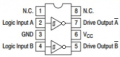
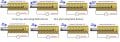
That you've been using the wrong dirver is a real posssibility. But this diagram that you've shown is of a normal, non-inverting driver:
I was basing my answer on the data sheet given. I hate it when the data sheets don't have a "truth table" included when they are logic based chips.Those tiny circles at the front of the triangles representing the gates mean that the output is inverted with respect to the input. And the lines above letters A and B at the output labels mean the same thing.
Thank you. Some questions I have in LTSpice just vanished.Those tiny circles at the front of the triangles representing the gates mean that the output is inverted with respect to the input. And the lines above letters A and B at the output labels mean the same thing.
C, did you mean that? Or did you mean 10k between gate and source on the mosfets? Without the 10k between G and S if the drive is shut down with a gate still charged won't it still be 'on' if the power is turned back on, unless some time has elapsed?Did you install pull-down resistors to ground at their inputs?
I meant pull-downs at the driver's inputs. I didn't read the driver's datasheet, and some of them have open collector inputs, so a pull down resistor is needed. Ben hasn't posted exactly which driver he's using, and I'm unfamiliar with his controller's i/o characteristics, so I suggested those resistors just to be on the safe side.@Ben Varvil and cmartinez
C, did you mean that? Or did you mean 10k between gate and source on the mosfets? Without the 10k between G and S if the drive is shut down with a gate still charged won't it still be 'on' if the power is turned back on, unless some time has elapsed?
Ben hasn't posted exactly which driver he's using,
I looked at the IRL540 MOSFET data sheet again: https://www.vishay.com/docs/91300/91300.pdfInteresting, the numbers on the chips are no longer there. Maybe they burned off?
Their brothers still in the case read: MC34151P then AKAA then 1806G
I think it's worth a try.I looked at the IRL540 MOSFET data sheet again: https://www.vishay.com/docs/91300/91300.pdf
It looks like 28A is the "avalanche current" absolute maximum... which feels like it applies to my application.
As was mentioned earlier, I'm likely pulling much more current than I think I am. So, it feels like time to redesign the coils. I'm balancing the numbers: Wire gauge, number of coils and overall resistance... It feels like the system I have will be able to handle 3A, motivating me to shoot for 4ohms. Does this sound like a good plan? 4ohm, coils?
THanks for any thoughts.

I'm on board to wind new coils with thinner wire. I'm trying to make better decisions about gauge, resistance and amperage... This is proving to be tougher than I anticipated. The Trombetta people (thanks DNArobotics) tell me the P515-A57V12 pulls 13amps with a coil resistance of .92ohms.You show the driver chip with no numbers that can't be good.
If you want this to work you need to use smaller wire and make the coils right cause what your making will not do what you say you want.
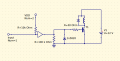
I did reading on pull-up resistors. Thank you. I feel like I get it. I still don't understand what the diode from the gate to ground does, but I'll trust you and hopefully figure it out later.The driver chip you say your using needs pull up on the input You need 4 diodes on the gate to ground.
No. I thought the 10 ohm resistor on the gate was to prevent ringing. I see now that V=IR says I'm pumping 1.2Amps to the MOSFET. I see you selected 30ohms so that the gate sees 400mA.thats 10 ohm there you have on the gate you do no that means 1.2 amps could flow out to the gate.
I agree, I definitely cooked the driver chip. Why does the specification list chip performance for 10mA, 50mA and 400mA. Is that just to give designers a spectrum? and designers are to assume the highest value is the max?Whats that say the last line 400 mA the max clamped for the whole chip is 1 amp you done cooked the name off the chip.
Bipolar drivers use H-bridge circuitry to actually reverse the current flow through the phases. By energizing the phases with alternating the polarity, all the coils can be put to work turning the motor.
Unipolar vs. Bipolar
Unipolar drivers, always energize the phases in the same way. One lead, the "common" lead, will always be negative. The other lead will always be positive. Unipolar drivers can be implemented with simple transistor circuitry. The disadvantage is that there is less available torque because only half of the coils can be energized at a time.
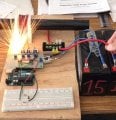
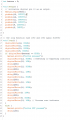
two things: First, I looked at my code again and realize that there IS a delay between coil activations (200ms), which explains why the lamp pulsed rather than being on continuously. Second, output 13 is just the on-board LED to tell me when something is happening. It is not connected to a coil.His code has one coil on for 1.4 seconds and I'm sure it getting everything hot LOL
I realize my windings look like one coil, 1" wide. But there are four separate, 1/4" coils, each with independent access to power. The code is push button activated... so each coil is activated for 200ms then everything goes off, waiting for the next button press. I don't see where "that coil is on for 1.4 anyway you look at it" is coming from.I don't think you understand how a coil works
you fire 1 2 3 4 your loop is 1.4 seconds that coil is on for 1.4 anyway you look at it.
Like I said it's made wrong the coil needs to be at most 24 or 22 gauge wire.
and 4 ohm and I would center tap coils would work best they can pull or push the shaft the easy way
The one I made is 1 ohm 24 gauge and I get's hot at 5 amps and it was on maybe half a second.