Why won't my linear stepper motor work?

cmartinez

Joined Jan 17, 2007
8,768
The more wire used the stronger the electro magnet.
And also the more wire used, the higher its series resistance. Wouldn't there be a point in which an optimal number of loops have been reached to obtain a maximum magnetic field for a given voltage applied to the coil?
 

be80be

Joined Jul 5, 2008
2,395
And also the more wire used, the higher its series resistance. Wouldn't there be a point in which an optimal number of loops have been reached to obtain a maximum magnetic field for a given voltage applied to the coil?
Yes there is a lot to think about a 20 turn coil of big wire like in the first post
not much of a magnet.
Screenshot from 2018-06-10 16-02-41.png
He needs 4 of these with smaller wire and I would center tap them, Why because the TS is using a Mosfet as a switch if
 

be80be

Joined Jul 5, 2008
2,395
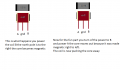
I would start like this
coil.png

Little more to show how the core needs to be
If you want try this I'll waste my time drawing up how to control it with a arduino
page1.png
More to think about
coil1.png
If you use a magnet for the core you have to make sure you set them right
so the poles are right.
 
Last edited:

Thread Starter

Ben Varvil

Joined Apr 30, 2018
197
Magnet is not amps in a small loop of big wire, The more wire used the stronger the electro magnet.

There one more thing you really need to be careful this could end up hurting you .
This can move a rod at great speed once you get it right.
So don't point it at you when testing
I appreciate the optimism. Thank you.

a quick visualization: 250ft of 22 GA wire gives me only 59 wraps around the 1.3" tube. Wire diameter of 0.052" means the entire coil is 1.3" wide. I'm happy to be surprised, but I just don't see one short, thin layer of coil moving 2 lbs of steel. However, I'll assume it is going to shoot out for the sake of safety. Thank you.
 

Sensacell

Joined Jun 19, 2012
3,785
Hmm.

Been watching this one a while now, impressed with your dogged perseverance.
Blowing up all those parts would have nuked my enthusiasm long ago.

I suggest re-thinking the whole "open frame linear stepper" idea, while it could theoretically work, it's a very inefficient concept to work from.

If you study any practical electromagnetic device, you start to see a "design language" that revolves around efficiently using materials and energy to accomplish a function, in the smallest, lightest and cheapest configuration possible.

Magnetic flux is conducted in these structures using high permeability materials (iron/steel) in the smallest possible loop, with air gaps between the moving parts reduced to an absolute minimum. Coil designs are critically optimized to provide maximum magnetic flux for a given volume, voltage and power. (this alone is a HUGE subject)

Your concept relies on air as the primary magnetic flux path around the coils, the magnetic resistance of air is very high, making it terribly inefficient at converting energy to force and movement.

Linear magnetic actuators of any length are rare beasts, much better to use a conventional motor and convert rotary to linear with a simple mechanism.

If you think about it, a rotary motor is just a linear motor "rolled up" into an infinite configuration- while providing additional advantages:
Very efficient use of magnetic energy, the circular configuration minimizes flux paths while supporting small air gaps.
Attractive forces are inherently self-balancing.

I would use a brushed DC servo motor with incremental encoder.
Use a timing belt to convert rotary to linear.
Use a microcontroller to make a position control loop for the motor. (or buy a servo controller)

With this setup, you could achieve spectacular precision and performance without too much effort.
 

Thread Starter

Ben Varvil

Joined Apr 30, 2018
197
You say, when powering B, "The core becomes magnetic" then when the coils switch, coil A repels the core's newly created magnetic field.
So even if the core is not a magnet, but just a ferrous material, activating coil A (behind the core at this point) will repel the core?!?! Wow. Counter-intuitive. I've only ever seen a magnet attract a metal rod. I will absolutely try this.

If you want try this I'll waste my time drawing up how to control it with a arduino
I'll gladly use it. Thank you.

If you use a magnet for the core you have to make sure you set them right
so the poles are right.
I found this to be easy because the magnets want to go that way on their own.
 

Thread Starter

Ben Varvil

Joined Apr 30, 2018
197
Why are you moving 2.5 pounds of steel
I thought you wanted to play pool
2 pounds of steel.
I'm going for 5x the weight of the cue ball, which is 6oz x 5 = 2.2lbs. I picked 5x because I feel like that's the mass of the human hand and arm connected to the cue at the moment of impact. I'm guessing there is a far better material than steel, but that is what I have right now.

I'm threading a rod down the center of the core pieces. The cue stick shaft threads onto the end of that threaded rod.
 

Thread Starter

Ben Varvil

Joined Apr 30, 2018
197
Hey Sensacell,

while it could theoretically work, it's a very inefficient concept to work from.
YES!!! "It could theoretically work." Thank you.

If you study any practical electromagnetic device, you start to see a "design language" that revolves around efficiently using materials and energy to accomplish a function, in the smallest, lightest and cheapest configuration possible.
I feel the design language being spoken among practical electromagnetic devices assumes a common interest in high sales. One of the nice parts about this project for me is that it is impractical and that I don't have to worry about selling it. I want it to look cool and to get to people interested.

Magnetic flux is conducted in these structures using high permeability materials (iron/steel) in the smallest possible loop, with air gaps between the moving parts reduced to an absolute minimum. Coil designs are critically optimized to provide maximum magnetic flux for a given volume, voltage and power. (this alone is a HUGE subject)
Alright! Steel should be good after all.
Cmartinez was talking about the critically optimized features based on Volume, Voltage and power earlier. Everything I've been reading since about calculating the magnetic field makes sense except this "magnetic flux" value. You can't just look up flux values based on current and wire type? (Or at least I'm not seeing how, yet). It seems as if you have to test a coil, then back out this flux value mathematically. I guess that let's you use the flux value in future calculations involving that coil. Anyway, yes, I am definitely trying to minimize the air gap between the coil and the steel.

I would use a brushed DC servo motor with incremental encoder.
Use a timing belt to convert rotary to linear.
Use a microcontroller to make a position control loop for the motor. (or buy a servo controller)

With this setup, you could achieve spectacular precision and performance without too much effort.
Yup. There has been strong support for this methodology from the start. I'll add that from an artistic perspective, I'm trying to not have this project sound like the typical robotic "Whirrrrr" Whirrrrrr!" I want it to be elegant with maybe a "whoosh whooosh".

Art may very well have to be sacrificed for functionality after these tests. We'll see.

In the meantime, here is a video of me testing the project geometry a while ago.
 

Thread Starter

Ben Varvil

Joined Apr 30, 2018
197
Are you purposefully making the cores longer than the coils here? or is that just from making a quick drawing? In your second drawing they are the same. My plan is to make the cores as long as the coils (1.3") This also happens to make each steel core 0.5LBs, meaning 4 of those = 2lb of steel.
 

shortbus

Joined Sep 30, 2009
10,050
I would use a brushed DC servo motor with incremental encoder.
Use a timing belt to convert rotary to linear.
Use a microcontroller to make a position control loop for the motor. (or buy a servo controller)
Which is what I've been trying to get across for some time. Like all modern inkjet printers use for the side to side movement. And is what is being used in the original pool playing robot he showed a link to.
 

shortbus

Joined Sep 30, 2009
10,050
And the ink jet printer ink thing came out of a year old printer most newer printers have only motors that is not a stepper
it's a plain old 24 volt motor
And it is using the toothed belt and pulleys I've been talking about for some time. You didn't show that side of the the mechanism in your video, why? That is why I thought it was a linear reluctance motor, from what was shown.

Solenoid which is made for along stroke
A solenoid is far from what the original project was about.
 

be80be

Joined Jul 5, 2008
2,395
Need to backup here and think. What is this really needing to happen
4 coils sounds good I'd go with that.
Now let's make the shooting part work with four coils.
You fire coil1 rod moves right coil2 fires rod keeps moving same for the next 2 coils.
This is not that hard to do.
But you have to make four working coils.

Trying to make this happen with 4 the size the TS posted and pump a lot of amps on small coil not a good ideal
Make 4 of those then make the stick to have a 15 inch stroke would be the way to go. The whole thing could be easy to control
 

Thread Starter

Ben Varvil

Joined Apr 30, 2018
197
Need to backup here and think. What is this really needing to happen
4 coils sounds good I'd go with that.
Now let's make the shooting part work with four coils.
You fire coil1 rod moves right coil2 fires rod keeps moving same for the next 2 coils.
This is not that hard to do.
But you have to make four working coils.

Trying to make this happen with 4 the size the TS posted and pump a lot of amps on small coil not a good ideal
Make 4 of those then make the stick to have a 15 inch stroke would be the way to go. The whole thing could be easy to control
Just confirming: Each of the 4 separate coils is center tapped... with 4ohms (250' of 22AWG) on each side of the tap. 500' of wire total in each coil. This means that each coil needs 2 MOSFETs. 4 coils = 8 MOSFETs, 4 driver chips.

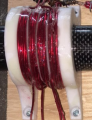
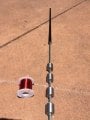
The wire came in and I spent some time on the metal lathe this morning making cores. The spool shown is 500' of 22AWG next to the 1.3" cores.

judith stick.jpg

I'm getting ready to start winding. My plan is to wind 250' in a space half as wide as a core, pull out a center tap, then wind another 250' half as wide as a core. SO, the entire center tapped winding will be the same length as one of the cores.
 
Top