Why won't my linear stepper motor work?

shortbus

Joined Sep 30, 2009
10,050

be80be

Joined Jul 5, 2008
2,395
In general, high voltage, high current and low switching frequencies favor the IGBT
No blowen chips
His is switching on to slow or under powered that's why he is blowing them
And google is your friend there maybe 100 hits why is my MOSFET burning up.
I didn't say better And I was saying faster as in there made to switch loads like these and the fact that I happen to have some from work
that love a 5 volt uC output pin

I'm not saying this has to use one but I do bet this the TS will find out that using the arduino to drive his coil going to take a lot more parts then just 4 MOSFETS 8 resistors and 4 diodes


https://www.google.com/search?q=why...ome..69i57.12789j0j7&sourceid=chrome&ie=UTF-8

If a MOSFET turns on to slow it get hots, If it don't turn on it get's hot If you turn it on and off to fast it heats up and lowers it amp rating.

The above is why its not that easy for someone who never used them to make a good H-bridge.

Happy rabbit hunting
 

cmartinez

Joined Jan 17, 2007
8,768
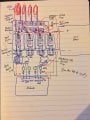
While waiting on parts, I've sketched myView attachment 153076 layout:
Ben, are you familiar with LTspice? ... this tool might come in handy. At least when trying to roughly calculate the stress that the parts in your circuit is going through.

Best thing is, it's free! ... which is perfectly adjusted to anyone's budget.

That is, of course, if you prefer to summon and witness magic smoke firsthand whilst empirically trying to understand what's going on.
 

Thread Starter

Ben Varvil

Joined Apr 30, 2018
197
Ben, are you familiar with LTspice? ... this tool might come in handy. At least when trying to roughly calculate the stress that the parts in your circuit is going through.

Best thing is, it's free! ... which is perfectly adjusted to anyone's budget.

That is, of course, if you prefer to summon and witness magic smoke firsthand whilst empirically trying to understand what's going on.
Nope. Never heard of it. I'll head that way now.
I'm nervous that you suggest this after looking at my sketch... am I fixing to toast components here?
 

cmartinez

Joined Jan 17, 2007
8,768
Nope. Never heard of it. I'll head that way now.
I'm nervous that you suggest this after looking at my sketch... am I fixing to toast components here?
You can toast components to your heart's desire ... but simulation is free! ... plus, you get to learn the real science behind the circuits, and not just rely on empirical knowledge
 

shortbus

Joined Sep 30, 2009
10,050
Personally I would put the indicator Leds in parallel with the coils. To keep them from pulling down the outputs of the Arduino. And somewhere you will need to get both the Arduino and main battery grounds together, so the Arduino can actually switch the gate drivers. Unless I missed the connection?
 

Thread Starter

Ben Varvil

Joined Apr 30, 2018
197
Personally I would put the indicator Leds in parallel with the coils. To keep them from pulling down the outputs of the Arduino. And somewhere you will need to get both the Arduino and main battery grounds together, so the Arduino can actually switch the gate drivers. Unless I missed the connection?
Hey Shortbus,

Putting the LEDs in parallel with the coils makes a lot of sense. It will allow me to confirm current flow through the coils rather than just confirm output from the Arduino. Good call.

Powering a little LED off of a giant battery is a little intimidating. After a bunch of reading about forward voltage, forward current, yadda yadda yadda, it looks like I should use a 570ohm resistor in series with the LED. I'm pretty sure I understand where that value comes from. We'll see. Does that sound correct? I'm using a 12V motorcycle battery...

Good catch on giving them a common ground. I intended to, but definitely left it out of my sketch. Thanks for the review.
 

Thread Starter

Ben Varvil

Joined Apr 30, 2018
197
You can toast components to your heart's desire ... but simulation is free! ... plus, you get to learn the real science behind the circuits, and not just rely on empirical knowledge
Wow. 2 hours of tutorials and experimenting with LT Spice and I feel very lost. I'm going to keep at it, but man, this is advanced. I'm wondering if the texts I'm reading from AAC will overlap with what I'm seeing in the simulators soon...

If you happen to be an LTspice wizard, I'm very open to tips/tricks. I'm trying to model one coil circuit of the sketched layout.
Thanks either way.
 

shortbus

Joined Sep 30, 2009
10,050
Powering a little LED off of a giant battery is a little intimidating. After a bunch of reading about forward voltage, forward current, yadda yadda yadda, it looks like I should use a 570ohm resistor in series with the LED. I'm pretty sure I understand where that value comes from. We'll see. Does that sound correct? I'm using a 12V motorcycle battery...
Hi, when I need to do that it is simpler for me to just use one of the many online Led resistor calculators. I hate math and am really challenged by it. Take your pick - https://www.google.com/search?q=online+Led+resistor+calculator&ie=utf-8&oe=utf-8&client=firefox-b-1
 

be80be

Joined Jul 5, 2008
2,395
There is only one thing that get's me what the TS is showing only going to move one way
To pull the rod back you have to reverse the voltage
 

cmartinez

Joined Jan 17, 2007
8,768
Wow. 2 hours of tutorials and experimenting with LT Spice and I feel very lost. I'm going to keep at it, but man, this is advanced. I'm wondering if the texts I'm reading from AAC will overlap with what I'm seeing in the simulators soon...

If you happen to be an LTspice wizard, I'm very open to tips/tricks. I'm trying to model one coil circuit of the sketched layout.
Thanks either way.
Ben, here's a strategy that might help: Stop drawing circuits by hand, and start using LTspice as just a sketching tool. That way you will learn how to create, wire up and manipulate components within its system. Post your sketches here, and we'll help you as you go.

Eventually, we can help you turn those sketches into real simulations, and then you'll really have something to show for all your effort, and not just pretty pictures.
 

Thread Starter

Ben Varvil

Joined Apr 30, 2018
197
There is only one thing that get's me what the TS is showing only going to move one way
To pull the rod back you have to reverse the voltage
Energizing the coils 1, 2, 3, 4, 1, 2, 3, 4 moves the stick one way, energizing them 4, 3, 2, 1, 4, 3, 2, 1 moves it the other direction... in theory.
I do hope to upgrade to an H-bridge eventually to utilize pushing as well as pulling, but not until I get this first system working.
 

be80be

Joined Jul 5, 2008
2,395
That can't work you ended at 4 if you send a 4, it just stay at 4 LOL to move back you have to change the poles

This not that easy there ways to make it work but that's not easy too do. Your rod have to be made out of a magnet which how it needs to be make is hard to do. The video I posted had 2 that's how I showed it moving 2 ways but I still had to swap the battery poles to do that.
 

Thread Starter

Ben Varvil

Joined Apr 30, 2018
197
That can't work you ended at 4 if you send a 4, it just stay at 4 LOL to move back you have to change the poles

This not that easy there ways to make it work but that's not easy too do. Your rod have to be made out of a magnet which how it needs to be make is hard to do. The video I posted had 2 that's how I showed it moving 2 ways but I still had to swap the battery poles to do that.
Hi be80be,

I think I can do this without changing poles:
There are 15 thin disc magnets spaced 1 inch apart within the tube. (each of the 4 coils are .25" in width) As a magnet within the coils aligns with coil # 4, the next magnet is in place to be pulled inside of #1 when it is activated, therefore 1,2,3,4,1,2,3,4 moves the stick 2" forward, using 2 different disc magnets.

(4,3,2,1)x15 moves the stick 15" backward.

Again, I do want to be able to change poles eventually.
 

Thread Starter

Ben Varvil

Joined Apr 30, 2018
197
Ben, here's a strategy that might help: Stop drawing circuits by hand, and start using LTspice as just a sketching tool. That way you will learn how to create, wire up and manipulate components within its system. Post your sketches here, and we'll help you as you go.

Eventually, we can help you turn those sketches into real simulations, and then you'll really have something to show for all your effort, and not just pretty pictures.
I like this strategy. I think it's called "Get out of the nest."
I'm working on an LTspice sketch to post. It'll be laughable, but a start nonetheless.
Thanks for the nudge.
 

Thread Starter

Ben Varvil

Joined Apr 30, 2018
197
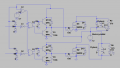
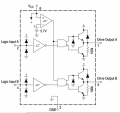
Here is my first shot at using LTspice. I tried to model one of the driver chips, two of the power MOSFETS and two of the coils. I'm not sure how to represent the two outputs from the Arduino, so I left those as hanging wires on the left. There also has to be a better way to connect power to components without covering the schematic in wires. I'm reading about "bus taps" is that the correct route to do that?

Thanks for any help.

judith circuit LTspice.png MC34151.png
 

Attachments

Top