Facebook
 Google
 GitHub
 Linkedin
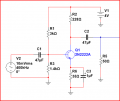
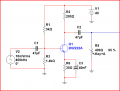
I am trying to simulate a circuit from an exercise. I am confident that I have calculated everything correctly, but unfortunately, the simulation does not match the calculation. The amplification in the upper half of the waveform is weaker than in the lower half. I suspect that the cause of this issue is the parameters of the transistor I selected. However, I don't have enough knowledge to adjust the SPICE model of the transistor to make the simulation match the calculations. Could you please help me with adjusting the model? Or is there another reason why the amplification is not symmetric in the simulation?
At first, consider this simple circuit:
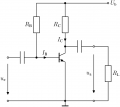
Given:
The input characteristic figure of the transistor is given as well. I had to determine the value of the resistor \( R_B \) that sets the base-emitter voltage \( U_{BE} \) of 0.7 V at the operating point. To do this, I wrote the following equation and drew a load line:
\( U_b = I_B R_B + U_{BE} \implies I_B = (U_b - U_{BE}) / R_B = \frac{U_b}{R_B} - \frac{U_{BE}}{R_B} \)
1. \( U_b = U_{BE} \implies I_B = 0\)
2. \( U_{BE} = 0.7 V \implies I_B = 40 \mu A \)
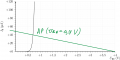
With this, I was able to calculate the value of \( R_B \):
\( R_B = \frac{\Delta U_{BE}}{\Delta I_B} = - \frac{0.7 V - 4 V}{40 \mu A - 0 \mu A} = 82.5 k\Omega \)
The next figure shows the output characteristic curves of the bipolar transistor from the circuit. I had to draw the corresponding load line for the resistor \( R_C \) and to mark the operating point. According to the diagram, the collector-emitter voltage \( U_{CE} \) is 1.9 V at this operating point:
1. \( U_b = I_C R_C \implies I_C = \frac{U_b}{R_C} = \frac{4 V}{250 \Omega} = 16 mA \) (if \( U_CE = 0 V \))
2. \(I_C = 0 A\) if \( U_{CE} = 4 V \) (= \( U_b \))
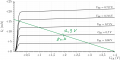
According to the given circuit, it is a common-emitter amplifier. The gain of this amplifier can be calculated as follows:
\( A = - S r_a = -13.22 \)
where
\( S = \frac{I_C}{U_T} (1 + \frac{U_{CE}}{|{U_A}|}) = \frac{8 mA}{26 mV} (1 + \frac{1.9 V}{50 V}) = 319.385 mS \)
\( r_a = (r_{CE} || R_C || R_L) = 41.4 \Omega \)
Now to the simulation. I took the bipolar transistor 2N2222 and adjusted its model as follows (bold marked values):
.model own2N2222 NPN(IS=1E-14 VAF=50 BF=200 IKF=0.3 XTB=1.5 BR=3 CJC=8E-12 CJE=25E-12 TR=100E-9 TF=400E-12 ITF=1 VTF=2 XTF=3 RB=10 RC=.3 RE=.2 Vceo=1.9 Icrating=800m mfg=NXP).
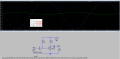
The amplified signal is blue. Its maximal positive value is around 100 mV but I expected to see the value around +132.22 mV (according to the gain A calculated above). Its minimal negative value is around -135 mV (almost as expected).
At first, consider this simple circuit:
Given:
- Current gain if the transistor is B = β = 200
- Early voltage \( |U_A| \) = 50 V
- Supply voltage \( U_b \) = 4 V
- Load resistor \( R_L \)= 50 Ω
- Collector resistor \( R_C \) = 250 Ω
- Thermal voltage \( U_T \) = 26 mV
The input characteristic figure of the transistor is given as well. I had to determine the value of the resistor \( R_B \) that sets the base-emitter voltage \( U_{BE} \) of 0.7 V at the operating point. To do this, I wrote the following equation and drew a load line:
\( U_b = I_B R_B + U_{BE} \implies I_B = (U_b - U_{BE}) / R_B = \frac{U_b}{R_B} - \frac{U_{BE}}{R_B} \)
1. \( U_b = U_{BE} \implies I_B = 0\)
2. \( U_{BE} = 0.7 V \implies I_B = 40 \mu A \)
With this, I was able to calculate the value of \( R_B \):
\( R_B = \frac{\Delta U_{BE}}{\Delta I_B} = - \frac{0.7 V - 4 V}{40 \mu A - 0 \mu A} = 82.5 k\Omega \)
The next figure shows the output characteristic curves of the bipolar transistor from the circuit. I had to draw the corresponding load line for the resistor \( R_C \) and to mark the operating point. According to the diagram, the collector-emitter voltage \( U_{CE} \) is 1.9 V at this operating point:
1. \( U_b = I_C R_C \implies I_C = \frac{U_b}{R_C} = \frac{4 V}{250 \Omega} = 16 mA \) (if \( U_CE = 0 V \))
2. \(I_C = 0 A\) if \( U_{CE} = 4 V \) (= \( U_b \))
According to the given circuit, it is a common-emitter amplifier. The gain of this amplifier can be calculated as follows:
\( A = - S r_a = -13.22 \)
where
\( S = \frac{I_C}{U_T} (1 + \frac{U_{CE}}{|{U_A}|}) = \frac{8 mA}{26 mV} (1 + \frac{1.9 V}{50 V}) = 319.385 mS \)
\( r_a = (r_{CE} || R_C || R_L) = 41.4 \Omega \)
Now to the simulation. I took the bipolar transistor 2N2222 and adjusted its model as follows (bold marked values):
.model own2N2222 NPN(IS=1E-14 VAF=50 BF=200 IKF=0.3 XTB=1.5 BR=3 CJC=8E-12 CJE=25E-12 TR=100E-9 TF=400E-12 ITF=1 VTF=2 XTF=3 RB=10 RC=.3 RE=.2 Vceo=1.9 Icrating=800m mfg=NXP).
The amplified signal is blue. Its maximal positive value is around 100 mV but I expected to see the value around +132.22 mV (according to the gain A calculated above). Its minimal negative value is around -135 mV (almost as expected).
Attachments
-
1.3 KB Views: 4