What relay do I need to eliminate burned points?

Thread Starter

sofasurfer

Joined Jun 16, 2023
7
I have a 12v winch on my truck. The 2 relays in it are Liming LR4190-DC12V-1C 40 amp/14DC (cost $7 at Autozone).
Code:
  http://www.lmrelay.com/mobile/product/417.html
The points burned up once and I replaced the relays. Now the have burned up again. When using the winch there is a lot of toggling the switch which I assume causes the burned points but I am not sure. Should I get relays with a higher amp rating or is there such a thing as a better quality relay? I also was told I may need "continuous duty" relays. Would that be the remedy?
 

MrChips

Joined Oct 2, 2009
34,628
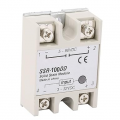
Replace the relay with a 12 VDC solid-state relay. There are no contacts to burn out.
Something like this one:

1725669264185.png

You will have to come up with a control circuit to switch from forward to reverse.
 

Thread Starter

sofasurfer

Joined Jun 16, 2023
7
See, this is my problem. I am not am electronics guy. I have 2 relays mounted in a 3x4 inch box. Also the relays are 5 pin (see links in first post).
 

MrChips

Joined Oct 2, 2009
34,628
See, this is my problem. I am not am electronics guy. I have 2 relays mounted in a 3x4 inch box. Also the relays are 5 pin (see links in first post).
That's ok. I am sure there must be an off-the-shelf solution.
We can do it with something called an "H-bridge".

I would wait for the automotive experts to chime in.
 

crutschow

Joined Mar 14, 2008
38,316
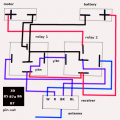
Can you post a schematic or wiring diagram of the relays and winch motor?

You may need to add diodes across the relay contacts to eliminate arcing from the motor inductance.
 
Last edited:

LowQCab

Joined Nov 6, 2012
5,101
The Relay(s) that You provided a link to are not even close to being able to handle a Winch-Motor.

Does the Winch have a Specification-Plate that You could take a close-up picture of and post it here ?

If not, an over-kill approach can be used.

I'll look-up a part# for You for 2-Heavy-Duty Double-Throw ( reversing ) 12-Volt-Contactors
that are specifically designed for this type of severe high-Current abuse.
I'm guessing that 2 of them will be around ~$60.oo.
They will normally last for over ~5-years or so with daily usage.

You will also need a larger plastic box to keep them out of the direct weather,
and some large-sized "Ring-Connectors" for the large connecting-studs that these Contactors use.

More information and pictures would help to insure that You are getting the appropriate advice.
.
.
.
 

Thread Starter

sofasurfer

Joined Jun 16, 2023
7
I have talked to people who use the 250 amp relays and the winches they are used in are for pulling trucks out of mud bogs etc. Something like 10,000 or 12,000 lbs of pulling force. My winch is used for mainly pulling a 400 lbs lawn tractor onto my truck. It would only rarely pull more than that.

I realize that this winch is a cheapy but when the relays are working it more than serves my purpose. So I wonder if another cheap relay at a higher amp would be an improvement? I found this one (the third one down one this website is 80 amp) https://electricscooterparts.com/power-relays.html and the diagram is the same as my old relays. Here is a pic of one of my old relays. http://www.lmrelay.com/mobile/product/417.html
 

crutschow

Joined Mar 14, 2008
38,316
So I wonder if another cheap relay at a higher amp would be an improvement?
They would, but diodes added across the relay contacts would greatly extend their life.

You would need 4 diodes rated for 50V and 10A or more.
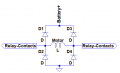
Connect one on each motor connection to the battery (+), cathode to battery.
Connect one on each motor connection to the battery (-), anode to (-) ground.

You could use a bridge rectifier package for the 4 diodes (example).
Connect the bridge (+) connection to the battery, the (-) connection to ground, and the other two connections (possibly labeled ~) to the motor.

Connection shown below:
1725686784654.png
 
Last edited:

MrChips

Joined Oct 2, 2009
34,628
If I had to do this for myself I would use the SSR (solid-state relay) connected to the 12 V battery.
Then I would feed the controlled 12 VDC to a DPDT center-off reversing switch to the winch motor.

So now, I would have to manually select FORWARD-OFF-REVERSE on the switch first before pressing a push-button to enable the SSR.

Something like this but NOT momentary contact.

1725721018257.png
 

MisterBill2

Joined Jan 23, 2018
27,172
Replace the relay with a 12 VDC solid-state relay. There are no contacts to burn out.
Something like this one:

View attachment 331110

You will have to come up with a control circuit to switch from forward to reverse.
There is no way that package could handle the full load current of a heavy-duty automotive winch! The terminals are not able to handle the current without overheating. AND, those relays ALL need to be mounted to an adequate heat sink if they will be carrying anything close to the rated current. WHICH, notice, is not mentioned on the image.
There are DC coil DC contact relays that CAN handle the current oof 40 or 66 amps. They are mechanical but they do not look at all like that relay. Fifty years ago they sold for $65 each. I have not checked their prices recently.
 

Ian0

Joined Aug 7, 2020
13,097
My first thought too.

In the TS diagram the relays have C, NO & NC contacts. The contactor you linked is just make or break contacts that are normally open.
There are n/c versions, n/o versions, changeover versions, magnetically latched versions, and dozens of coil options, and versions for higher current. One only has to explore the website a little further, especially as the actual current requirement has never been specified, only that 40A relays appear to be inadequate.
 

MisterBill2

Joined Jan 23, 2018
27,172
OK, I read now that the motor is in a winch pulling a mower/tractor up a ramp. And we get the comment that the relay is switched quite a bit in operation. Of Course, relay contact wear happens during operation. A DETAILED data sheet for the relays will probably state a promised number of full load operations. And certainly the inrush current is a fair amount, possibly greater than the claimed relay rating.
One option would be to keep the current circuit, but use those two relays only for directional selection, and use an automotive starter contactor to switch the battery source power to the circuit. Those starter contactors are made for very high current load control, but only for fairly short term operation.
 

Tonyr1084

Joined Sep 24, 2015
9,744
One option would be to keep the current circuit, but use those two relays only for directional selection, and use an automotive starter contactor to switch the battery source power to the circuit. Those starter contactors are made for very high current load control, but only for fairly short term operation.
Not a bad idea at all! I like it!
 

crutschow

Joined Mar 14, 2008
38,316
One option would be to keep the current circuit, but use those two relays only for directional selection, and use an automotive starter contactor to switch the battery source power to the circuit. Those starter contactors are made for very high current load control, but only for fairly short term operation.
That would require some additional circuitry, since his wiring diagram shows its radio controlled.
Perhaps a short delay for the contactor to be energized after the direction relays have operated.
Or perhaps the contactor operation would be enough slower than the relay operation so an added delay wouldn't be needed.

Also there are starter type contactors that are rated for 100% duty-cycle.

Edit: Just realized there will be a delay needed so the direction relays don't release before the contactor opens, since that's when the major arcing occurs.
 
Last edited:

MaxHeadRoom

Joined Jul 18, 2013
30,558
There is a distinct difference between AC & DC high current contactors.
BTW, those in the link in the OP are not suited for switching high current DC, for one thing, they are sealed, result is ionization of the interior.
 

Ian0

Joined Aug 7, 2020
13,097
There is a distinct difference between AC & DC high current contactors.
BTW, those in the link in the OP are not suited for switching high current DC, for one thing, they are sealed, result is ionization of the interior.
The larger Albright contactors are available with magnetic blowouts as well.
 
Top