Using Multiple Momentary Switches on the Same Circuit?

AnalogKid

Joined Aug 1, 2013
12,140
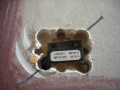
If I am understanding you correctly, you mean this? With these, would I then just put a magnet in each of the doors?
Correct.

Most reed switches are SPST-NO, with Normally Open contacts. Bring a magnet in close, and the switch contacts close. This is the standard for a string of series-connected door and window switches in an alarm loop, in a small enclosure with two wiring terminals. But it is the opposite of what you want. I don't think I've seen a two-terminal, NC reed switch, but there might be such a critter. What you have with three terminals is a SPDT switch, with both NO and NC contacts. Wire as many NO contacts as you want in parallel, as in the post #12 schematic.

ak
 

MrChips

Joined Oct 2, 2009
34,819
Correct.

Most reed switches are SPST-NO, with Normally Open contacts. Bring a magnet in close, and the switch contacts close. This is the standard for a string of series-connected door and window switches in an alarm loop, in a small enclosure with two wiring terminals. But it is the opposite of what you want. I don't think I've seen a two-terminal, NC reed switch, but there might be such a critter. What you have with three terminals is a SPDT switch, with both NO and NC contacts. Wire as many NO contacts as you want in parallel, as in the post #12 schematic.

ak
It depends on how the reed switches are wired.

If the switches are wired in series, then yes, the switches are OPEN when the magnet is removed. The alarm input or output relay needs to be configured for this situation.

If the switches are wired in parallel, any switch will CLOSE the circuit when the magnet is removed. This is the situation you want when any door is opened.
 

Tonyr1084

Joined Sep 24, 2015
9,744
I'm a little dubious of the description in your last post. That LOOKS like a 3 wire reed switch. IF it is a 3 wire reed then one lead is a common lead ( C ) and the other two are normally open ( NO ) and normally closed ( NC ). If it has the extra wire (the NO) then that doesn't matter. You won't be using that. You'll want to use the NC wire. That way when you close the doors and a magnet is close to the reed switches the NC will go open, meaning your lights won't light.

As for your query of 9V versus 12V - - - Either works as long as your LED's are set for the right current. My bewonderment is why use 9V when you have a basic 12V system already present on the boat. With 9V you have to keep a different charger on it. OR keep the 12V running as a 9V charger.

Engineer Scott said it best - the fancier the plumbing the easier it is to stop up the drain. (from Star Trek; The Search for Spock). Why complicate things. I'd suggest 12V since it's already there.
 

Thread Starter

McDork

Joined May 14, 2025
9
As for your query of 9V versus 12V - - - Either works as long as your LED's are set for the right current. My bewonderment is why use 9V when you have a basic 12V system already present on the boat. With 9V you have to keep a different charger on it. OR keep the 12V running as a 9V charger.
I am a hobbyist; my only prior experience with this stuff is wiring little models, and am not at all comfortable messing with the electrical system of the boat. If I damage anything in the project I am making, I'm out $50 at most. If I fry the boat's electrical system...no.
 

MrChips

Joined Oct 2, 2009
34,819
There always exists risk of a fire. That is why we install fuses and circuit breakers.
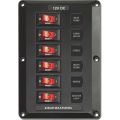
Stick with the 12 V system that is already there. There should be a distribution panel on the boat. Each line should have a fuse or breaker and a switch.

1747450572937.png
 

Thread Starter

McDork

Joined May 14, 2025
9
I appreciate your confidence in my abilities! The most complex thing I've wired is a $50 model kit with three LEDs in it. I am a novice and I know it. I don't feel confident enough in my abilities to mess with the electrical system of a vehicle that costs thousands of dollars. If I become more skilled at this, I can always go back to it later. If I damage the boat with my tinkering, I won't be able to get un-divorced. LoL
 

Thread Starter

McDork

Joined May 14, 2025
9
I am absolutely comfortable wiring some LEDs to switches and a battery pack, and that is what I am going to do.
 
You can house the reed switches and their connections in a non-magnetic enclosure. Plastic, aluminum etc.
I think you need an "OR gate" so any of the three reed switches open-circuit will turn on the LED light, is that right?
But zero power drain when the switches are closed (magnet is close) and LED off?
 

Tonyr1084

Joined Sep 24, 2015
9,744
If you are not comfortable doing this on your own, get someone who knows how to do it.
I am absolutely comfortable wiring some LEDs to switches and a battery pack, and that is what I am going to do.
I think @MrChips was referring to your fear of messing up the 12V system on your boat. Of course you can wire up any voltage battery you like if you want a totally isolated system, isolated from your boat's 12V wiring. But it's just an opinion, using the boat's electrical system would be the way to go. As long as your magnets are well mounted and are not going to fall away from the reed switches. In that event you would merely drain your battery. Not a disaster, just an inconvenience.
I think you need an "OR gate" so any of the three reed switches open-circuit will turn on the LED light, is that right?
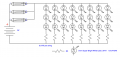
If you refer to the illustration on post #12 you'll see that the switches are wired in an OR configuration. No need for gates.
 
Just confirming the logic wanted: Any magnet away, turns on the light. I wasn't saying add gates- it's just the term for the logic.
Your idea to use reed switches with changeover/dual contact, the N.C. contact would work, keeping it simple.

What I find with 3-wire reed switches is that they are just fragile. Rated 0.25A to 0.5A for current (N.C. contact), any short-circuit or overload will burn them up, they glow orange. So much for my model railroad detecting a train lol.
So fusing this whole thing, it's important to have a small fuse first from the battery feed, say 1A or less.
 

Tonyr1084

Joined Sep 24, 2015
9,744
The fragility of reed switches has already been discussed. Use of a 3 input OR gate will UP the current capacity but probably not enough for the LED's the TS wants to use. However, the mention of fusing is important as well.

As I recall, back in 1982 I worked installing burglar alarms. One such switch was a switch that was installed in the doorjamb. On the door was mounted a magnet that pulled a billet inside the jamb and (I THINK) break the circuit. IF SO - - - then such a switch would likely carry far more current than a reed switch. But I think the burglar alarm companies have gotten away from heavy switching and running wires all over the house. I'll have a look and see if I can find such a switch.
 

Tonyr1084

Joined Sep 24, 2015
9,744
If you use microswitch type lever switches they can easily carry the current.
I definitely agree.

I've messed with reed switches in the past and have had dubious luck with them. And you can't know the quality of what you buy since the contacts are internal to a glass blister. Oxygen in the bulb versus Argon or other inert gas, can the bulb leak? Micro Miniature switches are the better choice in my opinion - TOO!

As far as the schematic in post #12 - that's based on a 12V system. if you're using 9V then you're going to have to reduce the number of LED's in a string and increase the number of strings. That's going to increase the overall amperage.
 

Tonyr1084

Joined Sep 24, 2015
9,744
Going with 9V you're going to need 8 groups of 3 LED strings. 15mA times 8 parallel strings will equal 120mA. That will give you 24 LED's (not 25).Screenshot 2025-05-18 at 11.07.54 AM.png
The resistor only needs to drop 90mV. So a 1/4W or even a 1/8W resistor will serve.

CONSIDER THIS:
With a 9V source, how long do you want those lights to produce useable amounts of light? Depending on the type of 9V battery you will experience a voltage drop anywhere from a nuisance to being totally useless in the event of a prolonged need for light. A 12V marine battery - likely deep cycle - will be able to light your LED's MUCH longer than a 9V battery pack. Unless you're building a 9V battery with 2Ah capacity, the above will draw 120mAh for over 16 hours.

9V ÷ 0.12Ah = 16.67 hours.
 
I thought about it and would switch the low-side with the reed switches. So BATT+ to fuse, then LED strip(s) then reed switches to GND. This gives coverage for a ground fault anywhere after the LED's, worst thing is the LEDs light up.

Cherry MP201802 reed switch is SPST-NC 0.2A looks nice, it's all potted and two flying leads. The MP201801 is SPST-NO.

Project reminds me of automotive under the hood lamps - in the old days they were mercury tilt switches, now they are ball tilt switches, if you could put them on the door.
 

MrChips

Joined Oct 2, 2009
34,819
There is a simple solution that does not require reed switches on the doors. Tap off 12 V from the cabin lights to power the LEDs. All you need to do is turn on the switch to the cabin lights. If you wish you can add a separate switch to the LEDs.

If you have a spare circuit on the distribution panel, use that.
 
Top