Uni-T 139C problem.

DickCappels

Joined Aug 21, 2008
10,661
If it is of any consolation, I rarely use the small current range on DMMs.

I usually measure currents below an amp or two using an external shunt because burning a resistor is much less trouble than burning a fuse or worse. Sometimes when you think you are going to messure a small current it turns out to be a short.
 

joeqsmith

Joined Oct 15, 2016
63
I tend to be in that same camp. Not so much because of the fuse but I will need to measure higher currents than the meter can handle, I want to lower the burden voltage or I want to see what is going on with a scope. Many times I will use a clamp rather than a shunt.

To your point though, you are right in that as a result it is rare I blow those HRC fuses.
 

rsjsouza

Joined Apr 21, 2014
427
No doubt there were some Darwin wannabe's watching my tests, seeing some meter being tested at 8KV and thinking they could hook it to their MOT with a continuous 2KV and everything would be fine. Flip side is the people who comment about why would I ever expect a meter that say's right on it that it can handle 600V, to handle 8KV. Maybe a few of them have learned something from these tests but I doubt it.
Never lose hope, Joe. Out of your decent sized following there'll be at least a few folks that will take your lessons and soar.

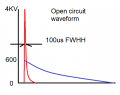
There are two generators used during the half cycle test. One generates a high voltage low energy waveform, the other low voltage high energy one. The high voltage generator is the same one used for my normal tests. When I run the half cycle test, the high voltage generator is set to 4KV peak, 100us FWHH with a 2 ohm source (not the 50us FWHH called out by the IEC standards). Rise times are in the order of 1.2us and the decay is exponential, limited to about 20J. Again, the same waveform I use for the normal testing.
Thanks for the clarification. Sometime in the near future (when time permits) I will calculate the energy from the parameters and waveforms mentioned above.

Basically, this generator is what is causing the meter being tested to breakdown. The only time I will consider running this test is IF the meter brakes down during the normal test. The high voltage generator triggers the low voltage generator which will in turn output a higher energy waveform that will also decay exponentially over a half AC line cycle. The excess energy is once again absorbed internal to the generator. I would need to dig up my notes but I want to say this generator is setup for 660Vpeak. I wanted something common that I knew EVERY meter I looked at should handle with no troubles. The energy available is in the order of 600J.
If I understood correctly: the 4kV generator runs and, if there is a breakdown, it turns on the 660V generator in a similar waveshape (but with the extra oomph). Are these two waveforms (the 4kV and the 660V) added or the 4kV turns off as soon as there is a breakdown? I think so, but wanted to confirm.

Also, when you say the energy is "absorbed internal to the generator" you mean there is a 2 ohm resistor in series with the output, right?

The transients I use could certainly be lethal, which is why I am very cautious when running these tests. Still they hardly compare with the real test, so you never will see a meter come apart with my tests like you will with the IEC tests. But again, that was never the goal.
"Lethality" is relative to many factors - I got zapped by what I estimate 10~12kV from an ignition coil.

If it is of any consolation, I rarely use the small current range on DMMs.
I rarely do as well, but only because of the very high burden voltage. I have a microcurrent from Dave Jones for these lower currents; totally unprotected, but still quite useful for what I do. :D
 

joeqsmith

Joined Oct 15, 2016
63
If I understood correctly: the 4kV generator runs and, if there is a breakdown, it turns on the 660V generator in a similar waveshape (but with the extra oomph). Are these two waveforms (the 4kV and the 660V) added or the 4kV turns off as soon as there is a breakdown? I think so, but wanted to confirm.

The low voltage generator monitor's it's output voltage. Once it reaches somewhere around 1.5KV, it will turn on. So the meter basically has to be an open to trigger the low voltage wave. Normally, I don't see any meters breakdown this low so the voltage will continue to rise. Again, the 660V is so low, it doesn't do anything to a good meter.

Also, when you say the energy is "absorbed internal to the generator" you mean there is a 2 ohm resistor in series with the output, right?

If the meter happens to breakdown from the high voltage, the arc will cause the transient to decay much more quickly because it presents a lower impedance. 20J isn't much. Once the voltage drops down to the 660V, the low voltage generator continues to fed it. Again, the low voltage generator has it's own output network and will normally decay in a half cycle (the network absorbing the excess and converting to heat) but with an arc, it will decay much faster. There is not enough energy to cause a lot of damage. I think in all the time I have been running these tests, I saw one meter's case split open.

I have attached a sketch of what the open circuit waveform would look like. I've shown these waveforms several times and once and a while someone will still post how I am hooking these meters directly to a capacitor bank. The lack of basic common sense amazes me. Yep those capacitors just have that much leakage. lol.

The 2 ohm source, 100us FWHH and the 1.2us rise time are controlled by the output network. If there is no load on the output, the 2 ohm source doesn't dissipate much power. The IEC standards provide some insight on how to design this network.

"Lethality" is relative to many factors - I got zapped by what I estimate 10~12kV from an ignition coil.

I doubt you will see 20J from an ignition coil. My MSD ignition that I use on the dragbike is rated for 190mJ per spark. Some time ago, I made a video where introduced one of the electrical safety standards and covered some of the sections that talk about the voltage, energy vs the risk. This standard is what drove some of my decisions when I designed the generators. Based on that standard, I can tell you that some of the transients I apply to these meters could certainly be lethal.
 

Attachments

Last edited:

joeqsmith

Joined Oct 15, 2016
63
Never lose hope, Joe. Out of your decent sized following there'll be at least a few folks that will take your lessons and soar.
.....

I rarely do as well, but only because of the very high burden voltage. I have a microcurrent from Dave Jones for these lower currents; totally unprotected, but still quite useful for what I do. :D
Another very common misconception is that the transients have far more energy than I say they do. I have been asked about testing various AC line powered devices. A few people wanted me to test AC power strips. One person wanted me to test USB chargers. I actually ran a few USB chargers for the fun of it but of course, nothing happens. Worse is people then think that these USB chargers are great because they survived my do nothing of a test. o_O On the opposite end, I will hear from the people who's meter I just tossed into the dumpster because it couldn't survive. The common statement is something about me stressing them far beyond their intended design.

I made a video where I cobbled up a simple powered shunt. It's very similar to Dave's but there's not too many ways to skin that cat. I put a fuse in mine.
 

rsjsouza

Joined Apr 21, 2014
427
Another very common misconception is that the transients have far more energy than I say they do. I have been asked about testing various AC line powered devices. A few people wanted me to test AC power strips. One person wanted me to test USB chargers. I actually ran a few USB chargers for the fun of it but of course, nothing happens. Worse is people then think that these USB chargers are great because they survived my do nothing of a test. o_O On the opposite end, I will hear from the people who's meter I just tossed into the dumpster because it couldn't survive. The common statement is something about me stressing them far beyond their intended design.
Being in Youtube for so long, I can almost be sure that a vast majority of people that ask for this are interested in seeing explosions and lightning sparks.

I really get a lot from your videos and love your channel but, being human, I can say that I have also a guilty pleasure in seeing things such as:
 

joeqsmith

Joined Oct 15, 2016
63
We used to watch all of Dave's early videos. Between these and the fanboys was really the catalyst for running my own tests.

It was worth watching again. Sub 1ms, 4.5KV, 400J compared with my 6ish KV, 20J 2 ohm source. Notice how they took out the MOVs in the Fluke 28II. Of course, he again calls the PTC a MOV. I've had several people tell me how I am damaging the MOVs by applying too much voltage, running the transients too fast .... But the reality is, I have yet to damage a MOV. The PTC/resistor combo limits the current through them. Even in cases where the little 5mm PTC breaks down and there is no resistor, the MOVs are rated for higher energy than I can apply with my setup. 20J isn't much.

If my goal had been to cause as much drama as possible, I think I would have started with one of the large oil filled caps like Photonicinduction uses with some big cables. He has shown busting some HRC fuses with some decent fault current ratings. May make for a more popular channel but personally, I wouldn't have learned anything from it.
 

rsjsouza

Joined Apr 21, 2014
427
It was worth watching again. Sub 1ms, 4.5KV, 400J compared with my 6ish KV, 20J 2 ohm source. Notice how they took out the MOVs in the Fluke 28II. Of course, he again calls the PTC a MOV. I've had several people tell me how I am damaging the MOVs by applying too much voltage, running the transients too fast .... But the reality is, I have yet to damage a MOV. The PTC/resistor combo limits the current through them. Even in cases where the little 5mm PTC breaks down and there is no resistor, the MOVs are rated for higher energy than I can apply with my setup. 20J isn't much.
When I watched the first time, I was surprised to see how the Fluke 77 was the only meter that was actually dangerous to the operator - its flying dial did not inspire much confidence. However, by not knowing the prior history of the meter one can always argue this wouldn't happen with a new one.

If my goal had been to cause as much drama as possible, I think I would have started with one of the large oil filled caps like Photonicinduction uses with some big cables. He has shown busting some HRC fuses with some decent fault current ratings.
Exactly. However, to reproduce very high fault currents one only needs some ultra capacitors, just like Afrotechmods:
 

joeqsmith

Joined Oct 15, 2016
63
I would want to at least be at double the fuse's 1KV rating otherwise it's not going to be much of a show. 4X would be better.

So you don't think that the case splitting apart on that cheap meter would be a concern? I guess you would have gloves on. Of course, you may have a face shield on as well so the knob may not be much of a problem. Then again, I doubt you would be using these meters. lol.
 

rsjsouza

Joined Apr 21, 2014
427
So you don't think that the case splitting apart on that cheap meter would be a concern? I guess you would have gloves on. Of course, you may have a face shield on as well so the knob may not be much of a problem. Then again, I doubt you would be using these meters. lol.
Yeah, I suspect both meters shouldn't be used at these energy levels :D

That brought me a concern, as my go to meter to use in permanent installations (pool pump, HVAC) is the old grey/brown Fluke 27/FM, which uses a similar rotary switch assembly. Perhaps I should reconsider and start taking the HPAKs instead, although I don't think a circuit with two 30A breakers in series (plus the 100A on the feeder) would reach 400J - I need to do the calculations later.

If at 800J or 1kJ the case goes flying off the screws but the Fluke only ejects the dial, then the cheaper meter would certainly be worse.
 

joeqsmith

Joined Oct 15, 2016
63
Interesting thought as I suspect the breakers will be slow. I would think you are more limited by the distance from the box, type of cable...
I've never tried to measure our outlets like this. I have a meter that measures the AC line by basically pulsing it with a programmable current. It's been a while since I've used it and can't remember what metrics it shows.
 

rsjsouza

Joined Apr 21, 2014
427
Interesting thought as I suspect the breakers will be slow. I would think you are more limited by the distance from the box, type of cable...
I've never tried to measure our outlets like this. I have a meter that measures the AC line by basically pulsing it with a programmable current. It's been a while since I've used it and can't remember what metrics it shows.
Exactly, that is why I think it would warrant some worst-case calculations - the energy delivery on a short circuit could be quite hefty due to this slow reaction, but I can wonder if it really reaches 400J.

Looking around on my sparse time I found this interesting article that gives the technical/common names of all the breaker parameters (which helps with internet searches). However, I couldn't find detailed specifications for a typical 30A Square D breaker apart from the breaking (interrupt) capacity of 10kA, thus I suspect these other parameters may be defined by the standard.

However, I found in this other reference that, for domestic breakers, the instantaneous pickup should be no more than five times the nominal current. That, tied to the attached article I found which says that for typical low-voltage breakers the short-time delay is about 30 cycles, gives room to guesstimate the energy fault level.

I risk making a fool of myself in a public venue with my back of the envelope calculations, but using 2V as the RMS short circuit voltage (it would certainly be a decaying curve determined by the impedance of the line + DMM) and the other parameters above, I reached the following:

E = P * t = 2V * 150A * (30 cycles * 1/60s) = 150J

I suspect my estimate is not terribly far off, but obviously much more experienced folks can correct me.

Recently I had a shorted phase on the pool pump that damaged a relay (fused short the NO contacts) and, despite the relay has a very thin transparent plastic enclosure, the only damage was the material that vapourized internally. Any DMM has much more protection than the relay, but they can be used in much higher power environments.
 

Attachments

joeqsmith

Joined Oct 15, 2016
63
Assuming you are not trying to read the output current of the circuit by putting the meter into current mode and placing it in parallel with the load (which we have seen people do). I wouldn't expect the normal fault currents to be the problem from a safety concern. It would be from a 4KV 50us transient. The CBs are not going to do anything. If the meter were to breakdown, now we have something to play with....

When the tree was hit last summer, it coupled onto the sprinkler system and make it back to the control box. The box wasn't plugged in at the time. Everything was shut down. The input fuse was glass which was gone. The PCB had some slits and spark gaps but that was no match for mother nature who managed to strip a fair amount of copper from the board.

Many years ago, our neighborhood took a pretty big transient. We used electric heat. Each element had two fuses. One to each leg of the 220. It was during the summer and the furnace was off. It took out the fuses along with some bulbs. The neighbor across the road on the other hand, it took out their power meter!

It's hard to say how bad it could be in a home. Maybe start with the CAT II requirement in the IEC standards?
 
Assuming you are not trying to read the output current of the circuit by putting the meter into current mode and placing it in parallel with the load (which we have seen people do). I wouldn't expect the normal fault currents to be the problem from a safety concern. It would be from a 4KV 50us transient. The CBs are not going to do anything. If the meter were to breakdown, now we have something to play with....

When the tree was hit last summer, it coupled onto the sprinkler system and make it back to the control box. The box wasn't plugged in at the time. Everything was shut down. The input fuse was glass which was gone. The PCB had some slits and spark gaps but that was no match for mother nature who managed to strip a fair amount of copper from the board.

Many years ago, our neighborhood took a pretty big transient. We used electric heat. Each element had two fuses. One to each leg of the 220. It was during the summer and the furnace was off. It took out the fuses along with some bulbs. The neighbor across the road on the other hand, it took out their power meter!

It's hard to say how bad it could be in a home. Maybe start with the CAT II requirement in the IEC standards?
How did this turn into a JOEQSMITH testing mantra thread yet again.. ..Wasn't this originally about the UT139C...??
 

joeqsmith

Joined Oct 15, 2016
63
How did this turn into a JOEQSMITH testing mantra thread yet again.. ..Wasn't this originally about the UT139C...??
If you have a problem with my posts, you should bring it to the attention of the moderators. Obviously, if you took the time to read all the posts, in this thread, you may understand how it changed.
 
If you have a problem with my posts, you should bring it to the attention of the moderators. Obviously, if you took the time to read all the posts, in this thread, you may understand how it changed.
That's my point...it shouldn't change.
Start a new thread instead of hijacking what was an interesting post.
 
Again, if you have a problem with it, I suggest you bring it to the moderator's attention. Maybe they will sympathize with you. Otherwise, I will continue to post as I see

Continue to do as you please, I really don't give 2 cents. Just really tired of your obnoxious hijacking of every post. I mean really, must you provide your video links with every thread. Stay on topic or begin a new thread it's really not difficult...or perhaps it is? I was genuinely interested in this thread until you drowned it.
 

joeqsmith

Joined Oct 15, 2016
63
Continue to do as you please, I really don't give 2 cents. Just really tired of your obnoxious hijacking of every post. I mean really, must you provide your video links with every thread. Stay on topic or begin a new thread it's really not difficult...or perhaps it is? I was genuinely interested in this thread until you drowned it.
For someone who doesn't give two cents you sure complain a lot. I plan to continue posting as I see fit regardless of your feelings about it. If you want to change that, I have told you how.
 
Top