Boss DM-2 PCB problem

Thread Starter

sonohe

Joined Jan 11, 2025
77
I want to build a Boss DM-2 pedal. It had 4 versions. I want to build the first one that uses the MN3005 chip. A PBC is available to order for it online. I checked, and it perfectly matches that of the original pedal. Except for 2 components. An extra diode (D6) is added, that was only available in the original pedal in the last version, but not in the first. And annother component referred to as CF is added to cable soldering points 8 and 10. This was not included in any version of the original pedal PCB. Why were these mods added to the copy PCB and how much is their value?

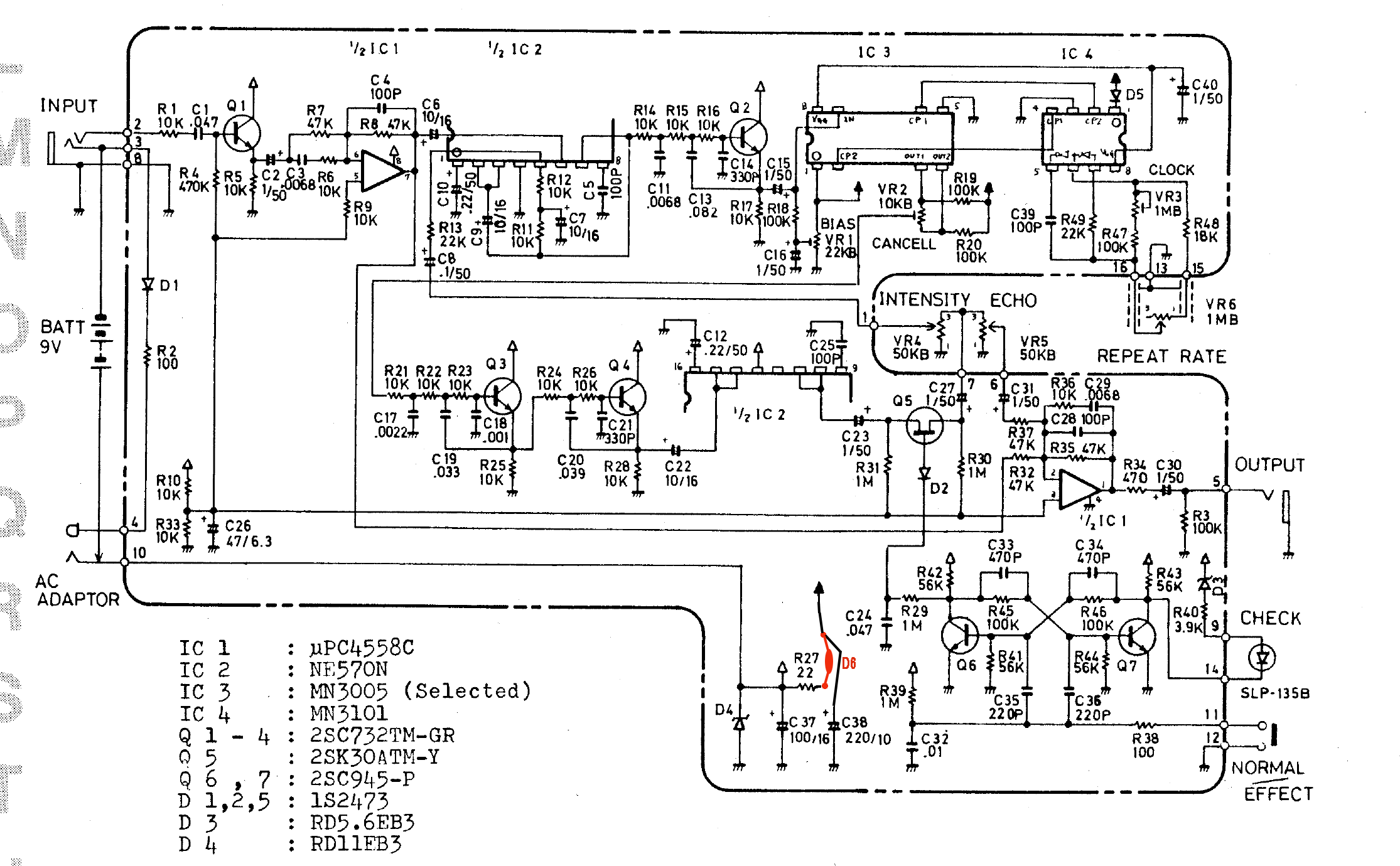
I drew these mods onto the schematic (the D6 is added in a way that the connection between C38 and R27 is broken, and the D6 is inserted between the two:
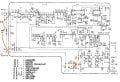
schematic.jpg
 

panic mode

Joined Oct 10, 2011
4,995
Look at power rails around R27 (two arrows pointing up). one is white, the other is black (filled). the filled one gets extra filtering (C38) and it is used to power IC3 and IC4. so probably early version lacked the proper filtration (clock transients were noise in audio) so it was added directly to the cable and alter on included in board revision.
 
Last edited:

Thread Starter

sonohe

Joined Jan 11, 2025
77
Clook at power rails around R27 (two arrows pointing up). one is white, the other is black (filled). the filled one gets extra filtering (C38) and it is used to power IC3 and IC4. so probably early version lacked the proper filtration (clock transients were noise in audio) so it was added directly to the cable and alter on included in board revision.
Meanwhile I noticed I drew it wrongly, and redrawn the connections, I don't know whether it changes anything?

 
Meanwhile I noticed I drew it wrongly, and redrawn the connections, I don't know whether it changes anything?

Your second diagram changes the whole scenario. D6 now sits inline with positive power. It acts as series reverse polarity protection. This saves your rare MN3005 chip from accidental burnout. Install Schottky diode 1N5817 at D6. Orient its stripe upward. This minimizes voltage drop to preserve headroom. Solder a 100nF ceramic capacitor at CF. Place it across pads 8 and 10. This filters out high-frequency power supply noise. It keeps clock noise out of other pedals. Design or modify your PCB layout using EasyEDA. It is a free, beginner-friendly online circuit tool. You can easily draw schematics and trace connections there. Then, order your completed custom board with one click to NextPCB or any other reputed PCB printing service.
 

Thread Starter

sonohe

Joined Jan 11, 2025
77
Design or modify your PCB layout using EasyEDA. It is a free, beginner-friendly online circuit tool. You can easily draw schematics and trace connections there. Then, order your completed custom board with one click to NextPCB or any other reputed PCB printing service.
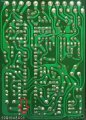
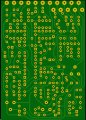
Thanks for the clarification of the two components. In connection with the PCB though, I am still confused. You can see the original PBC attached below. It was an old style 1 sided PCB with widening traces here and there. I was told somewhere that the widened traces mostly belong to GND, and the role is to be able to receive the bigger load without issues when voltage spikes occur, that is a characteristing due to the components and function of this circuit. The engineers had no chance to place groundfill or wide GND rails on the top, so this is how they solved it. There is already a PCB available to order, that had the 2 unknown components I asked about. It perfectly matches with tho old, original PCB regarding hole placements, but the routes on it have uniform width and are thin. According to what was told me it will create problems on the GND routes and clock noise and ground bounce will occur due to the fact that threre are no widened traces. What do you think of that? The new PCB has 1oz trace copper thickness.

So this is the old original PCB:
Boss DM2 orig.jpg

This is the new one available to order (I verified the hole placement 100% matches and the 2 differing points are the CF and D6 as mentioned above):

0941355430655.jpg
 

panic mode

Joined Oct 10, 2011
4,995
you worry about non-issues. old style had hand drawn PCB traces. new one is done using CAD, hence uniform width. width of traces has nothing to do with it - it is dictated by the amount of current that flows through it. i see nothing in the circuit that draws high current. in fact the supply is a 9V battery and at the time circuit was designed, 9V battery was good for only few mA or it would drain too quickly. the new design seem to use 1mm wide traces which should be ok for up to some 2A. at any rate it is way more than needed. besides, you are looking at popular product with design that is practically unchanged for half a century. so, relax... just think how schematics of any other electronics products have changed since 80s (TV, radio, music players). they are unrecognizable. and if you are still worried, what stops you from putting piece of wire instead of that diode?
 
Last edited:

Thread Starter

sonohe

Joined Jan 11, 2025
77
just think how schematics of any other electronics products have changed since 80s (TV, radio, music players). they are unrecognizable. and if you are still worried, what stops you from putting piece of wire instead of that diode?
The 2 unknown components that represent the mod on the available copy PCB is no problem for me especially now as you provided suggestions of their value and functions. I just wanted to clarify those because I did experience that many pedals have noise and other annoying issues. I never owned a DM-2, so it is possible if I build it on a PCB with original BOM, that will annoy me as well, and maybe the two mod components will be the ones missing. But I will do it exactly as you mention, I will apply the trace mods for the 2 added components, if I don't like them, I will solder them out and use jumpers instead of them.

One of my favourite musicians has been using this exact pedal since the beginning of the 80's,so theoretically if it is good for him, it should be good for me. But I have no info about which circuit version is in his pedal. So in case the mods are clarified, that is a safer bet for me, because this way I can add them or remove them if needed.
 

MisterBill2

Joined Jan 23, 2018
27,558
In the first wiring diagram , I see that CF is added as a Filter Capacitor across the DC input, and that D6 was added to serve as a short circuit if the power feed was ever reversed. NOTE!! In quite a few pedal circuits I have seen the power conncector with the center pin negative.
I understand why it was done and I have nothing good to say about it.
And certainly they are wiring diagrams because they show physical depiction of the IC devices instead of symbolic images of the internal functions.
 

Thread Starter

sonohe

Joined Jan 11, 2025
77
In the first wiring diagram , I see that CF is added as a Filter Capacitor across the DC input, and that D6 was added to serve as a short circuit if the power feed was ever reversed. NOTE!! In quite a few pedal circuits I have seen the power conncector with the center pin negative.
I understand why it was done and I have nothing good to say about it.
And certainly they are wiring diagrams because they show physical depiction of the IC devices instead of symbolic images of the internal functions.
Thanks!

As I know, to be able to use this pedal with a regulated PSU instead of an unregulated, some compnents has to be removed. Which are those ones? D1 and R2?
 

MisterBill2

Joined Jan 23, 2018
27,558
The most important to remove to use a regulated supply would be the shunt regulator diode D4. Possibly D2, although since we were not told if the externql supply connector is center positive or center negative. At least, I do not recall seeing it mentioned.

I have seen some pedal devices wired center negative because they use a two circuit plug in a 3 circuit jack as a cheap power switch. Thaty saves a bit of money over using a two circuit jack with an extra switching contat pair. OR using an actual ON/OFF power switch.
 
Top