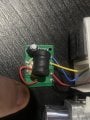
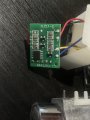
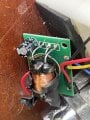
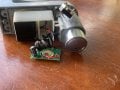
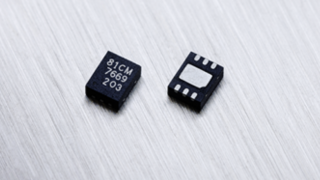
Hi. Thanks for your comments. How does the circuit detects the motion?. Is the black ic an accelerometer?.OK, I see the photo of the PCB, which has an unmarked 8-pin IC and three transistors with the numbers removed. The other side has an inductance and a polarized capacitor. And a piezo disk sounder.
So my guess is that it is a frequency swept oscillator.
Hello MisterBill2. Attached there is a pic of the black item in the back. I peel off the cover to check what is it. It looks like an inductor, not a mercury switch.I doubt that the IC is an accellerometer, although it might be. My guess is that the larger black item on the back side of the PCB is actually a mercury switch type of device. BUT, that is only a guess. There is a whole lot about the "Locker" that is not clear nor obvious.
Hello Alex. No there is not magnet near the inductor. I tried using the screwdriver to look for any magnetic piece but no luck. There is a piezo speaker below the inductor (see attached pic), but is not magnetic, and its less loud than the main piezo speaker. The small one just makes some noise when you activate the circuit.Is there a magnet near that inductor? Does the disc have slots or holes?
Hello. MisterBill. I tried activating the circuit and just barely touching both piezo discs each time, and it activated the alarm without too much movement at all.That piezo disc inside is probably the vibration/motion sensor. I have seen that in some automotive alarm systems. They make a rugged and cheap sensor.
Hello. I want to understand how it works as part of a project. How could it make it louder?I have no experience at all with alarms on 2-wheelers of any kind. I knew about the piezo device working as a sensor because I was given the alarm system that was removed when a friend upgraded (replaced)the alarm system of a VERY FAST used car they bought.
It had piezo vibration sensors. If the Disc-lock alarm works, why tear it apart???. Or do you want to make it much louder??
Hello. Thanks guys for your help in understanding the circuit.There are definite limitations to the amount of energy that can be applied to transducers, especially to piezo-electric transducers. What happens is that the stress produced by the electric field is limited by the strength of the piezo portion, When it breaks, "the show is over." This means that there IS A POWER LIMIT!! Improving the acoustical coupling effectiveness can help, but the size increases and that may be a problem.
Adding an additional electronic sounder could be quite effective, but space on an electric bike is quite limited.
The alternative approaches that could work are specificly prohibited by this site and so I do not mention them.
Hello. Thanks for your message. Yes, it could be. The problem is that the IC has no name, then it is possible to find it easily if it has a motion detector or not. But, I just tapped the piezo speaker and it triggered the alarm right away. Maybe they used a cheap implementation for the motion detection instead of using a more expensive IC with a sensor inside.IMO:
The inductor is just an inductor; no other function. With three leads, it could be part of a flyback autotransformer voltage-boosted driver for the piezo element.
The piezo is just a beeper element, nothing else. As a motion detector, it is not a good one; it produces zero output in two of the three motion axes.
There are too many parts on the bottom of the board for just a piezo driver. If you are sure there is no other motion sensor or electronic assembly elsewhere in the device, then the IC probably is the sensor. I'd look around for a mercury switch tilt detector.
ak