Understanding how an optocoupler works in this circuit.

Thread Starter

feryuu

Joined Aug 29, 2025
15
Hello,
I just discovered optocouplers and had a question how this circuit works:

Heres a pic of the optocoupler HCNR201:
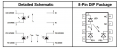
optocouple_schematic.png

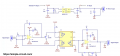
And the circuit in question:


optocoupler_example.png


So the only way PD1 and PD2 turn ON is if there is current flowing through the LED,right?

My next question is the need for PD1 to be hooked up to the inverting input of the op-amp, is this so the output has a return path when the op-amp try's is best to force the inputs to zero volts between each other? Since current cannot flow from signal to PD1 cathode side....So when PD1 is ON current is flowing from the GND_ISO.

And if you just wanted to drive another op-amp(U4) wouldnt you just need the PD2 of this circuit? Since the light from LED is powering PD2, the output of U3 is proportional to output of PD2?

Thanks
 

MrChips

Joined Oct 2, 2009
34,628
You need to define the application and why you would want to incorporate an optocoupler/optoisolator.

The circuit schematics you have posted uses optocoupler to provide galvanic isolation between two separate circuits.
 

crutschow

Joined Mar 14, 2008
38,316
So the only way PD1 and PD2 turn ON is if there is current flowing through the LED,right?
Right.
The photodiodes turning ON means they conduct current, with the amount of that current basically proportional to the LED current.
the need for PD1 to be hooked up to the inverting input of the op-amp
Since the photodiode output current is somewhat non-linear with respect to LED input current, PD1 is used to provide negative feedback correction to the LED current so that that output of PD2 accurately reproduces the analog input at the opto output (This depends upon the two outputs being essential matched for a given LED current).

Such an opto with double outputs and such input feedback is typically used when accurate reproduction of an AC signal, such as audio, is desired.

If you don't need such analog fidelity or are just using the opto to carry a digital (switch) signal, then you can use the more common opto with one input and one output.
 
Last edited:

BobTPH

Joined Jun 5, 2013
11,463
Most optocouplers use a photo transistor for the output, which can put out a lot more current. The diode ones are a special purpose part.
 

crutschow

Joined Mar 14, 2008
38,316
Most optocouplers use a photo transistor for the output, which can put out a lot more current. The diode ones are a special purpose part.
Yes.
The diode output types generally have a higher frequency response and are used when that is needed, but usually needs more output circuitry to amplify the smaller signal..
 
Last edited:

Thread Starter

feryuu

Joined Aug 29, 2025
15
Right.
The photodiodes turning ON means they conduct current, with the amount of that current basically proportional to the LED current.
Since the photodiode output current is somewhat non-linear with respect to LED input current, PD1 is used to provide negative feedback correction to the LED current so that that output of PD2 accurately reproduces the analog input at the opto output (This depends upon the two outputs being essential matched for a given LED current).

Such an opto with double outputs and such input feedback is typically used when accurate reproduction of an AC signal, such as audio, is desired.

If you don't need such analog fidelity or are just using the opto to carry a digital (switch) signal, then you can use the more common opto with one input and one output.
Ahhh I now see the feedback loop,thanks!
 

MisterBill2

Joined Jan 23, 2018
27,164
What I see is an ANALOG system for isolating an analog signal with photonic devices that produce a voltage output, rather than just switch on and off. A simple ON/OFF system could be much simpler.
 

MisterBill2

Joined Jan 23, 2018
27,164
My reason for the comment is that while the TS asked about optp-couplers operation, the application was not stated directly. and simple ON/OFF opto-isolaters cost less. and are simpler to utilize.
 

sghioto

Joined Dec 31, 2017
8,633
This thread about linear optocouplers reminded me of this circuit I used sometime back in the 80's.
Drawn on the inside back cover of Forrest Mims "Engineer's Notebook II"
1766854111235.png
 
Last edited:

schmitt trigger

Joined Jul 12, 2010
2,027
The circuit in post #1 is a DC-accurate isolation circuit.
If all that is required is to pass AC signals and a coupling capacitor is used to block DC level shifts, then the circuit in post #12 is the way to go.
 
Top