Facebook
 Google
 GitHub
 Linkedin
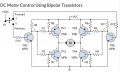
Hi everyone! I saw this amplifier in another thread on this site and decided to build it to drive power to a very simple DC motor modeled by a resistor and inductor in series. I get roughly 9.6V at the output node which after some research is enough to power a simple dc motor. I'm a second year EE student. We just talked about amplifiers in class and I want to fully understand the circuit. I just finished circuit analysis 1 and am in my first microelectronics class. The lab teaching assistant tried to explain the circuit to me, but i still don't understand what's really going on. My TA did say this circuit was a bit advanced for what we're learning, but from what i understand it is a push-pull class AB for the BJTS with current being pulled from the positive node into the circuit. The diodes are supposed to provide a voltage drop of 0.7x2=1.4V which biases the two BJTS allowing them to stay "on" to push current through. the Q1 transistor is in a class A setup which is used to also drive current through to the transistors. 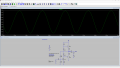
Attachments
-
2.7 KB Views: 2