Thank you, Eric.
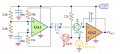
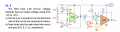
I am suppose to plot the waveforms of the left side, the A,B,C nodes and the right side with D,E,F nodes with respect to time, knowing that node C oscillates between +1V and +11V and the LEDs have 1.4V turning-on voltages.
I have the major trouble with the right side, I don't understand the path of charge/discharge of the capacitor, when is the green LED or the red+yellow and how I can approach the Vout waveform.
Firstly I said: to turn on the LED I need 1.4V, so at node D I'll have 2.8V. Then I did the two cases when C is +11V or +1V, if the former the voltage across the 1nF cap is 11-2.8 = 8.2V is the second I'm not able to answer why it's not negative. Then I know that if node E is at 1.4V the yellow LED is on I have a current flowing equal to I = (12-1.4)/2.2k= 4.8mA. After that I wasn't able to go on
hi G77,
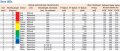
A Yellow LED forward voltage is not 1.4V.
Where did you get the LED operating voltage values, also what do assume the RED and GREEN LED voltage values.
Hi G77.
If you could draw/sketch the waveforms on that original image of the circuit, the waveforms and voltages you calculate it will help us easier to follow your work.
E
It's an exam exercise, so this is all I know. I understood that the first opamp acts as a comparator to generate the C waveform between 1V and 11V. Answering Bob, the rate of the of change probably is the time constant of the circuit so tau= 100nF*22k, and the output change relatively to charge-discharge of the capacitor. But I'm non able to draw the waveform.
hi G,
I understand now how the LED's 1.4V, it is as stated in the question, but be aware in practice the range of colours have different forward voltages.
Sketch the waveforms, post and we can check them.
E
It looks to me that you are going to have to analyse OA1 fully in order to find out what the frequency of oscillation is and of course that includes the pulse timing. This is going to take some careful thought on how this works due to the configuration and the given output voltages, which are all important too.
One of the reasons is that the circuit is coupled with a capacitor, and capacitors charge and discharge.
So do you know how to analyze OA1 in detail?
It's not really that hard but might be unusual for you if you've never did a lot of comparator circuits before this.

 Facebook
 Google
 GitHub
 Linkedin