Facebook
 Google
 GitHub
 Linkedin
I don't understand this presentation. It seems to me that he is conflating transient (exponential) RC behavior with steady-state sinusoidal AC phasor theory, and then mistakenly claiming that voltage across a capacitor always lags current by 90 degrees even in the presence of resistance. (He also makes a basic error in math near the end.) Can someone help me understand what's going on here?
Need Help Understanding Presentation - AC Circuit Impedance
- Thread starter Z.W. Wolf
- Start date
Scroll to continue with content


As soon as he says, "the flow of voltage", my Spidey Senses started twanging.
It looks like he is describing a circuit in sinusoidal steady state.
Because the video starts in mid-presentation, we don't know what the point was that he was trying to really make using the exponential curves. There seemed to be a fair bit of technobabble there. I suspect he was trying to describe how the transient response settles into the steady-state response and was probably trying to come up with an hand-wavy explanation off the cuff.
In sinusoidal steady state, the voltage and current in a capacitor are always shifted by 90°. He is only talking about the voltage across the capacitor and the current through the capacitor.
I'm not a fan of using the term "displacement" in this context -- "shifted" or "offset" are better choices. But that's not a hill worth dying on.
At the end, he flubs up pretty good -- leaving his absolute disregard for proper tracking of units aside, he initially says that the source voltage is 70.7 V. At first it looked like he was going to buy that, but then did catch that it was obviously wrong and changed it to 7.07 V. But then he completely failed to realize that this is just as obviously wrong.
The lesson here is that you need to always, always, always ask if your answer makes sense. If you are given two sides of a right triangle, you KNOW that the hypotenuse can be no smaller than the longest side and no longer than the sum of the two sides, so any answer that is not in the range of 10 V to 20 V must be wrong. It sounds like a couple of the students were catching on that the answer didn't make sense right at the end, but it cut off before we could see how that ended up.
But we need to give some grace because it is easy to make silly mistakes and not catch them when you are doing things on the fly in front of an audience. You are juggling a number of tasks and things fall through the cracks.
It looks like he is describing a circuit in sinusoidal steady state.
Because the video starts in mid-presentation, we don't know what the point was that he was trying to really make using the exponential curves. There seemed to be a fair bit of technobabble there. I suspect he was trying to describe how the transient response settles into the steady-state response and was probably trying to come up with an hand-wavy explanation off the cuff.
In sinusoidal steady state, the voltage and current in a capacitor are always shifted by 90°. He is only talking about the voltage across the capacitor and the current through the capacitor.
I'm not a fan of using the term "displacement" in this context -- "shifted" or "offset" are better choices. But that's not a hill worth dying on.
At the end, he flubs up pretty good -- leaving his absolute disregard for proper tracking of units aside, he initially says that the source voltage is 70.7 V. At first it looked like he was going to buy that, but then did catch that it was obviously wrong and changed it to 7.07 V. But then he completely failed to realize that this is just as obviously wrong.
The lesson here is that you need to always, always, always ask if your answer makes sense. If you are given two sides of a right triangle, you KNOW that the hypotenuse can be no smaller than the longest side and no longer than the sum of the two sides, so any answer that is not in the range of 10 V to 20 V must be wrong. It sounds like a couple of the students were catching on that the answer didn't make sense right at the end, but it cut off before we could see how that ended up.
But we need to give some grace because it is easy to make silly mistakes and not catch them when you are doing things on the fly in front of an audience. You are juggling a number of tasks and things fall through the cracks.

Hi,I don't understand this presentation. It seems to me that he is conflating transient (exponential) RC behavior with steady-state sinusoidal AC phasor theory, and then mistakenly claiming that voltage across a capacitor always lags current by 90 degrees even in the presence of resistance. (He also makes a basic error in math near the end.) Can someone help me understand what's going on here?
After reading the other replies so far, I didn't need to or want to watch the video.
If you want to learn this stuff really good, learn how to do it with complex numbers. Complex numbers make AC analysis a lot less complex.
It takes a little while to get used to, but it makes the future work much easier and you don't have to rely on preconceived notions and formulas that may or may not apply to the given situation you encounter.
This even helps with transient analysis if you are willing to learn how to use Laplace Transforms.
The instructor in the video presents some complex material in a hurried manner without introducing and explaining the concepts clearly. He also uses the term "displacement". I prefer to call it "phase angle" or "phase shift".
Before delving into the application of phasor diagrams to AC circuits, we need to cover the fundamentals of passive components.
Resistors, capacitors, and inductors are three passive components frequently encountered in electronics. These all have a property called impedance given the mathematical symbol Z.
Impedance consists of resistance R and reactance X.
Resistance, reactance, and impedance all impede the flow of current. They all share the same unit ohm.
Resistance impedes the flow of DC current (i.e. at 0 Hz frequency).
Reactance impedes the flow of AC current (i.e. at non-zero frequency).
Impedance is the sum of resistance and reactance, written mathematically as
Z = R + jX
where,
R = resistance
X = reactance
Z = impedance
j = √-1
Mathematically, the complex operator √-1 is written as i.
In electronics, i and I are already used for current. Hence we use j instead of i to represent the complex operator √-1.
(More about this later.)
Series and Parallel Combination
Resistances in series are added together:
Reff = R1 + R2 + R3
The reciprocal of resistance R is conductance G.
G = 1 / R
With resistances in parallel, we add the conductance.
Geff = G1 + G2 + G3
Similarly, impedances in series are added:
Zeff = Z1 + Z2 + Z3
The reciprocal of impedance Z is admittance Y.
Y = 1 / Z
With impedances in parallel, we add the admittance.
Yeff = Y1 + Y2 + Y3
Ideal Resistor, Capacitor, Inductor
Every resistor, capacitor, and inductor has impedance.
Z = R + jX
For an ideal resistor, the reactance is zero.
For an ideal capacitor and inductor, the resistance is zero.
Reactance of Inductor and Capacitor
The reactance of an inductor is given as,
XL = ωL
The reactance of a capacitor is given as,
XC = 1 / (ωC)
where,
ω = 2πf
f = frequency (hertz)
ω = angular frequency (radians/s)
Impedance of Inductor and Capacitor
The impedance of an ideal inductor is written as
ZL = jXL = jωL
The impedance of an ideal capacitor is written as
ZC = jXC = j / (ωC) = -1 /(jωC)
Inductor and capacitor current in response to a step voltage
When a voltage is applied to an inductor, the inductor's reactance impedes the flow of current. Hence the current starts at zero and then increases. We say that the current lags the voltage.
When a voltage is applied to a capacitor, the current is large while the voltage starts at zero. We say that the current leads the voltage.
A time series of a capacitor being charged shows that the capacitor voltage changes as an exponential function and the current decreases also as an exponential function. (This is one of the graphs shown in the video.)
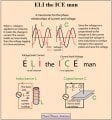
A good aid to memory is this phrase, ELI the ICE man.
In an inductor L, the voltage E leads the current I.
In a capacitor C, the current I leads the voltage E.
(E stands for EMF).
In an ideal inductor, sinusoidal current (AC) follows the voltage by 90° (or π/2). That is, the current lags the voltage by 90°.
In an ideal capacitor, sinusoical current (AC) leads the voltage by by 90° (or π/2).
Reference: http://hyperphysics.phy-astr.gsu.edu/hbase/electric/phase.html#c3
Phasors and complex numbers
What is the significance of the complex operator √-1 or j anyway?
Complex numbers are derived from Euler's Formula,
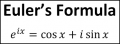
What this means for electronics is that we can represent complex numbers in two forms graphically, using polar form and cartesian form (coordinates). It is useful to consider the complex operator j as a phase shift operator of 90° or π/2.
Using cartesian form, we draw real numbers along the x-axis, and imaginary numbers along the y-axis.
Thus, positive j values are drawn upwards from zero while negative j values are drawn downwards from zero. (The y-axis represents a rotation of π/2 from the x-axis in cartesian coordinates. Positive angular rotation is represented by a counter clock-wise rotation).
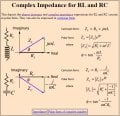
Let us take the two examples of R and L in series and R and C in series.
The resistance R is drawn as a vector along the x-axis.
The reactance Xc and XL are drawn along the y-axis, where positive is upwards, and negative is downwards, i.e. π/2 rotation in the clock-wise direction.
The resultant impedance Zeff is the vector addition of the two vectors.
If the resistance and reactance have the same magnitude, then the effective impedance will have a phase shift of 45° or π/4.
Thus, phasor diagrams in cartesian form allow us to visualize and calculate the phase shift when we combine resistance and reactance in a complex AC circuit.
Reference: http://hyperphysics.phy-astr.gsu.edu/hbase/electric/impcom.html#c1
Before delving into the application of phasor diagrams to AC circuits, we need to cover the fundamentals of passive components.
Resistors, capacitors, and inductors are three passive components frequently encountered in electronics. These all have a property called impedance given the mathematical symbol Z.
Impedance consists of resistance R and reactance X.
Resistance, reactance, and impedance all impede the flow of current. They all share the same unit ohm.
Resistance impedes the flow of DC current (i.e. at 0 Hz frequency).
Reactance impedes the flow of AC current (i.e. at non-zero frequency).
Impedance is the sum of resistance and reactance, written mathematically as
Z = R + jX
where,
R = resistance
X = reactance
Z = impedance
j = √-1
Mathematically, the complex operator √-1 is written as i.
In electronics, i and I are already used for current. Hence we use j instead of i to represent the complex operator √-1.
(More about this later.)
Series and Parallel Combination
Resistances in series are added together:
Reff = R1 + R2 + R3
The reciprocal of resistance R is conductance G.
G = 1 / R
With resistances in parallel, we add the conductance.
Geff = G1 + G2 + G3
Similarly, impedances in series are added:
Zeff = Z1 + Z2 + Z3
The reciprocal of impedance Z is admittance Y.
Y = 1 / Z
With impedances in parallel, we add the admittance.
Yeff = Y1 + Y2 + Y3
Ideal Resistor, Capacitor, Inductor
Every resistor, capacitor, and inductor has impedance.
Z = R + jX
For an ideal resistor, the reactance is zero.
For an ideal capacitor and inductor, the resistance is zero.
Reactance of Inductor and Capacitor
The reactance of an inductor is given as,
XL = ωL
The reactance of a capacitor is given as,
XC = 1 / (ωC)
where,
ω = 2πf
f = frequency (hertz)
ω = angular frequency (radians/s)
Impedance of Inductor and Capacitor
The impedance of an ideal inductor is written as
ZL = jXL = jωL
The impedance of an ideal capacitor is written as
ZC = jXC = j / (ωC) = -1 /(jωC)
Inductor and capacitor current in response to a step voltage
When a voltage is applied to an inductor, the inductor's reactance impedes the flow of current. Hence the current starts at zero and then increases. We say that the current lags the voltage.
When a voltage is applied to a capacitor, the current is large while the voltage starts at zero. We say that the current leads the voltage.
A time series of a capacitor being charged shows that the capacitor voltage changes as an exponential function and the current decreases also as an exponential function. (This is one of the graphs shown in the video.)
A good aid to memory is this phrase, ELI the ICE man.
In an inductor L, the voltage E leads the current I.
In a capacitor C, the current I leads the voltage E.
(E stands for EMF).
In an ideal inductor, sinusoidal current (AC) follows the voltage by 90° (or π/2). That is, the current lags the voltage by 90°.
In an ideal capacitor, sinusoical current (AC) leads the voltage by by 90° (or π/2).
Reference: http://hyperphysics.phy-astr.gsu.edu/hbase/electric/phase.html#c3
Phasors and complex numbers
What is the significance of the complex operator √-1 or j anyway?
Complex numbers are derived from Euler's Formula,
What this means for electronics is that we can represent complex numbers in two forms graphically, using polar form and cartesian form (coordinates). It is useful to consider the complex operator j as a phase shift operator of 90° or π/2.
Using cartesian form, we draw real numbers along the x-axis, and imaginary numbers along the y-axis.
Thus, positive j values are drawn upwards from zero while negative j values are drawn downwards from zero. (The y-axis represents a rotation of π/2 from the x-axis in cartesian coordinates. Positive angular rotation is represented by a counter clock-wise rotation).
Let us take the two examples of R and L in series and R and C in series.
The resistance R is drawn as a vector along the x-axis.
The reactance Xc and XL are drawn along the y-axis, where positive is upwards, and negative is downwards, i.e. π/2 rotation in the clock-wise direction.
The resultant impedance Zeff is the vector addition of the two vectors.
If the resistance and reactance have the same magnitude, then the effective impedance will have a phase shift of 45° or π/4.
Thus, phasor diagrams in cartesian form allow us to visualize and calculate the phase shift when we combine resistance and reactance in a complex AC circuit.
Reference: http://hyperphysics.phy-astr.gsu.edu/hbase/electric/impcom.html#c1

That is indeed true if you measure the voltage across the capacitance versus the current through it.claiming that voltage across a capacitor always lags current by 90 degrees even in the presence of resistance
Any resistance in series or parallel with the capacitor does not change that.

Good point. Inductors and capacitors store energy. An ideal inductor and ideal capacitor can store energy and release it with 100% efficiency, i.e. no energy is lost.
An LC resonant circuit with ideal inductor and ideal capacitor will resonate for infinite time once excited. With a real inductor and real capacitor, energy is lost in the resistance. Hence the oscillation decays over time.
An LC resonant circuit with ideal inductor and ideal capacitor will resonate for infinite time once excited. With a real inductor and real capacitor, energy is lost in the resistance. Hence the oscillation decays over time.
Can you speculate as to why he makes the math error? My notion is that the instructor was not performing the calculation in his head at all. He was attempting to recall a student exercise from a textbook. He recalled the answer from that exercise correctly, but wrote the formula inputs incorrectly. For example: If the inputs were VR=50V and VC=50V, the correct source voltage is VS~70.7
The mistake was a transposition error between two very common numbers used in electrical engineering instruction. Then he realized 70.7 couldn't be the right answer and he moved the decimal. But that was also obviously not right, confusing the students.
BTW, I think he was a either a student aide or a self-appointed student aide during a study session for a test.
The mistake was a transposition error between two very common numbers used in electrical engineering instruction. Then he realized 70.7 couldn't be the right answer and he moved the decimal. But that was also obviously not right, confusing the students.
BTW, I think he was a either a student aide or a self-appointed student aide during a study session for a test.
Put another way: The number 70.7 is one of the most frequently used (and memorized) answers in AC circuit instruction. The instructor mixed up the inputs for the RC problem (50 V inputs) with the input for his actual calculation (10 V inputs) while correctly recalling the common 70.7 V result. A warning against relying on rote memorization over real understanding. Just my speculation, of course.
Of course, 1.414 and 0.707 are common mathematical values buried in every engineer’s head, also, 3.1415926, 2.71828, or even 0.37 and 0.63.
Anyone paying attention would have known that the answer had to be greater than 10 and less than 20.
Come on, we all make mistakes. Give the guy a break.
Anyone paying attention would have known that the answer had to be greater than 10 and less than 20.
Come on, we all make mistakes. Give the guy a break.
There's no way to know why he made the mistake and little to be gained from speculating about it. Regardless of why he made the mistake in this case, the simple fact is that we will make mistakes on a regular basis throughout our careers for a whole host of reasons. The bigger warning is to always ask yourself if your answer makes sense. Just get in the habit of always asking that question. After a surprisingly small amount of time, you won't even think about it consciously -- your mind will automatically do rough sanity checks and results that don't pass will simply "look wrong" and bug you to the point that you've got to stop and focus on them in more detail. It certainly doesn't guarantee that mistakes won't slip by, but most of them won't.
As for rote memorization, I agree. The indications are that this course is being targeted at non-engineering students who likely lack the math background to understand where the formulas that were written on the board come from. Instead, they are being trained to memorize when to use which formula. That the instructor (be it an actual instructor or aide or whatever) says things like, "these are is called j operators" indicates that he doesn't understand the math, but instead is regurgitating what amounts to technobabble. To make matters worse, they are being told that capacitive reactance is positive quantity but being told that it gets plotted on the negative j-axis. What they are doing, which is, sadly, very common at this level, is embedding the negative sign associated with capacitive reactance into the formulas, which needlessly explodes the number of formulas that needs to be memorized. Worse, they require the student to memorize disjointed patches to fix things that the math, if dont' correctly, will track just fine. For instance, on the board to the left is written that the phase angle is the arctangent of Xc/R. This is correct IF Xc is a negative value, because the phase angle is negative. But the formula for Xc has it being a positive quantity, which means that the formula for phase angle is going to yield a positive angle and the student is responsible for going, "Oh, yeah, since it's a capacitor I have to remember to throw a minus sign on the phase angle and/or plot it on the phasor diagram as a negative going phasor."
It's insane, but the vast majority of instructors teaching courses at this level, including many of the authors writing texts for courses at this level, were taught the same way and don't have the math background to recognize the insanity.
As for rote memorization, I agree. The indications are that this course is being targeted at non-engineering students who likely lack the math background to understand where the formulas that were written on the board come from. Instead, they are being trained to memorize when to use which formula. That the instructor (be it an actual instructor or aide or whatever) says things like, "these are is called j operators" indicates that he doesn't understand the math, but instead is regurgitating what amounts to technobabble. To make matters worse, they are being told that capacitive reactance is positive quantity but being told that it gets plotted on the negative j-axis. What they are doing, which is, sadly, very common at this level, is embedding the negative sign associated with capacitive reactance into the formulas, which needlessly explodes the number of formulas that needs to be memorized. Worse, they require the student to memorize disjointed patches to fix things that the math, if dont' correctly, will track just fine. For instance, on the board to the left is written that the phase angle is the arctangent of Xc/R. This is correct IF Xc is a negative value, because the phase angle is negative. But the formula for Xc has it being a positive quantity, which means that the formula for phase angle is going to yield a positive angle and the student is responsible for going, "Oh, yeah, since it's a capacitor I have to remember to throw a minus sign on the phase angle and/or plot it on the phasor diagram as a negative going phasor."
It's insane, but the vast majority of instructors teaching courses at this level, including many of the authors writing texts for courses at this level, were taught the same way and don't have the math background to recognize the insanity.
Thank you, to all of you.
I was trying to untangle the source of my confusion, in regard to the presentation in this video...
I admit that my understanding is lacking, so I enlisted the help of Gemini. Is this accurate? Or should I throw Gemini out the window?
1. Confusion: "Voltage and Time" vs. "Voltage and Current"
The Analysis: The instructor confuses the quantities being compared (Voltage vs. Current) with the domain they are measured in (Time). You all have confirmed the correct physical definition is "voltage across the capacitance versus the current through it." (I think)
The Instructor's Quote (00:21): "across the capacitor that displacement no matter what value the resistor is... you still have a 90 degree displacement between voltage and time"
Correction: A phase shift is an angle between two waveforms (Voltage vs. Current). "Time" is the horizontal axis on the oscilloscope, not the physical quantity being shifted.
Consequence: By saying the displacement is with "time," he obscures the physical cause of the shift (the capacitor charging/discharging current), making it sound like an arbitrary delay rather than a lead/lag relationship between two electrical properties.
2. Confusion: The 45 degree + 45 degree Geometry
The Analysis: The instructor garbles the description of the phasor triangle. He tries to explain the 90 degree angle of the capacitor by adding two degree angles, which is geometrically incorrect for the vector addition he is drawing.
The Instructor's Quote (04:02): "so you have something in here that's we know would be 45 degrees you know from here to here there's another 45 degrees so it's 90 all together for the right side"
Correction: In the R = Xc example, the 45 degrees is the Phase Angle of the source voltage relative to the current. The 90 degree angle he refers to "for the right side" is the fixed angle between the Resistor voltage and Capacitor voltage.
Consequence: He conflates the Sum of the Acute Angles (45 degrees + 45 degrees = 90 degrees) with the Phase Difference between the components (90 degrees). This implies that the 90 degree capacitor shift is somehow the result of adding two 45 degree angles, which contradicts his earlier claim that the capacitor is "always" 90 degrees. You all have confirmed that the 90 degree shift is intrinsic to the component, not a sum of circuit angles. (I think)
3. Confusion: "Flow of Voltage"
The Analysis: The instructor uses non-standard terminology that blurs the distinction between potential (Voltage) and flow (Current).
The Instructor's Quote (00:09): "because of this time constant because of this opposition to the flow of voltage"
Correction: Voltage does not "flow"; current flows. Voltage is the pressure that causes the flow. The opposition is to the flow of current.
Consequence: This phrasing suggests a fundamental misunderstanding of what Impedance actually opposes. It reinforces the students' confusion about whether they are calculating a delay in time (flow) or a difference in potential (voltage).
I was trying to untangle the source of my confusion, in regard to the presentation in this video...
I admit that my understanding is lacking, so I enlisted the help of Gemini. Is this accurate? Or should I throw Gemini out the window?
1. Confusion: "Voltage and Time" vs. "Voltage and Current"
The Analysis: The instructor confuses the quantities being compared (Voltage vs. Current) with the domain they are measured in (Time). You all have confirmed the correct physical definition is "voltage across the capacitance versus the current through it." (I think)
The Instructor's Quote (00:21): "across the capacitor that displacement no matter what value the resistor is... you still have a 90 degree displacement between voltage and time"
Correction: A phase shift is an angle between two waveforms (Voltage vs. Current). "Time" is the horizontal axis on the oscilloscope, not the physical quantity being shifted.
Consequence: By saying the displacement is with "time," he obscures the physical cause of the shift (the capacitor charging/discharging current), making it sound like an arbitrary delay rather than a lead/lag relationship between two electrical properties.
2. Confusion: The 45 degree + 45 degree Geometry
The Analysis: The instructor garbles the description of the phasor triangle. He tries to explain the 90 degree angle of the capacitor by adding two degree angles, which is geometrically incorrect for the vector addition he is drawing.
The Instructor's Quote (04:02): "so you have something in here that's we know would be 45 degrees you know from here to here there's another 45 degrees so it's 90 all together for the right side"
Correction: In the R = Xc example, the 45 degrees is the Phase Angle of the source voltage relative to the current. The 90 degree angle he refers to "for the right side" is the fixed angle between the Resistor voltage and Capacitor voltage.
Consequence: He conflates the Sum of the Acute Angles (45 degrees + 45 degrees = 90 degrees) with the Phase Difference between the components (90 degrees). This implies that the 90 degree capacitor shift is somehow the result of adding two 45 degree angles, which contradicts his earlier claim that the capacitor is "always" 90 degrees. You all have confirmed that the 90 degree shift is intrinsic to the component, not a sum of circuit angles. (I think)
3. Confusion: "Flow of Voltage"
The Analysis: The instructor uses non-standard terminology that blurs the distinction between potential (Voltage) and flow (Current).
The Instructor's Quote (00:09): "because of this time constant because of this opposition to the flow of voltage"
Correction: Voltage does not "flow"; current flows. Voltage is the pressure that causes the flow. The opposition is to the flow of current.
Consequence: This phrasing suggests a fundamental misunderstanding of what Impedance actually opposes. It reinforces the students' confusion about whether they are calculating a delay in time (flow) or a difference in potential (voltage).
Hello again,
The difference between having a perfect plus or minus 90 degrees and having some other angle between 0 and +90 or between 0 and -90 comes from either having R=0 or R=some positive finite value.
If R=0 then we have a perfect plus or minus 90 degrees depending on if it is an inductor or a capacitor.
The formula for the resistor+capacitor current phase angle is:
ph=atan2(1,w*R*C)
using the two argument inverse tangent function, and making R=0 we get:
ph=pi/2 which is also 90 degrees, where we can note that if the real part is 0 then it becomes purely imaginary. Of course C cannot be 0 also even though in this formulation it doesn't seem to matter, and that is because we are assuming we still have a capacitor in the circuit.
If there is anything being added together to get a phase angle it could be because of the way the inverse tangent works. It's really subtraction though. This comes from working on the numerator separately from the denominator and then subtracting one angle from the other. I don't know for sure if he used this idea or not though it's just a guess.
The formulas above come from a simple analysis using complex number math. The results just spill out from the math, more or less, paying attention to any possible degenerate cases.
The difference between having a perfect plus or minus 90 degrees and having some other angle between 0 and +90 or between 0 and -90 comes from either having R=0 or R=some positive finite value.
If R=0 then we have a perfect plus or minus 90 degrees depending on if it is an inductor or a capacitor.
The formula for the resistor+capacitor current phase angle is:
ph=atan2(1,w*R*C)
using the two argument inverse tangent function, and making R=0 we get:
ph=pi/2 which is also 90 degrees, where we can note that if the real part is 0 then it becomes purely imaginary. Of course C cannot be 0 also even though in this formulation it doesn't seem to matter, and that is because we are assuming we still have a capacitor in the circuit.
If there is anything being added together to get a phase angle it could be because of the way the inverse tangent works. It's really subtraction though. This comes from working on the numerator separately from the denominator and then subtracting one angle from the other. I don't know for sure if he used this idea or not though it's just a guess.
The formulas above come from a simple analysis using complex number math. The results just spill out from the math, more or less, paying attention to any possible degenerate cases.
Don't forget that capacitive reactance is negative.Hello again,
The difference between having a perfect plus or minus 90 degrees and having some other angle between 0 and +90 or between 0 and -90 comes from either having R=0 or R=some positive finite value.
If R=0 then we have a perfect plus or minus 90 degrees depending on if it is an inductor or a capacitor.
The formula for the resistor+capacitor current phase angle is:
ph=atan2(1,w*R*C)
using the two argument inverse tangent function, and making R=0 we get:
ph=pi/2 which is also 90 degrees, where we can note that if the real part is 0 then it becomes purely imaginary. Of course C cannot be 0 also even though in this formulation it doesn't seem to matter, and that is because we are assuming we still have a capacitor in the circuit.
If there is anything being added together to get a phase angle it could be because of the way the inverse tangent works. It's really subtraction though. This comes from working on the numerator separately from the denominator and then subtracting one angle from the other. I don't know for sure if he used this idea or not though it's just a guess.
The formulas above come from a simple analysis using complex number math. The results just spill out from the math, more or less, paying attention to any possible degenerate cases.
\(
\theta_Z \; = \; arctan\left( \frac{ Im \left\{ Z \right\} }{ Re\left\{ Z \right\} } \right) \\
\theta_Z \; = \; atan2\left( Im\left\{ Z \right\} , Re \left\{ Z \right\} \right)
\)
Most atan2() functions put the opposite side (numerator) first, but not all.
In either case, it is essential to associate the sign of each side with the proper term.
For a series RC branch
\(
Z \; = \; R \; + \; \frac{1}{j \omega C} \\
Z \; = \; R \; + \; j \left( \frac{-1}{\omega C} \right) \\
\therefore \\
\theta_Z \; = \; atan2\left( R , \frac{-1}{\omega C} \right) \\
\theta_Z \; = \; atan2\left( \omega RC , -1 \right)
\)
If using an atan2() function that has the adjacent side first
\(
\theta_Z \; = \; atan2\left( -1, \omega RC \right)
\)
That minus sign has to be on the y term.
Personally, I much prefer to keep the resistance and reactance separate if I'm using atan2(). It drastically reduces the risk of making a mistake.
EDIT: Fixed first equation for theta -- has the numerator/denominator flipped.
Last edited:

He seems to be associated with this work in some way:I don't understand this presentation. It seems to me that he is conflating transient (exponential) RC behavior with steady-state sinusoidal AC phasor theory, and then mistakenly claiming that voltage across a capacitor always lags current by 90 degrees even in the presence of resistance. (He also makes a basic error in math near the end.) Can someone help me understand what's going on here?
https://galileo.hsites.harvard.edu/project-goal
See: https://www.youtube.com/@tedesco48/videos
Hi there,Don't forget that capacitive reactance is negative.
\(
\theta_Z \; = \; arctan\left( \frac{ Re \left\{ Z \right\} }{ Im\left\{ Z \right\} } \right) \\
\theta_Z \; = \; atan2\left( Im\left\{ Z \right\} , Re \left\{ Z \right\} \right)
\)
Most atan2() functions put the opposite side (numerator) first, but not all.
In either case, it is essential to associate the sign of each side with the proper term.
For a series RC branch
\(
Z \; = \; R \; + \; \frac{1}{j \omega C} \\
Z \; = \; R \; + \; j \left( \frac{-1}{\omega C} \right) \\
\therefore \\
\theta_Z \; = \; atan2\left( R , \frac{-1}{\omega C} \right) \\
\theta_Z \; = \; atan2\left( \omega RC , -1 \right)
\)
If using an atan2() function that has the adjacent side first
\(
\theta_Z \; = \; atan2\left( -1, \omega RC \right)
\)
That minus sign has to be on the y term.
Personally, I much prefer to keep the resistance and reactance separate if I'm using atan2(). It drastically reduces the risk of making a mistake.
We can say that the phase angle is 90 degrees for either a capacitor or inductor, but you are right in implying that in this kind of discussion we should point out the sign as well as the angle. You'll note that we've already seen the somewhat comical mnemonic eli the ice man (I'm using lower case so the 'eyes' stand out clear in most fonts). That's something that would go along with the unsigned version.
As I said though, you are right I should have written:
ph= -atan2(1,w*R*C)
or the other version, because that is a sort of stand-alone math expression where we would probably assume we should get the right sign from that.
I checked my math sheet and I had written:
(w*C)/(w*C*R-%i)
where %i is of course the imaginary operator, and right on the next line:
-atan2(1,w*C*R)
Are you sure you wrote this correctly:
θz=arctan(Re{Z}/Im{Z})
I asked because we never put the real over the imaginary part. The numerator is assumed to be the 'y' axis and the denominator the 'x' axis. That goes along with the complex plane. If we don't do that, we don't get the right angle.
In other words:
atan(x)!=atan(1/x)
we would have to do something like:
atan(x)=pi/2-atan(1/x)
or
atan(x)=-pi/2-atan(1/x)
and be careful about x=0.
Something like that

He's a rather infamous UFO researcher and retired Electrical Engineer.He seems to be associated with this work in some way:
https://galileo.hsites.harvard.edu/project-goal
See: https://www.youtube.com/@tedesco48/videos
If we want to be able to trust the math, then the math needs to be correct. atan2() will only give us the correct angle for all four quadrants if the sign of each argument is maintained. You can't "factor it out". If you do, then there's no point using atan2() -- just use the normal atan() function.Hi there,
We can say that the phase angle is 90 degrees for either a capacitor or inductor, but you are right in implying that in this kind of discussion we should point out the sign as well as the angle. You'll note that we've already seen the somewhat comical mnemonic eli the ice man (I'm using lower case so the 'eyes' stand out clear in most fonts). That's something that would go along with the unsigned version.
As I said though, you are right I should have written:
ph= -atan2(1,w*R*C)
Also, by writing it this way, you've just managed to do what courses at this level typically do, which is take a single relationship and create multiple equations that the person has to memorize.
Θ= atan2(X,R) (where the arguments to atan2() are (y,x), as in most library functions.
Applies equally well to capacitors, inductors, or any mix.
Nope, I messed it up. I was too focused on getting the curly braces to render that I didn't pay close enough attention to the bigger picture. I've corrected that above. Thanks for catching it.Are you sure you wrote this correctly:
θz=arctan(Re{Z}/Im{Z})
That explains why his presentation is a bit out of touch with reality.He's a rather infamous UFO researcher and retired Electrical Engineer.
But, seriously, if you are being confused by someone that makes too many mistakes in their presentations, especially in presentations that they've gone to the trouble of recording and posting online, which one would hope would involve some level of proofing, then the best advice I can give you is to avoid watching that person's presentations going forward.