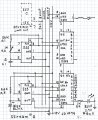
Nice to see you back Wendy and thanks for taking time out of your busy life. I was trying to do the schematic post #149 circuit for 256 LED's. I see the separate circuit with the push button activation. Question is, The push button circuit will supply 12v vcc to the chasing circuit of the 4017's and 555 timer? Also you have a LM317 tied to the 2nd section of transistors. Is the LM317 dedicated to only these transistors? If so, can I use a 7812 fixed reg for the rest of the vcc triggered by the push button?
Oh and another question. If I wanted to make like a stream of LED's that will rise up and leave the back end on and then off, would i use a bar graph design? so if i had 200 led's and it starts to illuminate from 1 to 200 then off. all the led's will be on giving a effect like water rising or voltage rising. Is there a simple way to do this? Maybe a chip already made?
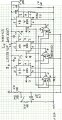
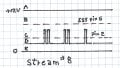
Here is Stream # 6 using a SR in the 40XX family good for VDD 3-15 V. Data input here uses a blinking blue LED with a 555 signal shaper illustrated in Stream # 8. Line D is representation of led V which is fed into pin 2 of 555, is inverted on output giving about 80 % on time to SR Data input. The SR does not have a Reset but uses an Output Enable, when Low outputs are high impedance, LED's off. If switch C, Stream, of Lock Out ( Stream # 7 ) is pressed, Out. Enable goes high for 15 sec.or as desired, 555 clock generator & blinking LED - On allowing any stored garbage to be washed out on first pass. Re post # 185: If SR Data input is held high LED 's will come on in succession like a bar graph.
As the sequence starts, led 1 is on and stays on while led 2 is on and led 1 is still on. when the sequence reaches 249 led's, all are on until the last led 250 is on and stays on for 20 sec then goes off back to restart. Like pouring water into a glass and dumping it out when it reaches the top.
Also on your 256 led chaser, I want to verify that the LM317 attached to the transistor, the emitter is connected to the input of the regulator and the output goes through the 100k resistor to ground.
Re post # 190: It can be done, maybe a bunch of 4017's & OR's or my pref. 32 SR's having resets & other misc. IC's. If holding out for 12 V Vcc then it might be 74C164 ( $ 1.00 or more ) or 4015 ( $ .32, 2- 4 bit SRs in one package ). 20 sec of steady on might be a bit boring so could throw in some circulating blinkings while waiting for reset & start over? Open for suggestions !
I think the OP is wanting something more akin to a shift register, where the bits flow down the stream. I'll have to look to see what shift registers are out there (to some extent I already am, for a personal project I'm working on the design for).
Thanks for the help. Both of you are the university instructors. I took a some electronics in school but the teacher didn't seem to put much effort into the class. Thanks for all the help!!!!!!!!!!!!!!!!!!!!!!!!!!!
If Wendy does not have a better SR then we can still use the 4094 SR as shown in Stream # 6 with changes in control as outlined in Stream # 9. Let's start with SR empty, all LED's off, Data input = 1, high, clock D, running. LED's come on one at a time & stay on until LED # 250 comes on which sets flip- flop , FF-A. FF not Q output goes low triggering one shot, OS- B; 20 sec. high pulse enables blinking data input, inverted it stops clock, D, trailing edge resets FF-A, ( cap. missing ) & sets OS-C, 1/2 sec pulse. Short pulse puts a high on data in. speeds up clock, G, by paralleling timing resistor of D, giving period of 1 msec. & disables LED's, which sweeps out all existing "1 "s giving the effect of a reset. Ready for a new start?
Believe FF-A should be reset by only OS-C, inverted trailing edge ?
When I get a bit more free time I'll post an example of the shift register concept. I have to look at a data sheet, but I think you can drive each output of the shift register to 5ma, so you would not need drivers.
I looked at the HEF4894BP, 12 stage SR, open drain ( no problem ) functionally equiv. to CD4094 but$ 1.67ea.
compared to $ .13 ea. for CD4094BE, G&C Supermarket.
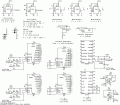
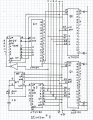
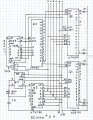
As part of your learning experience and as you have some 74154's & 74193's from the old TTL family, thought you might like to assemble a LED chaser. The simple form would use only Q1, Q3, & Q4 giving a 16 LED chaser. It might be helpful to also review a data sheet for the IC's. Q3 is a UP-DN, up- down binary counter which gives the required 4 line addresses as inputs to the 74154 decoder. ( miner goof. should have labeled outputs 0-15 rather than 1-16 ). The only change necessary is to enable decoding by grounding G2, pin 19, G1
is also supposed to go to ground. If address lines A,B. & C are high =7 out put #6 will go low turning on LED # 7. We can add more decoders by grounding the G1 & G2's & adding a resistor from LEDs group of anodes to + for each added decoder. Up to 10 decoders can be driven by counter, more would require buffering of address lines.
If we want a long chaser we can sequentially enable the decoders by adding another decoder, Q5, & counter, Q6. When Q3 reaches full count, on reset of D trailing edge goes low, inverted advances Q6 by one count, Q5 advances by one enabling the next decoder.
Another possibility is to use the Down count of Q3 to allow LEDs to chase up & down.
Some corrections made, added pin nos. to Q7. I have not used TTL since early 1970s , but ' believe you can leave unused input pins open & will= a 1 or high input.
Some corrections made, added pin nos. to Q7. I have not used TTL since early 1970s , but ' believe you can leave unused input pins open & will= a 1 or high input.View attachment 104906

 Facebook
 Google
 GitHub
 Linkedin