Facebook
 Google
 GitHub
 Linkedin

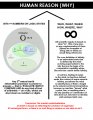
Here it is in a graphic... and if you are not on board with 90% of this, I am dismantling your head portion, putting it in a FedEx box, and sending it through a 2090 wormhole to Cyberdyne overnight. 
We haven't defined MEANING, and it seems like you're assuming consciousness in your use of it. Since consciousness is the elephant in the doll house, I find it useful to approach from the other way -- from things that few would describe as conscious -- and then see how functionally close I can get to things that people do think of as conscious.IF the brain is limited to bits/numbers as its sole computational instrument and defining mechanism of the person who is supposedly representing it,
THEN
all of its references to such person and "things" are simply bits/numbers, and bits/numbers are POSITIVELY MEANINGLESS OR RANDOM to the medium storing them unless ANOTHER outside system attributes MEANING to them for THEMSELVES. The outside system must be something OTHER than bits/numbers, because again, same problem.
I mean, we could go through the effort of deriving boolean rings from first principles, but why bother? We've assumed standard propositional logic, and under that assumption everything I said is automatically true.Ah, but you’re forgetting something in the above. You don’t know what Boolean rings are per the constraints.
On the contrary, if you accept propositional logic, you necessarily must accept the accompanying mathematical structures. They go hand in hand; they imply each other. There quite literally cannot exist a universe in which the logic is true but the math isn't.I contend that the above is all abstract derivative invention, as Kronecker might. Sophisticated AF, but it’s not necessarily reflective of how things work at the very base level. I contend my proof says otherwise without invoking anything but the base, observational axiomatic elements built into human reason such as “add” and “logic OR” that a 6 y/o could employ.
Again, though, all of that is discrete bits that have zero connection to each other! The computer (brain) “knows” nothing. It is a box of wires, switches, timers, sensors, and bulbs. None of what you discuss above can be defined in it. None of it.We haven't defined MEANING, and it seems like you're assuming consciousness in your use of it. Since consciousness is the elephant in the doll house, I find it useful to approach from the other way -- from things that few would describe as conscious -- and then see how functionally close I can get to things that people do think of as conscious.
A possible synonym for MEANING is referent. When I ask What do you mean?, I'm really asking What concepts are you referring to?
CONCEPT is a particular configuration of a set of sub-states. My concept of the color red started with a precept, a short-term configuration of sensory sub-states in the occipital lobe of the cerebral cortex induced by light of a particular wavelength. Over time, as I experienced different flavors of red, I developed a robust concept of red as a set of long-term states stored in memory. Importantly, the particular neural pattern of my concept of red is meaningful only to my brain -- to an outside observer, the pattern does not represent "red". In other words, the pattern itself is meaningless (in the absolute sense); what gives it meaning is the pattern's relationship with the rest of the patterns in my brain. This is made more clear below.
Computers can hold sub-states, thus computers can hold CONCEPTs. The only difference between a computer's concept of something and a human's is that the computer's set of relationships is programmed deliberately, whereas ours has been wired in over time through our genetic code. And by virtue of being able to hold CONCEPTs, computers can derive MEANING from otherwise arbitrary configurations of states. This is how my computer knows to treat a particular 32-bit sequence as a group of four ASCII characters, while treating another 32-bit sequence as an integer value.
The collection of gates, etc. holds a CONCEPT (a set of long-term states) of "self". I'd guess that newborn infants do not have any notion of "self"; they're a brand new bundle of gates, etc. with most of its states zero'd out, as it were. But as the bundle of gates' sensors come online, it starts to fill up its long-term states with CONCEPTs. One of these concepts is that of "self".You are a collection of gates, capacitors, wires and a counter on an old abandoned cutting board from the Unabomber's cabin. "You" are no where to be found.
There is no "concept of number." There. are. only. high. and. low. voltages.
A computer is an "adding machine" only! And it does so with the voltages that represent boolean logic states!
The "sheep" is a CONCEPT, just like "self". It's stored in memory.Where is the "sheep" in that whole getup (insert 900 question marks in 40 fonts here)?
For the life of me, I can’t figure out how you figure this.The collection of gates, etc. holds a CONCEPT (a set of long-term states) of "self". I'd guess that newborn infants do not have any notion of "self"; they're a brand new bundle of gates, etc. with most of its states zero'd out, as it were. But as the bundle of gates' sensors come online, it starts to fill up its long-term states with CONCEPTs. One of these concepts is that of "self".
Babies put there hands in their mouths. At some point in its development, a baby figures out that this soothing sensory experience is controllable. What's actually controlling it? The bundle of gates. As concepts are stored, some of the sensory states start becoming familiar. "Hey, that's my hand in my mouth." The notion of "self" is a result of the sensory feedback loop.
The "sheep" is a CONCEPT, just like "self". It's stored in memory.
You seem to be saying that propositional logic is a grounded, obvious universal fact, whereas boolean algebras are abstract "theory". (Ironic? Boole's Laws of Thought explicitly attempted to formalize propositional logic.) The problem with your notion is that propositional logic is exactly as abstract as boolean math -- one is not more "real" than the other. So, if you accept propositional logic, then you necessarily accept boolean algebras. There's no negotiating this!Yes, I very much do, because this is a classic case where, unlike something such as GR, it actually STARTS from real-world observation, not mental abstraction and complex theory.
WTF? Take a stick of RAM and write voltages to its first three pins corresponding to "high, low, high". We'd say we've set its first three bits to "101". We can instruct a computer to use those bits in a calculation.Simple: If bits weren't both logic states and numbers, you couldn't load up a calculator app and calculate new values with it AND ALSO do if-statement evaluations in a compiler with the same bits. 100% facts and proof right there.
We're getting rid of existing propositional logic then, and inventing a new one, because the hardware proves otherwise.You seem to be saying that propositional logic is a grounded, obvious universal fact, whereas boolean algebras are abstract "theory". (Ironic? Boole's Laws of Thought explicitly attempted to formalize propositional logic.) The problem with your notion is that propositional logic is exactly as abstract as boolean math -- one is not more "real" than the other. So, if you accept propositional logic, then you necessarily accept boolean algebras. There's no negotiating this!
And, as I demonstrated before, the OR of propositional logic is not "+", it is \( \vee \). Let me put it another way: If you believe that OR and "+" are the same, then you cannot believe in propositional logic, as the two operations are necessarily different. So, which one do you want to get rid of: propositional logic, or the equality of OR and "+"? You have to pick one, because there is no universe in which both can be true. (You can use propositional logic itself to show that this is true!)
I don't care what anyone says — the 0's and 1's as voltages are able to be used as logic states and base 2 numbers and added using "+" or "OR" (as in base-line human awareness of what those things mean). I don't care what towns we set on fire here, if 50% of it has to go, it has to go in the quest of an authentic ToE.Umm... Again, going back to the fact that you are a brain examining another "brain/computer." You are "bits examining bits."WTF? Take a stick of RAM and write voltages to its first three pins corresponding to "high, low, high". We'd say we've set its first three bits to "101". We can instruct a computer to use those bits in a calculation.
Now, write three other voltages to those pins. We can instruct a computer to use those bits in an if-else evaluation. What's the big deal? Where are the numbers? No where. We're instructing the computer to interpret the bits as if they represent numbers in the first case. In the second, we're instructing the computer to interpret the bits as if they were logic states. Aye?
Fundamentally, everything is just a set of states. In this sense, everything can store information, and the cadaver and I are no different. But not all subsets are the same. We've already distinguished LIFE subsets. We can also distinguish subsets based on their capability to process information. Such processes are state transformations, and some subsets of states are more fungible than others; that is, some subsets -- what we would recognize as information processors -- have the property that they can be transformed over and over. The cadaver is more fungible than a rock, but less fungible than a CPU or most humans with the LIFE property.And as a bit processor, you’re no diff than the cadaver.
INFORMATION is the configuration of a state. The more possible configurations (which we can measure in units of bits), the more INFORMATION a state can confer. Representations have nothing to do with INFORMATION. We know this because INFORMATION can be transduced and transferred through various representations.Because “information” that consists of binary bits without their representation is not really a complete definition of information.
What partiality? Information is transferred independently of what the receiver does with that information. When the "dog light" hits my eyes, a bunch of my brain states change. When the "UV light" hits the cadaver, a bunch of its skin states change. "Meaning" is irrelevant to the process of all of this happening. What we call "meaning" is the receiver's association between different subsets of states. I see a dog and a bunch of non-optical circuits in my brain get triggered; we say that the dog has "meaning" to me. Watson's language processing device hears "The most populated U.S. city" causing a bunch of other circuits to fire as it parses the words. These words have meaning to Watson, because it associates them with other substates, and it returns the answer "New York City".Why are you showing partiality between the “signal” that represents “dog” and the signal that represents “light”? Or insisting one collection of bits has more _MEANING to you??
Then at the same time say Siri Watson doesn’t care, but “you” do? Huh?
Disagree, and I don't believe this disagreement makes discourse hopeless.Proposition: Without a definition for what something is, the scientific term “information” is incomplete.
What?! There is no ontology in saying that "01011" represents the number eleven. When we treat "01011" as the base-2 representation of the number eleven, we are not claiming that "01011" is the number eleven. Think about how absurd that would be, for in the very next second I could treat "01011" as representing the state of lights in my house. Does that mean that "01011" suddenly became something else just because I wished it so? What if we both look at the same "01011" sequence -- say, on a shared RAM chip -- and you treat it as the number eleven, while I treat it as the color red. What, then, is the ontology of "01011"?The string 01011 might be information, but without an ontological correlation, it is fully meaningless.
The more accurate statement is "One form of an information processing machine marks state through the use of two voltage levels." This is by no means the only way of processing information. We can build computers that use any number of levels, including a "continuum" of levels. Analog computing through water pressure is a thing....Any information processing machine is able to function by use of contrasting states of voltage (high and low).
Counter example: Any modern computer can use three-level states to compute with numbers of any set as well as evaluate logic states all the same. These are trits.Proof: Any modern computer can use these states to compute with numbers of any set as well as evaluate logic states all the same. These are bits — a bit is a number and a logic state.
I think you'll be disappointed to learn that the hardware empirically disagrees with you.And how the "+" operator is ENTIRELY EQUAL to the "OR" operator as is represented in the hardware empirically.
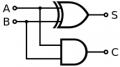
Not quite. Remember, if we want to do arithmetic that includes addition and multiplication, then we necessarily need a ring structure. If we're using the boolean ring over the set {0, 1}, thenThe truth is, 1 + 1 = 0 is NOT true as-is. The circuitry proves this out. The proper boolean way of seeing 1 + 1 is
1 + 1 = 10
Ok, so MARIO is defined as a particular state of n bits on a RAM chip.Until further notice, you are Mario: a collection of bits in RAM that can essentially be represented as pixels on a screen.
The bits of what stored, MARIO? My brain does not have the MARIO state. If I see an image of MARIO on a screen, some of my brain's sub-states hold the concept of MARIO. This concept is a set of associated states that have been influenced by MARIO in some way.Your brain has the bits stored.
Something stored MARIO in the RAM, and it "knew" what MARIO was (otherwise you are saying that MARIO was a random event). Likewise, my brain "knows" that it's storing something MARIO-like because of the optical reaction to MARIO triggered associations with other states in the brain.But your brain has no idea what it’s storing, no diff than RAM.
This property needs clarification. The bits used to store MARIO in RAM are physically independent of each other. But when they hold MARIO, the bits are most definitely related to each other; their relation is precisely what comprises MARIO. In other words, by writing the state of MARIO to RAM, we've imposed an order on the bits that conveys information.Properties of Mario:
1) composed of n number of discrete bits, each of which have no direct connection to any other
No sure what this means. You defined MARIO as a particular state; this state was copied (presumably exactly) to RAM. Therefore, that sub-state of RAM is as MARIO as it gets.2) there is no “Mario” to the device containing the bits we are calling Mario
MARIO is a single state. CONCEPT is an association between multiple states. COMPUTATION is a processing of states. So, yes, I agree that MARIO has neither CONCEPT nor COMPUTATION. So what?3) therefore there are no non-numeric axioms of any kind in Mario, has no concept of a concept, definition, knowing, reason, meaning, computation, logic, sense of any kind
Nice graphic, though it doesn't show how the conclusion follows from the premises. Also, I disagree with at least one of its premises.Here it is in a graphic... and if you are not on board with 90% of this, I am dismantling your head portion, putting it in a FedEx box, and sending it through a 2090 wormhole to Cyberdyne overnight.
Totally disagree. I close my eyes and imagine a dog. What's happening is that, having read your sentence, several sub-states of my brain are activated, including sub-states that are associated with my CONCEPT of "dog". The mental images I experience are not spawned from nothing; they were created, stored, and evolved from all my previous experiences of dog-related stimuli.If you close your eyes, you can, from _NOTHING spawn a _SOMETHING called a “dog” _FORM and “see” it, or _SENSE it as a first-order definition that you can use in scientific inquiry. That dog is not composed of discrete bits, in the same way Siri Watson is not seeing the weather before she “talks” about it.
The "thought form" is just a set of sub-states. Being states, they can be described by n-bit strings. Such a description doesn't exist in my brain, but the states it represents does.The dog exists in a colocated space between your ears as a “thought form.” This form is not located as discrete bits in the brain, period.
Perhaps it's about time you defined 5D INFINITY.It is in the domain of boundless 5D INFINITY, which is a concept that exists outside of discrete bits, and is supra-material, because the universe maxes out at 2^n bits.
If I have to be assigned to a church, I suppose it'd be the Church of Information. In this church, brains are just a very tiny subset of things that process information, only slightly more interesting than computers.Excommunicate yourself from Brain Exclusive Church already and be alive!