Technics SU-VX800 amplifier

Thread Starter

Marius83

Joined Dec 28, 2017
423
Just to be clear, we are looking for a low resistance path somewhere in the RIGHT channel from -Vs to GND..
That is a difficult task in most circumstances. The ultimate solution is rip out all components and test each one, one at a time. Of course, we want to avoid having to do that.

I will need some time to look at where the various jumpers are installed so that we can do a binary-style search.
I understand.. thanks for helping out :)
 

MrChips

Joined Oct 2, 2009
34,830
Now that we know what we are looking for, i.e. about 500Ω between J401 and J219, there is no need to test both directions.
Test resistance with RED probe on J401, BLACK probe on LEFT side of J219 (when facing J219 label correctly facing up).

Remove Q426 and test Q426.

With Q426 removed, test resistance between J401 and J219 .

Measure resistance across R448, both directions.
 

Thread Starter

Marius83

Joined Dec 28, 2017
423
Now that we know what we are looking for, i.e. about 500Ω between J401 and J219, there is no need to test both directions.
Test resistance with RED probe on J401, BLACK probe on LEFT side of J219 (when facing J219 label correctly facing up).
Ok, so i removed Q426


Q426:
Red to B

Black to E: open
Black to C: open
Black to B
Red to E: 866
Red to C: 832
Red to E
Black to C: open
Black to E
Red to C: open

Measured resistance after removing Q416, it's the same as earlier.
Red to J401 and black to left J219: 520Ω

Measured R448, 570Ω both ways
 

Thread Starter

Marius83

Joined Dec 28, 2017
423
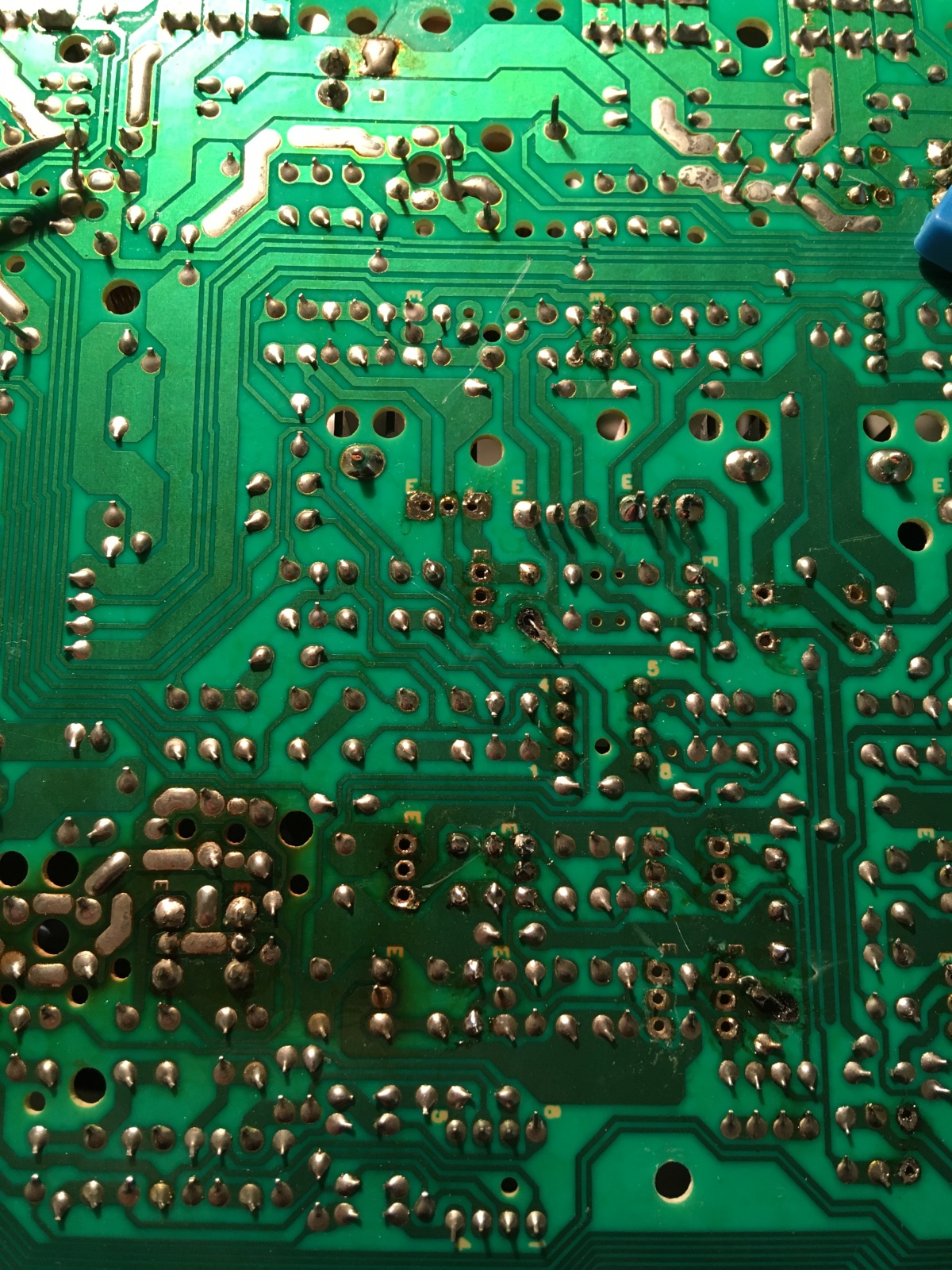
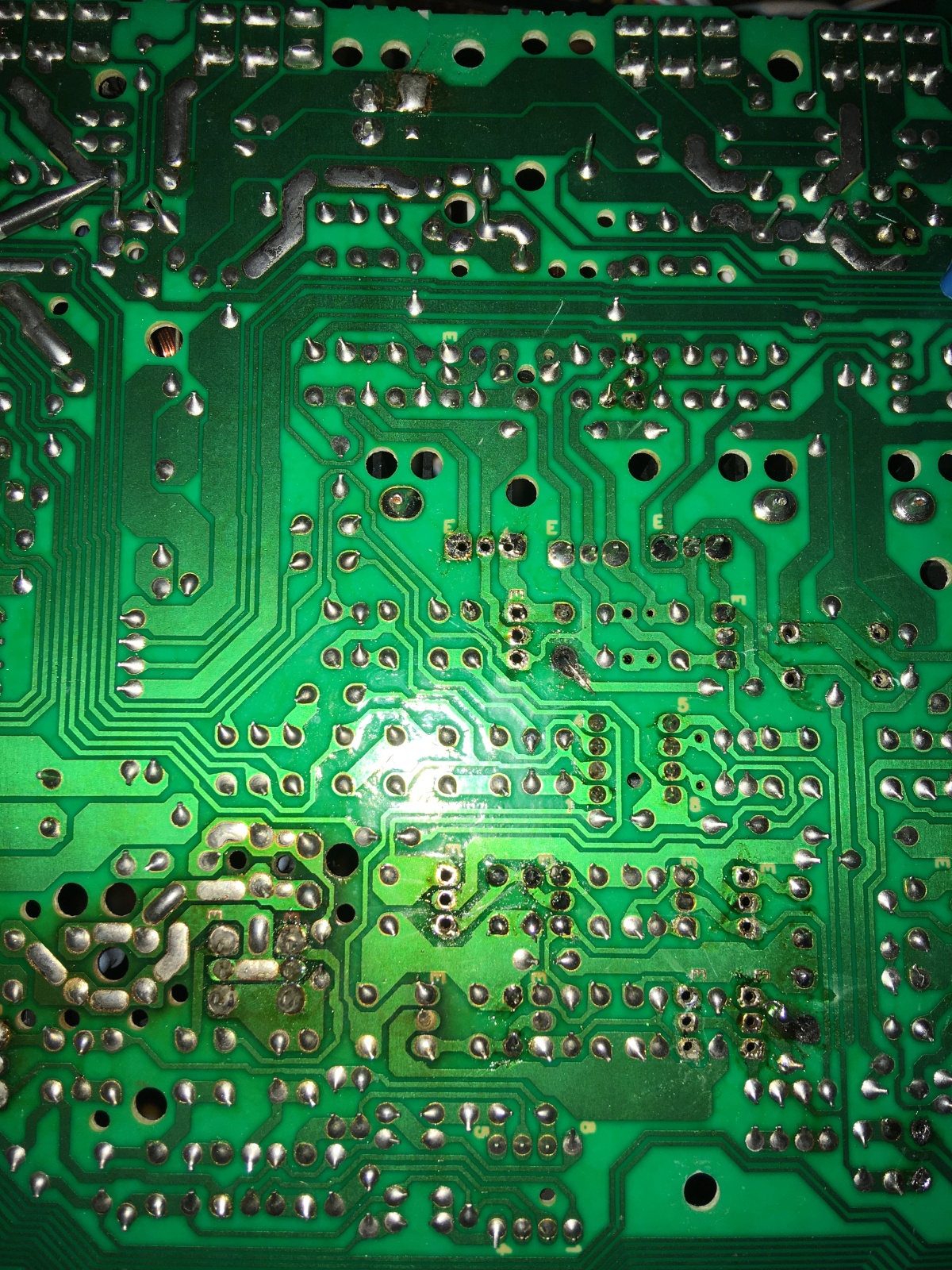
Hard to get a really good picture, here's one with flash and one without..
I can try to do a better job if it's hardt to see :D


MrChips

Joined Oct 2, 2009
34,830
Thanks for the great photos. I can see the traces very clearly now.

Remove Q425 and test.

Check resistance between J401 and J219.

I hope you're keeping track of which components we have removed lately.
 

MrChips

Joined Oct 2, 2009
34,830
A few questions and tips for you.

What type of solder are you using? Is it lead-free solder?
Do you have access to Sn/Pb solder?

Do you have ample amount of solder wick? We will need you to go around the pads to mop up any excess solder.
Do you have any alcohol? Not the kind you consume. Isopropyl alcohol and Q-tips. We will need some to clean up around the pads and traces.
 

Thread Starter

Marius83

Joined Dec 28, 2017
423
Thanks for the great photos. I can see the traces very clearly now.

Remove Q425 and test.

Check resistance between J401 and J219.

I hope you're keeping track of which components we have removed lately.
I do put every component i remove in it's own marked little plasticbag and make a note if it's ok or not.

So i removed Q425

Q425
Red to B
Black to E: 109
Black to C: 43
Black to B
Red to E: 110
Red to C: 43
Red to E
Black to C: 72
Black to E
Red to C: 72

So i guess this isn't ok..

I then measured the resistance between (red to J401) and left J219
Measuring is now like open, increases till it's out of range.. or i got it to stop at 53 at 2000K setting.. hehe..
 

Thread Starter

Marius83

Joined Dec 28, 2017
423
A few questions and tips for you.

What type of solder are you using? Is it lead-free solder?
Do you have access to Sn/Pb solder?

Do you have ample amount of solder wick? We will need you to go around the pads to mop up any excess solder.
Do you have any alcohol? Not the kind you consume. Isopropyl alcohol and Q-tips We will need some to clean up around the pads and traces.
I don't know much about the solder, other than it is lead-free, yes.
I might go ahead and buy some Sn/Pb solder if it's preferred, i really don't know the difference..:)

I do have much solder wick so go around mopping up any excess is no problem.
I also got alcohol to clean with. Is there any special places, or just generally everywhere i have removed and put in components :)
 

MrChips

Joined Oct 2, 2009
34,830
I think we have found the culprit, Q425.
Do an in-circuit test on Q429.

You will find Sn/Pb solder (63% tin and 37% lead) is easier to work with. It has a lower melting temperature (183°C or 361°F) and flows more easily.
Yes, it would be a good idea to go around pads with the solder wick where components have been removed and mop up excess solder.
Do not spend too long when heating solder pads because there is the danger of lifting the copper pads and traces off the fiberglass laminate.

Use a Q-tip dipped in isopropanol (isopropyl alcohol) and scrub around the joints to clean up the resin where anyone did some soldering.

Replace J219 jumper with solid hook up wire of similar gauge (22-24 AWG). The leads cut off from resistors are good for this.

We will step-by-step re-install components to the board and do some resistance checks along the way.
Let me know when you get the 6.8Ω ¼W resistors.
 

MrChips

Joined Oct 2, 2009
34,830
Here is my mental list of what I think is off the board. Correct me if I am wrong.

C425
C426
R506

Q515
Q517

Lately:
R401
R402

Q401
Q402
Q405
Q406
Q408

Recently removed:
J219
Q416
Q426
Q430
IC402
Q425
 

Thread Starter

Marius83

Joined Dec 28, 2017
423
I think we have found the culprit, Q425.
Do an in-circuit test on Q429.

You will find Sn/Pb solder (63% tin and 37% lead) is easier to work with. It has a lower melting temperature (183°C or 361°F) and flows more easily.
Yes, it would be a good idea to go around pads with the solder wick where components have been removed and mop up excess solder.
Do not spend too long when heating solder pads because there is the danger of lifting the copper pads and traces off the fiberglass laminate.

Use a Q-tip dipped in isopropanol (isopropyl alcohol) and scrub around the joints to clean up the resin where anyone did some soldering.

Replace J219 jumper with solid hook up wire of similar gauge (22-24 AWG). The leads cut off from resistors are good for this.

We will step-by-step re-install components to the board and do some resistance checks along the way.
Let me know when you get the 6.8Ω ¼W resistors.
ok, so that is the difference... i don't think i have any problem with my solder, it floats fine without heating the components so i just think i'm gonna use what i have, but thanks for the tip and explanation.
yes i will go around and mop up excess solder,and i'm always fast not to heat up too much.

I will try to get 6.8 ohm resistors as soon as possible.

I took an in circuit measurement of Q429

Q429
Red to B

Black to E: short (17)
Black to C: short (3)
Black to B
Red to E: short (17)
Red to C: short (3)
Red to E
Black to C: short (14)
Black to E
Red to C: short (14)


I will check your component list soon
 

Thread Starter

Marius83

Joined Dec 28, 2017
423
Here is my mental list of what I think is off the board. Correct me if I am wrong.

C425
C426
R506

Q515
Q517

Lately:
R401
R402

Q401
Q402
Q405
Q406
Q408

Recently removed:
J219
Q416
Q426
Q430
IC402
Q425

This is a correct list.
I have now also pulled Q429 and Q427
 

Thread Starter

Marius83

Joined Dec 28, 2017
423
Do in-circuit test on Q427, Q428, and Q430.

Pull Q429 and test it.
Q430 is removed earlier and tested out of circuit in post #215
Q430
Red to B

Black to E: open circuit
Black to C: open circuit
Black to B
Red to E: 703
Red to C: 692
Red to E
Black to C: open circuit
Black to E
Red to C: open circuit

Q429 tested out of circuit
Red to B

Black to E: 18 (short)
Black to C: 4 (short)
Black to B
Red to E: 18 (short)
Red to C: 4 (short)
Red to E
Black to C: 15 (short)
Black to E
Red to C: 15 (short)

I started to measure Q427 in circuit, but cause of the result i pulled it.
Q427 tested out of circuit
Red to B

Black to E: 2 (short)
Black to C: 425
Black to B
Red to E: 3 (short)
Red to C: 950
Red to E
Black to C: 414
Black to E
Red to C: 932

Q428 tested IN CIRCUIT
Red to B

Black to E: 806
Black to C: 804
Black to B
Red to E: open
Red to C: open
Red to E
Black to C: open
Black to E
Red to C: open
 
Last edited:

Thread Starter

Marius83

Joined Dec 28, 2017
423
Replace J219 jumper with solid hook up wire of similar gauge (22-24 AWG). The leads cut off from resistors are good for this.
I just bended the ends togheter and soldered the break, is this a bad solution? My resistor leads are a bit thinner
 
Last edited:

MrChips

Joined Oct 2, 2009
34,830
I don't know if you saw my posts, #234 and #235 ... or if you are still thinking about our next move :)
Sorry, not thinking. Just recuperating from a growler of beer over the weekend.:D

We are going to monitor the resistance from the power supply to ground as we put some components back on to the board one at a time.
I need to look at the board to see where is the easiest connection to +V and -V.
 

Thread Starter

Marius83

Joined Dec 28, 2017
423
Sorry, not thinking. Just recuperating from a growler of beer over the weekend.:D

We are going to monitor the resistance from the power supply to ground as we put some components back on to the board one at a time.
I need to look at the board to see where is the easiest connection to +V and -V.
hehe. nice! :)
Not my intention to sound impatient, i got all the time in the world, you just normally answers really fast, so i was just wondering :D
 
Top