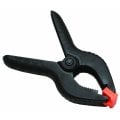
Spring Clamp Woes

Thread Starter

MrAl

Joined Jun 17, 2014
13,704
Get a 3D printer.

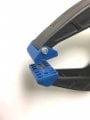
C-clamp repaired with 3D printing. I printed the cap to the correct size. Then I heated it with a heat gun and forced it on the ball at the top of screw head.

View attachment 259495
Thats a very interesting idea for sure. Make your own tips/pads.
Dont have a 3d printer at the moment though. If i did i might even make an entire new clamp. I did make some of my own clamps long ago using interwoven strips of wood. The wood strips rub on adjacent strips and so when you close it friction holds it closed.
 

panic mode

Joined Oct 10, 2011
4,983
Backing soda and superglue quickly form rather strong bond and allows creating some mass/volume and tend to be tougher than super glue alone. actually any volume i ever accomplished with superglue was rather flakey and weak. but together they create something solid rather quickly.
 

Thread Starter

MrAl

Joined Jun 17, 2014
13,704
Backing soda and superglue quickly form rather strong bond and allows creating some mass/volume and tend to be tougher than super glue alone. actually any volume i ever accomplished with superglue was rather flakey and weak. but together they create something solid rather quickly.
Ok thanks i'll give it a try. Not sure how to apply it just yet though it's a very small piece and it has to be able to rotate.
 

Thread Starter

MrAl

Joined Jun 17, 2014
13,704
It would be impossible to assemble the clamp after that, though, since it depends on the opening in clip part to snap around a fixed pin.
Yes i was thinking of keeping it on while the fix is being done, or maybe the pin is removable. The pin can be pushed out on some of them but unfortunately on the ones i want to do the most the pins do not push out the side. This means any fix has to be applied with the pad installed.

I was also thinking lightly grease the pin, then apply epoxy, but i dont think epoxy sticks to this plastic very well.

Maybe drill a tiny hole in each pad, then insert Dyneema string, tie to body or maybe loop around the pin. IF tied to body at least the pad would not get lost. A lot of work though with all my clamps.


I guess this wont be easy.
 

Ya’akov

Joined Jan 27, 2019
10,235
Yes i was thinking of keeping it on while the fix is being done, or maybe the pin is removable. The pin can be pushed out on some of them but unfortunately on the ones i want to do the most the pins do not push out the side. This means any fix has to be applied with the pad installed.

I was also thinking lightly grease the pin, then apply epoxy, but i dont think epoxy sticks to this plastic very well.

Maybe drill a tiny hole in each pad, then insert Dyneema string, tie to body or maybe loop around the pin. IF tied to body at least the pad would not get lost. A lot of work though with all my clamps.


I guess this wont be easy.
I have a set of a dozen clamps I bought to hold a photographic backdrop to a frame. I never had problems with them, and I just inspected the construction. They are pined the same way my modification works, There is a through hole on the clamp arm and the pad body (which is solid) and a driven pin holds it together. Very soild—it’s not going to anywhere. It would have to break to come off.

There are the clamps. Really cheap, a couple of sizes avaialbe. I bought mine a few years ago, so things could have changed but they look very similar and are obviously using the same construction. Perhaps cut your losses for a few bucks?

1643884535175.jpeg
 

shortbus

Joined Sep 30, 2009
10,050
Backing soda and superglue quickly form rather strong bond and allows creating some mass/volume and tend to be tougher than super glue alone
The super glue baking soda trick is often used by people repairing guitar nuts and saddles. The trick to it is building it up in thin layers to stop it from flaking.
 

panic mode

Joined Oct 10, 2011
4,983
that is a better (sturdier) design. mine are similar to post 26. they can move but not much. but with this set i did not have single failure. old ones used to fail rather often so they got replaced.
 

Thread Starter

MrAl

Joined Jun 17, 2014
13,704
Yeah you would think they solved this by now, and they did, but not all clamps are made the same.
I found ONE clamp i must have had for 20 years and it has the complete circular rotating pad which means it can not come off unless you break it off. Not that difficult to understand i would think, you make the pad with a circular hole fo the pin, then during assembly you push the pin in and secure it. Never fell off in over 20 years.
The new set i just got falls off after every use. Cant understand that because they feel secure.

So i got fed up and tried some experiments.

First, pull both off and use without pads. That solves the problem right off. The circular ends will match up with any flat surface just the pressure area is greatly reduced unless you use separate pads of some sort like maybe felt

Second, direct application of super glue. As expected, they no longer rotate. Who cares.

Third, direct application of quick dry epoxy. As expected, they no longer rotate. Again, who cares.

Fourth and rather interesting, indirect application of epoxy. Before the application however this time the pads are yanked off, then with a small brush apply some dielectric grease to pin and surrounding area where the pad rubs against. The grease prevents the epoxy from adhering to the body of the clamp but not to the pad. So after greasing the pad is replaced then epoxy applied carefully. It is hard to get an exact application though because the clamp pad is small.
Results: after the epoxy dries, the pads still rotate but are a bit stiffer. No big deal though. They should not be able to come off now though.
It is hard to apply the epoxy though cause it gets all over the place if not careful.
Dielectric grease was chosen because it does not contain petroleum so does not harm plastics.

The easiest of all was the pad removal. Hey they still work.
The second to that was the direct application of super glue. The pads no longer rotate but not sure if i care anymore.
Third was the direct application of epoxy. Have to mix in small batches, a little tricky to apply to small parts.
The hardest of course was the pre greasing because of the extra step and have to be careful not to get grease on the pad itself.

Comments welcome :)
 

MrChips

Joined Oct 2, 2009
34,814
I mean print new pads to replace the broken or lost ones.
PLA and ABS are the first two materials of choice for 3D printing. ABS is stronger than PLA.
 

shortbus

Joined Sep 30, 2009
10,050
First, pull both off and use without pads. That solves the problem right off. The circular ends will match up with any flat surface just the pressure area is greatly reduced unless you use separate pads of some sort like maybe fel

Wonder where you heard that before? :) Without the pads while to surface area of the pressure is decreased, the total pressure applied is actually more due to a smaller area applying the same spring pressure. The clamps of mine with no pads work just great.
 

Thread Starter

MrAl

Joined Jun 17, 2014
13,704
I mean print new pads to replace the broken or lost ones.
PLA and ABS are the first two materials of choice for 3D printing. ABS is stronger than PLA.
Oh ok, maybe i will look into getting one would be interesting i think, and could be used for other things. I'll have to check the price range these days.
 

Thread Starter

MrAl

Joined Jun 17, 2014
13,704
Wonder where you heard that before? :) Without the pads while to surface area of the pressure is decreased, the total pressure applied is actually more due to a smaller area applying the same spring pressure. The clamps of mine with no pads work just great.
Oh you mentioned that before? Sorry i may have forgotten i was getting quite frustrated with this new set. Never expected them to come off so easy.

So a slight modification to that idea will be the one i use for most of these clamps. I will pull the pads off, but keep them in a small storage container. If a job comes up where i need them, ill pop them back on before use and pop them back off after use. Ti wont matter if any get lost now either because some of them wont ever have pads again anyway.

So i guess the easiest solution that should handle any situation is pop them off, then in use maybe pop them back on, then pop back off after use.
I use them to glue paper sometimes too so the pads will be needed for some things, or at least a couple small squares of something to distribute the force better.

Im going to check out the 3d printers now too.
 

Thread Starter

MrAl

Joined Jun 17, 2014
13,704
Got some special Locktite glue for plastics today.
It has a special activator that allows gluing plastics like nylon and supposedly teflon.
Activator was all dried up though have to wait now for a replacement.
 

shortbus

Joined Sep 30, 2009
10,050
Activator was all dried up though have to wait now for a replacement.
That for some reason has always been a problem for Loctite. When still working we used a couple of their thread lockers that worked faster when using an activator spray. It came in a spray can that held a few ounces of the liquid. If you didn't use the whole can at one use, and it only took a small squirt of it, and put it away for a later use it wouldn't spray. It dried up in the can after just one use.
 
Top