SPICE Simulation is Great; Circuit Implementation Fails!

Jolly13

Joined Mar 25, 2018
44
Well the + input is weird and all other bets are off. Do power rails look good in this mode.

Did voltage fallower work ( just connect output to v- input) will quickly find a wiring problem.
Still may be oscillating ( does not explain v+ values ) you measure with a scope or Voltage Metter, may be faster than you can read.

Just drop a 1n cap across v- and Out. see what happens. Will not be proper value and its overkill if you are oscillating.
eetech00 pointed out change r109 to more like 1.2 ohms. My simulation can never drive this hard enough to get with 9ohms load.
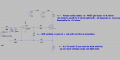
screen.png
 

Attachments

Thread Starter

phillipsoasis

Joined Aug 22, 2022
170
Thanks for helping me out!

1. I rebuilt the circuit on a different breadboard. The one I was using was a cheap board from China for soldering parts together. The rebuilt circuit is on a push in breadboard to facilitate making changes.

2. Same results on the push in breadboard as the soldered breadboard for the whole circuit.

3. I then disconnected the MOSFET from the circuit and added a pot with the ends connected to GND and +3.3V, and the center to the gate of the MOSFET. Applying 15V to the MOSFET drain with the light bulb connected, I was able to control the current through the MOSFET with the pot. I think the MOSFET is working.

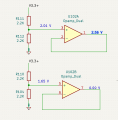
4. I then tried disconnecting the op-amp from the circuit and connected 2 x 2.2K resistors between GND and +3.3V as shown in the attached schematic. The voltages at the nodes are indicated. I think op-amp A is dead and op-amp B is working.
Screenshot from 2024-08-27 11-12-56.png


Well the + input is weird and all other bets are off. Do power rails look good in this mode.

Yes, the power rails and ground are all solid. No oscillations.

Did voltage fallower work ( just connect output to v- input) will quickly find a wiring problem.

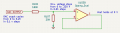
5. I connected op-amp B as you suggested with Vout connected to Vin-. I think op-amp B is also dead, as the output should be following the input, unless I am missing something.
Screenshot from 2024-08-27 11-41-16.png

I need to get some more TLV2462s, unless I am really missing something. I can't use the new replacement as I am using DIPs on this solderless breadboard.

Still may be oscillating ( does not explain v+ values ) you measure with a scope or Voltage Metter, may be faster than you can read.

Measurements made with both scope and meter. No oscillations.

Just drop a 1n cap across v- and Out. see what happens. Will not be proper value and its overkill if you are oscillating.
eetech00 pointed out change r109 to more like 1.2 ohms. My simulation can never drive this hard enough to get with 9ohms load.

View attachment 330162

Looking at your simulation circuit, your DAC driver is a sine wave with parameters 1.6V offset, 1.6V amplitude at 10 Hz. Not sure why you picked a sine wave. I was driving the circuit with a ramp to watch the current as the DAC voltage increased. I also used a square wave to simulate switching the DAC from 0 V to full voltage (1.2 V for the light and 3.3V for the igniter, 0.4R).

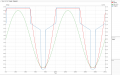
With a sine wave input, I get this in my simulation, which looks OK with no oscillations.
Screenshot from 2024-08-27 12-23-14.png

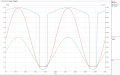
For the light bulb, the current should be limited to ~1 A. The simulation should look something like this.
Screenshot from 2024-08-27 13-12-42.png

Also, what I get with a pulse as input:
Screenshot from 2024-08-27 12-29-25.png

Adding the 1nF cap as you suggested makes no difference in my simulations. I am not questioning your simulations, just pointing out some differences in our two simulations. Perhaps different op-amp models or MOSFET models.

However, simulations don't solve the problem I am having with the actual circuit. As I said, I have to get some more op-amps to see if my circuit is really an op-amp killer, or maybe you can point out where I am wrong in my analysis.

Just as a side note. The actual use of the cicuit involves having two different loads. The light bulb, ~9R, and the rocket motor igniter, ~0.4R. A relay is used to select one over the other. When the bulb is used, the current is limited to ~1 A for a few seconds (human reaction time). When the igniter is selected, the current is a full 3A for ~500 msec - the igniter either breaks or the current is turned off.

I just noticed in your simulation schematic that R6 is connected to GND. It should be connected to +3.3V.
 
Last edited:

Thread Starter

phillipsoasis

Joined Aug 22, 2022
170
Well, this is embarrassing. 4 bad op-amps in a row out of a tube.... I put the fifth one in the circuit, and it worked just as expected. No wild voltages, the 5th op-amp behaved as it should, the light bulb slowly came on as the DAC input was increased to set the current through the bulb at 1 A (see attached pictures). Then, the DAC input went to zero, the bulb turned off, and Vsource sat at 0 V. No oscillations. Didn't need the 1 nF cap, but I will put it in and test again. It can never hurt.

It is a good thing we do not know who put 4 bad op-amps back into a tube.....;)
 

Attachments

Jolly13

Joined Mar 25, 2018
44
Good to hear ya 4 in a row is terrible tub, Allot of the fun of DIY is chasing these things down. As it was bad Op amp(s).. Well your gut had it nailed on post #1 .. :) just hard to prove

Cheers.

Pss , 1n cap is pretty large for what its doing ,, Reality is some were in 100pf. My simulation did not use a model for the op amp you are using so hard to say.
 

Thread Starter

phillipsoasis

Joined Aug 22, 2022
170
Good to hear ya 4 in a row is terrible tub, Allot of the fun of DIY is chasing these things down. As it was bad Op amp(s).. Well your gut had it nailed on post #1 .. :) just hard to prove

Cheers.

Pss , 1n cap is pretty large for what its doing ,, Reality is some were in 100pf. My simulation did not use a model for the op amp you are using so hard to say.
PXL_20240828_153710439.jpg
RIP little op-amps!

Thanks again for sticking with me through all this!

Would you be willing to share your op-amp model with me? It is a possible replacement for the TLV1642, which has become obsolete and the replacement does not come in a DIP package. The LT1677 does come in a DIP package. Thanks!
 
Last edited:

Jolly13

Joined Mar 25, 2018
44
Nothing special about LT1677 I used in the sim ..was using LTspice and the model comes with it and it's a rail/rail low voltage :)

If your in the US. Mouser has a about 1k TLV1642 in stock, they are about 3$ each. TI indicates it is still an active product also if you like it- https://www.ti.com/product/TLV2462

I have a bunch of TLV2372(dip) on hand for rail/rail in and out personally. It's only 3Mhz but can run on up to 16v , CMOS inputs , 2$ each so still pricy.

Almost any rail-rail low voltage will work. I am assuming you are not driving the DAC fast ( below 20Khz) .

Since you have a 15v rail you could actually use most "Single Supply" OP-amps as long as they get close enough to ground - OLD Lm358 comes to mind. (ground to VS – 1.5 ) @ $0.12 each
 

Jolly13

Joined Mar 25, 2018
44
Bummer i have about 25-30 left .. I just hack and such .. and it's not my go to . usually do not need rail/rail in and out .. Use them to drive ADC / DAC like you from a microcontroller .. But more for audio and such.

I did run the simulation LM358 and powering from 15v . Seemed to work in the simulation , as it can get really close to ground.

1724908295885.png
 

Thread Starter

phillipsoasis

Joined Aug 22, 2022
170
Bummer i have about 25-30 left .. I just hack and such .. and it's not my go to . usually do not need rail/rail in and out .. Use them to drive ADC / DAC like you from a microcontroller .. But more for audio and such.

I did run the simulation LM358 and powering from 15v . Seemed to work in the simulation , as it can get really close to ground.

View attachment 330409
Interesting. I never thought of powering the op-amp from the 15V source. Just kept everything at 3.3V. What is the advantage?
 

Jolly13

Joined Mar 25, 2018
44
IT's a jelly bean op amp .. you MAY have some in junk bin .. or others may work if you by chance have sitting around they usually call ones that can get very close to ground "Single Supply" and you do have the 15v rail on this project :)
lm358 = 0.12$
1724908988637.png
 
Top