Spice Simulation For Low Pass Filter

crutschow

Joined Mar 14, 2008
38,423
Could someone please advise how I can show the output from a Low Pass Filter graphically.
You need to do an AC analysis to get a Bode plot, as Eric showed.
If you set the AC voltage to 1V, the plotted output no attenuation value is 0dB, and the filter rolloff value with frequency is then directly shown.
 

Thread Starter

820L

Joined May 14, 2025
30
hi 82,
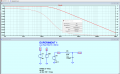
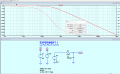
Do you mean like this example?
E
View attachment 356411View attachment 356412
Hi Eric

Thanks Eric.

I obviously need to do some research to better understand this stuff. My intention here was to have a low pass filter that would prevent an output voltage if the frequency was higher than 250 Hz. Am I on the right track? I see that at 45 degrees, the frequency is 336 Hz, not 250 Hz.
 
Last edited:

Thread Starter

820L

Joined May 14, 2025
30
You need to do an AC analysis to get a Bode plot, as Eric showed.
If you set the AC voltage to 1V, the plotted output no attenuation value is 0dB, and the filter rolloff value with frequency is then directly shown.
Thanks Crutschow.
 

crutschow

Joined Mar 14, 2008
38,423
My intention here was to have a low pass filter that would prevent an output voltage if the frequency was higher than 250 Hz.
A low-pass filter will reduce the output above its design frequency but won't "prevent" it.
I see that at 45 degrees, the frequency is 336 Hz, not 250 Hz
Yes, the calculated -3dB point for those RC values is 329Hz.
Why did you think it was 250?
 
Last edited:

Thread Starter

820L

Joined May 14, 2025
30
A low-pass filter will reduce the output above its design frequency but won't "prevent" it.
Yes, the calculated -3dB point for those RC values is 329Hz.
Why did you think it was 250?
I used the one of the online calculators and I can't remember which one. I tried the Digikey
calculator and gave a value of 329 Hz. Confirmed by calculator also.

Thanks crutschow. You fellows are a great help!!
 

WBahn

Joined Mar 31, 2012
32,777
Hi Eric

Thanks Eric.

I obviously need to do some research to better understand this stuff. My intention here was to have a low pass filter that would prevent an output voltage if the frequency was higher than 250 Hz. Am I on the right track? I see that at 45 degrees, the frequency is 336 Hz, not 250 Hz.
You need to start with what your needs are. For something like this, there are two basic considerations.

First, what is most attenuation you can tolerate at the high end of your passband. If your nominal cutoff is 250 Hz, then could you tolerate an attenuation of, say, 1 dB at 200 Hz?

The other is what is the minimum attenuation you must have at the low end of your reject band. For instance, is it tolerable if the attenuation at, say, 300 Hz was only 4 dB?

I'm just making those numbers up -- you need to look at your application and decide what your limits are.

Once you have those limits, you can then determine what order your filter needs to be in order to achieve them. There is little point spending time trying to get a first-order RC filter to work if your requirements can't be met with anything less than a third-order filter.
 

Thread Starter

820L

Joined May 14, 2025
30
You need to start with what your needs are. For something like this, there are two basic considerations.

First, what is most attenuation you can tolerate at the high end of your passband. If your nominal cutoff is 250 Hz, then could you tolerate an attenuation of, say, 1 dB at 200 Hz?

The other is what is the minimum attenuation you must have at the low end of your reject band. For instance, is it tolerable if the attenuation at, say, 300 Hz was only 4 dB?

I'm just making those numbers up -- you need to look at your application and decide what your limits are.

Once you have those limits, you can then determine what order your filter needs to be in order to achieve them. There is little point spending time trying to get a first-order RC filter to work if your requirements can't be met with anything less than a third-order filter.
Will do. Thank W.
 

Thread Starter

820L

Joined May 14, 2025
30
A low-pass filter will reduce the output above its design frequency but won't "prevent" it.
Yes, the calculated -3dB point for those RC values is 329Hz.
Why did you think it was 250?
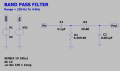
One more thing. I have a sim for a band pass filter with a range (hopefully) of 251 Hz to 4 KHz but I am not sure how to interpret the bode plot.
 

Attachments

crutschow

Joined Mar 14, 2008
38,423
I have a sim for a band pass filter with a range (hopefully) of 251 Hz to 4 KHz but I am not sure how to interpret the bode plot.
The plot is for the circuit LTspice thinks you have.
You need to check your work for typos, especially when the sim gives odd results, as you seem to be prone to them. :rolleyes:
The value for R1 had two decimal points, which LTspice then interprets as a very small resistance value.
 
Last edited:

crutschow

Joined Mar 14, 2008
38,423
Saw your short reply to me before they apparently deleted it, so I will therefore block any new posts from you as I don't want to further offend your obviously delicate sensibilities. :p
 

WBahn

Joined Mar 31, 2012
32,777
You made an ignorant comment that was based on a lie. I don't need your kind of ignorance in my life. Get help dude!
He made an ignorant comment that was a lie????

Look at the value for R1 in the schematic you posted:

1758851804785.png

He said you have two decimal points in the value for R1.

Guess what? You have two decimal points in the value for R1.

He said that LTSpice will interpret that as a very small resistance value.

Guess what? LTSpice will interpret that as a very small resistance value (namely 6.369 Ω -- everything starting with the first character it can't accept is ignored.

He said that you need to check your work for typos, especially when the sim gives odd results.

Guess what? You need to check your work for typos (and other types of errors), especially when the sim gives odd results.

He said you seem to be prone (to making silly mistakes, like typos).

Guess what? You seem to be prone to making silly mistakes, like typos.

Your first circuit used component values that clearly yield a cutoff frequency of 329 Hz, but you made some kind of mistake that you didn't catch and thought it should be 250 Hz. Your next schematic has a resistor value that is off by three orders of magnitude because of a silly typo, and you didn't catch it even though it completely trashed your results.

We all make silly mistakes on a routine basis. Taking offense to someone pointing out that you need to be more careful about catching and correcting them does not bode well for you ever developing the skills needed in this field.
 

WBahn

Joined Mar 31, 2012
32,777
GUESS WHAT? THE ONLINE CALCULATOR WAS ERRANT, NOT ME.

GUESS WHAT? MIND YOUR OWN BUSINESS.
The fact that you even had to use an online calculator in the first place is a pretty significant warning flag.

But, I'll gladly take your advice and leave you to your own devices. Goodbye.
 
Top